I am glad that Pima Friends are exploring these questions, since they are at the heart of our Quaker faith, and also a thorn in our side--a painful reminder we still have a long way to go in our spiritual journey towards unity. My response is colored by the fact that I consider myself both a Universalist and a Christian, and I see elements of both in the history of Quakerism and in Quakers today. I see no contradiction between Universalism and Christianity. If you look in the dictionary, you'll see that the first definition of “Universalism” is a Christian who believes that God will save everyone. Phil Gulley, a Quaker pastor from Indiana, got into trouble among some Christ-centered Friends when he made the case for Christian Universalism in the book If Grace Be True, but he was warmly received when he spoke at the Friends General Conference gathering. I think historical evidence shows that early Friends were both Christ-centered and Universalist.
There is no doubt that early Quakers saw themselves as Christian—in fact, they saw themselves as the only real Christians. Many early Friends argued vociferously in pamphlet wars and in tracts like Barclay’s Apology that their approach to Christianity was the most valid one. And early Friends did not hesitate to evangelize and proselytize.
George Fox wrote a letter to American Friends admonishing them to evangelize among the peoples there. Since this is not a passage you're likely to see in your Faith and Practice, it's worth quoting:
Dear Friends and brethren, ministers, exhorters, and admonishers that are gone into America and the Caribbean islands. Stir up the gift of God in you and the pure mind, and improve your talents; that you may be the light of the world, a city set upon a hill, that cannot be hidden. Let your light shine among the Indians, the blacks and the whites; that you may answer the truth in them, and bring them to the standard and ensign, that God has set up, Christ Jesus. For from the rising of the sun to the going down of the same, God's name shall be great among the Gentiles; and in every temple, or sanctified heart, "incense shall be offered up to God's name." And have salt in yourselves, that you may be the salt of the earth, that you may salt it; that it may be preserved from corruption and putrefaction; so that all sacrifices offered up to the Lord may be seasoned, and be a good savor to God.... And Friends, be not negligent but keep up your negroes' meetings and your family meetings; and have meetings with the Indian kings, and their councils and subjects everywhere, and with others. Bring them all to the baptizing and circumcising spirit, by which they may know God, and serve and worship him.
It is clear from passages like these that George Fox was not only a Christian, but an Evangelical who believed that Christ was the “way, the truth, and the life.” His reference to “salt” and “light” is one that I’ll come back to, since it is the theme of this year’s World Conference of Friends.
On the other hand, some prominent early Quakers embraced a tolerant view of other forms of Christianity, and even of other religions, as is evident in the writings of William Penn, Isaac Penington, and John Woolman. John Woolman wrote:
”There is a Principle which is pure, placed in the human Mind, which in different Places and Ages hath had different Names; it is, however, pure, and proceeds from God. It is deep, and inward, confined to no Forms of Religion, nor excluded from any, where the Heart stands in perfect Sincerity. In whomsoever this takes Root and grows, of what Nation soever, they become Brethren.”
As you may recall, when John Woolman felt led to go among the Indians, he didn't feel a need to convert them. He simply wanted to share what he knew about God, and to learn from them.
William Penn also saw the Indians as having “that of God” in them, unlike the Puritans who saw them as heathen savages who deserved to be exterminated. William Penn wrote about the Indians with great sympathy. He was a Universalist and believed that there was truth in all religions and in all people:
”The humble, meek, merciful, just, pious, and devout souls are everywhere of one religion; and when death has taken off the mask, they will know one another, though the liveries they wear here make them strangers.”
The issue of whether Quakerism should be inclusive or exclusive—conventionally Christian or faithful to the Inward Light—has long been a divisive one among American Quakers. In the 1820s a split developed between Friends who came to known as “Orthodox” and “Hicksites.” This split was partly because of power—rural Friends felt that wealthy Philadelphia Friends were lording it over them. Urban Friends felt that the rural Friends were out of touch with what was happening in the cities. The Orthodox wanted to become involved in Bible societies and other outreach efforts, like mainstream Christians. Followers of Elias Hicks, a rural Friend from Long Island, wanted to stick with traditional Quaker doctrines, such as the Inward Light, which seemed strange to many mainstream Christians. Elias Hicks was an extremely charismatic and popular preacher who travelled all over the United States and drew huge crowds, including many non-Quakers. The poet Walt Whitman was a big fan of Hicks and had a statue of him in his home in Camden, NJ. You can see glimpses of Hicksite Quakerism in The Leaves of Grass. Perhaps the most controversial teaching of Hicks had to do with the Bible. Hicks totally disapproved of Bible societies and didn't believe that they would do anything to advance “real Christianity.” In a controversial letter Hicks argued that when the Bible was translated into English in the 16th century, and people finally had a chance to read it in their own language, it didn't lead to more Christian love but to religious wars in which huge numbers of people were killed. Therefore, argued Hicks, it isn't the Bible, but the holy spirit that makes you a “real Christian.” As far as Hicks was concerned, only Spirit-led Quakers were “real Christians.”
In the latter part of the 19th century, an Evangelical revival swept through the Western states like a hurricane, bitterly dividing Friends into “real Christians” who were “saved” and the traditional, Inward Light Friends who didn't ascribe to the methods and theology of revivalism, and were therefore “unsaved.”
This revival was a severe trial for Joel and Hannah Bean, weighty Friends who had served as clerks of Iowa Yearly Meeting. The Beans tried to mend fences between these two camps, but they finally became exhausted and retired to San Jose. There they help found a Monthly meeting of the traditional sort, but when they went to get approval from Iowa Yearly Meeting, which had become Evangelical, they were denied. In fact, their recorded ministry status was taken away from them because they failed to answer correctly theological questions given to them in a written test. Never before had such a test been used among Quakers, nor had a recorded ministry status been taken away for doctrinal reasons.. Because the Beans were internationally known and respected, this became a huge issue.
This also led the Beans to do something unprecedented among Friends. They formed an independent monthly meeting, which led to the formation of an independent Quaker association, and finally to an independent Yearly Meeting. As you know, Intermountain Yearly Meeting is an offshoot of this Beanite movement.
All these painful splits were caused by disagreements over theology, over what it means to be a “real Quaker” or a “real Christian.”
Even a broad-minded liberal Friend like Howard Brinton used this divisive language at times. In his memoir Brinton refers to unprogrammed Quakers as “real” Quakers, and implies that pastoral Friends are not so real.
In the 1940s and 50s Howard Brinton worked hard to bring Hicksite and Orthodox Friends together because both practiced unprogrammed worship, but he didn't reach out to pastoral Friends and hardly mentions them in Friends for 300 Years because he felt that programmed worship was not Quakerly.
Given all this divisiveness, I can see why Friends are wary about identifying themselves as Christian or non-Christian. It feels safer, and saner, to keep Christ and God talk to a minimum. I am glad that you are willing to bring up these concerns, however. I think we can be better Quakers if we can be honest and admit our differences and have respectful dialogues about theological issues. We can learn much from each other when we open up and share our beliefs and spiritual experiences. And I think we can communicate with those in the ecumenical and interfaith movement, as well as our neighbors of other faiths, when we feel comfortable talking about theology among ourselves in a Friendly, non-exclusive way.
Until the 1960s or so (I don’t have any data to prove this, but this is my impression), most unprogrammed Quakers identified with being Christian, at least publicly. But many questioned the dogmas of traditional Christianity, and some were drawn to other religious practices, such as Buddhism.
It was for this reason that in the 1980s a group was formed called Quaker Universalist Fellowship to create a space for Quakers who didn’t identify with Christianity per se, but felt that Quakerism could and indeed should embrace people with a variety of faith perspectives. I belong to this group and am grateful to them for publishing my pamphlet “Islam from a Quaker Perspective” and Quakers and the Interfaith Movement. I also manage their blog at quakeruniversalist.org.
This Universalist approach was controversial at first, and some feared it might create new divisions. But the Universalist perspective met a deeply felt need and has become increasingly popular as people have come to unprogrammed meetings who are “refugees” from Christian denominations where they didn’t feel comfortable, or where they felt spiritually abused. Others have come from other faiths, such as Judaism and Buddhism, and are grateful to find a religious community that is non-dogmatic and welcoming. And a growing number of Friends proclaim themselves non-theists. Among the 50 thousand or so unprogrammed Friends in Britain and the United States, I would guess that probably a minority identify with being Christian in the traditional sense. Most espouse a theology closer to Unitarian Universalism.
This theological diversity has enriched Quakerism in many ways, but it has also led to questions like the one we are considering this morning. Are Quakers Christian? If not, what binds us together? What makes Quakerism distinctive?
Here in the United States, the majority of Quakers are Christian. One third belong to Friends United Meeting and another third are Evangelicals. Worldwide, the vast majority of Friends living in Africa and Latin America are Evangelicals. This is a fact I am being obliged to take more seriously and personally since I plan to attend the World Conference of Friends in Kenya, where Friends are almost all Evangelical. Kenya has 133,000 Quakers, far more than the number of Quakers here in the United States.
Two years ago, I felt a leading to reach out to Evangelical Quakers. This came about when I heard the theologian Marcus Borg speak at the Friends General Conference gathering. I asked him, “What is the biggest challenge for interfaith dialogue.” His response startled me. “The real challenge is not interfaith dialogue, but intra-faith dialogue.” He went on to say that some of the bitterest misunderstandings are among people within a faith tradition. That insight spoke to my condition. It was far easier for me to reach out to Muslims than to Evangelical Quakers.
Something seemed wrong with this picture, so I offered to become a representative to Friends World Committee for Consultation, the umbrella group started by Rufus Jones in the 1930s to enable Friends of different theological persuasions to come together and dialogue.
I believe it is crucially important for Friends to take part in the ecumenical and interfaith movement, and to have friendly relations with Evangelicals and even fundamentalists. To do so, we must be able to articulate our theology as clearly as we can, and we must learn to be compassionate listeners.
One reason I believe that God has led me to this work is because eight months ago I met a remarkable woman at a Peace Parade that took place in Pasadena on Palm Sunday. I went to this parade because the main speaker was Jim Loney, a Christian Peace Team member who was kidnapped along with Tom Fox in Iraq. Tom is one of my heroes and I wanted to honor him.
Meeting Jill was a major turning point in my life. She is an Evangelical Christian who defies media stereotypes. She believes passionately in the Bible as the Word of God and Jesus Christ as her savior, and she also believes passionately in social justice and peace. She moved into a low-income neighborhood in Pasadena to be a good neighbor and serve the poor. She started tutoring programs, a gang prevention program, and worked for affordable housing.
Jill opened me up to a world of Evangelical Christians who share many of our Quaker values. For example, Professor Glen Stassen of Fuller Seminary has written powerful books arguing for “Just Peacemaking” and he is also a peace activist. He is part of an Evangelical group called the Matthew 5 project that advocates the abolition of nuclear weapons and the use of diplomacy rather than arms to resolve international conflicts. Jill also knows Jim Wallis, the founder of Sojourners—an ardent advocate for progressive social change. And finally, Jill introduced me to a young countercultural Evangelical named Shane Claiborne who believes that Jesus is a revolutionary who calls us to work for economic justice. Shane started an intentional community called “The Simple Way” in one of the poorest neighborhoods of Philadelphia. He was also asked to be the keynote speaker at Philadelphia Yearly Meeting.
Jill has made me realize that many Evangelicals are open to many of our Quaker theological beliefs, as long as we can justify them biblically. Some, like Ron Mock, a professor of Political Science and Peace Studies at George Fox University, have a keen interest in the theory as well as practice of Christian peacemaking.
Other Evangelical Friends are taking active steps to promote peace. For example, Evangelical Friends in Rwanda founded Friends Peace House in 2000 because of the genocide that took place in 1994 in which estimated 800,000 people, about 20% of the total population, were killed. The surviving Rwandese were traumatized and destabilized. The young Friends Church of Rwanda, only founded 8 years previously, accepted the challenge this posed, and has taken an active part in the rehabilitation of Rwandese society ever since.
In Kenya, where I plan to attend the World Conference, Evangelical Friends are active in trying to insure that violence doesn’t break out during the next election. They are enlisting Friends to help do trainings in AVP. Jill and I hosted in our home a Quaker couple named Joe and Kathy Ossman who are planning to go to Kenya to help with this peacemaking effort.
Ever since 2000 Evangelical and liberal Friends have been working together in the African Great Lakes Initiative to do a variety of peacemaking efforts: trauma healing, conflict resolution training, compassionate listening.
I quoted George Fox at the beginning of my talk who said we need to be “salt” and “light”—which is the theme of this year’s World Conference of Friends. Jesus spoke often about the Light and urged us to a “Light to the world.” He also spoke about salt, which is a preservative and also essential to life (in small doses). How can we, as a world-wide community of Friends, show that we can indeed be a Light to the world, as well as a preservative that prevents the world from sinking into decay and corruption?
To be “salt” and light,” we need to transcend our differences, as Marge Abbott and the Quaker women in the Pacific Northwest have shown by their example. Thanks in part to the trust-building work of these women, Northwest Yearly Meeting joined FWCC. What these Quaker women have shown us is that we need to share our stories, listen to those we disagree with, and be open to a change of heart. We also need to seek common ground wherein we can put our faith into practice. One important lesson I have learned from my marriage to an Evangelical: we don’t have to agree about everything in order to love each other.
This afternoon I will task about spiritual experience and the Inward Light, what many Friends consider the most important aspect of our faith. For now I will leave you with this question: What do YOU think are the most important characteristics of Quakerism?

Thursday, January 26, 2012

“This I knew experimentally”: Friends and the Inward Light/Voice
This is the text of a message I have been asked to share at Pima Meeting in Tucson, AZ, this weekend for a workshop entitled "Quakers and Christianity: Personal Experience Vs. Religious Affiliation." This is the second half of my presentation. The first half was posted at quakeruniversalist.org under the title: "Are Quakers Christian, or non-Christian, or both, in the historical perspective of 400 years."
“This I knew experimentally.” With these words Fox summed up his “enlightenment experience,” his realization that only the Inward Christ could “speak to his condition” and guide him along the spiritual path he needed to follow. The word “experimentally” meant “experientially” in the 16th century, and Quakerism has been an experiential religion ever since.
What was the spiritual experience of early Friends and how can it speak to us today? I’d like to look at two famous passages in which Friends finds their inner voice. In his Journal, Fox writes about his struggles to find answers to deep spiritual questions, and how he finally hit rock bottom and was “saved” by an inward voice.
Fox realized that he could not find the meaning and purpose of his life by going to “experts.” Nor could he find the answers in books or through other outward means. He had to wait upon the Invisible God and listen for the Inward Voice. He had to put all his trust in the experience of God and Christ.
This realization was tremendously liberating for Fox and for his followers. No longer would they be bound by dogmas, or rituals, or paid clergy who spoke of spiritual matters they themselves had never experienced.
Fox realized that most people are “concluded under sin, and shut up in unbelief.” Let’s unpack what he meant by this. By “unbelief” Fox meant that many people pretend to believe what the church and the Bible teaches, when in fact they act like unbelievers. For example, they claim to be followers of Christ, but engage in war, accumulate riches, discriminate against the poor, etc. This disconnect between faith and action is what Fox meant by sin. We might call it “lack of integrity.”
The point of Quaker worship is to enable us to get in touch with our Inward Guide and to live a life of integrity, a life in harmony with what we know to be true and honest and real.
Margaret Fell captures the power of George Fox’s message in her journal. She was the wife of a prominent judge and led a conventionally religious life, dutifully going to church and listening to sermons. During one of these church services, a young man named George Fox stood up, boldly walked up to the pulpit and began to preach. Like Jesus, he “spoke with authority,” not like the paid priests she was used to hearing. Unlike these “hireling,” Fox spoke of a religion that was spiritual and heart-felt, not bound by outward forms. Fox affirmed that
Margaret Fell was so amazed by Fox’s utter confidence that she stood up in her pew and “wondered at his doctrine for I had never heard such before.” She described how Fox’s teachings rocked the foundation of her faith and brought her to tears:
For Margaret Fox, this was a life-changing realization. No longer would she be a passive “consumer” of sermons. She actively sought to find the truth within herself and this led her to become a religious leader and inspired preacher. As we moderns would say, she found her voice. She even wrote a pamphlet justifying women preaching—an idea that seemed utterly radical at this time, or for the next two centuries. Like Fox and other early Friends, Fell had the courage of her convictions and went to prison for her beliefs.
For the past 350 years, Quakers have been pioneers and leaders in religious movements because we have not relied on second-hand opinions and beliefs. We have tried to discover the truth “experimentally.” For this reason, Quakers rejected interpretations of the Bible that justified slavery or the oppression of women.
Not all Quakers have been comfortable with a creed-less religion, however. Some Friends worry that if there is no creed, Friends might lose their way and Quakerism might lose its Christian identity. This fear has led Friends to formulate the Richmond Declaration, a theological statement that affirms the basic truths of Christianity. It was adopted by Friends United Meeting in 1887. Evangelical Friends have similar statements of faith.
Creeds have value in that they can unite people and provide a sense of identity. But creeds can also be divisive. Rufus Jones and Howard Brinton were both adamantly opposed to creeds and creedal statements.
This morning, I asked you to think about what it means to be Quaker and to have a creed-less religion. What are the defining characteristics of our faith?
Historically, the basis of our faith has been the experience of the Inward Light. Although this experience can’t be reduced to words, it can be said to have at least two distinctive characteristics. First, the Inward Light reveals our shortcomings (sins) and second, it guides us towards a better life. Many liberals don’t feel comfortable with the word “sin” so I’d like to suggest a definition that is both biblical and compatible with our modern Quaker ideas. “Sin” in the Bible is not primarily about morality; it is about ethics. Jesus didn’t condemn the adulterer; he lambasted religious hypocrites and those in power, especially the 1%. The prophets of the Hebrew Bible were more concerned with justice than with personal morality. Prophets condemned the rich, lifted the concerns of the poor, and called on God’s people to live lives of justice and truth.
James, who was supposedly the brother of Jesus, defined sin as “partiality.” In his letter, which was a favorite text for early Friends, James wrote: “Whenever we show favoritism, it is a sin.” This teaching of James is the basis of our equality testimony. Whenever we discriminate based on class, race, or gender, we are hurting ourselves as well as others. James says that such sin can lead to deadly results. Racism, sexism, and economic injustice (capitalism) are all deadly “sins” because these “isms” keep us from experiencing our deep interconnectedness with our fellow human beings and with Spirit. Carried to the extreme, theses isms lead to violence and war. When we “see the Light,” we can no longer rationalize our hurtful behavior or attitudes. It was this Inward Light that revealed to John Woolman it was wrong to notarize a document authorizing a man to bequeath a slave in a will.
The Inward Light is also a source of joy and peace. George Fox’s heart “leapt for joy” when he heard an inward voice telling him “There is one, even Christ Jesus, that can speak to your condition.” Fox realized he didn’t need to go to priests, pastors, or other “experts” to solve life’s problems; the answers were within him, if he lived a life faithful to the Inward Light. What a liberating realization! This liberating Light is identified with the Logos, the Creative Word of God, described by John as the “the Light that shines in the darkness.” John also said that this Light is the Spirit that created and sustains the universe.
Universalist. The Light shines on and in everyone, regardless of sex, nationality or religious persuasion. “The Light that enlightens everyone was coming in the world” (John 1:9). This Light, which Quakers believed was fully embodied in Jesus Christ, is a universal light, the source of wisdom, inner peace, and just/righteous living for everyone. Those who turn away from the Light are doomed to a life of darkness and misery since this Light is the loving energy that created and sustains us and the universe. Those who turn towards the Light find peace, joy, and fulfillment (what some Christians call “salvation” or “holiness” and others call simply “wholeness.”).
Spirit-guided. Quakers believed that the holy spirit is more authoritative than written scripture (though the Bible is inspired and therefore deserving of study) or tradition. “The letter killeth, the Spirit giveth life.” This is what distinguishes Quakers from traditional Protestants and Catholics. Quakers are “Spirit-led,” not literalistic or tradition-bound.
Prophetic. Quakers are called to speak truth to power, just like the prophets of old. Our social testimonies about equality, peace, economic justice, etc. spring from this prophetic tradition which calls us to live up to our highest ideals. George Fox and William Penn along with other early Friend met with, and challenged, those in power to practice justice and truthfulness, and to be concerned for the marginalized and the oppressed.
Evangelistic. I know many liberals are uncomfortable with the word “evangelism” but we cannot deny that early Friends traveled far and wide to share their message with others, and won many over to what they called “the Truth.” I believe Quakers are still called to share the good news of the Inward Light with others, to “walk cheerfully on the earth, answering that of God in everyone.” As Fox wisely pointed out, the best way to share the Truth is by example. He urges us to live a Spirit-centered life, and to see “that of God” in others and respond to it.
Peaceful. Quakers are Pre-Constantinian Christians. That is, they reject empire and the worldly power associated with the Emperor Constantine, who converted to Christianity in the 4th century CE and used the cross as a talisman to wage war. Quakers reject this perversion of Christianity and call for a new order of society based on what Jesus and the prophets said about peace/shalom. Peace is not simply the absence of war. It is state of society in which every person can live a life of dignity and hope. This is sometimes called “the kingdom of God,” or “the beloved community.” Each of us carries a vision of this ideal society within us, and we cannot find true peace within until we are working to make this vision a reality in the world. Jesus expressed it beautifully: “Blessed are those who hunger and thirst for justice, for they will be filled” and “Blessed are the peacemakers for they will be called children of God.”
I am ending this talk by focusing on peace because I feel peace is the heart of our Quaker faith, and of Christianity. Peace doesn’t mean the absence of conflict. The Hebrew word for peace, “shalom,” means wholeness, health, well-being. When we experience shalom, we can face conflict in a spirit of love because we aren’t afraid to be honest, to share what we know to be true “experimentally.” Friends have sometimes shied away from theological discussions because they fear it can be divisive. But if we listen respectfully to each when we share our beliefs and spiritual experiences, it can bring us closer together.
I know this not only from my 25 years of taking part in Quaker worship sharing groups, but also because I have helped to organize “interfaith cafes.” These cafes are a lot like our worship sharing groups and were developed by a woman named Kay Lindahl who wrote books about “Sacred Listening.” The interfaith organization I belong to in Long Beach, CA, uses this model and invites people from various faith traditions to come together and sit around a table in groups of eight and reflect on open-ended questions, like, “What does prayer/meditation mean to you?” “How does your faith help you to make decisions?” “What does your faith teach about justice and peace.” People take turns speaking from their own experience and don’t argue or try to proselytize. These interfaith cafes draw 40-50 people and are helping to build a community of people in Long Beach who are learning how to get along with their neighbors at a deeply spiritual level. They are also deepening their own faith by learning to listen sympathetically to others. They also work together to address vital community needs, like homelessness and environmental concerns.
As a Quaker, I am grateful to practice a religion that emphasizes experience rather than dogma, and integrity rather than conformity. It may be hard to put into words what Quakers believe, or to fit us into a theological pigeon-hole, but I appreciate the freedom I have as a Quaker to “experiment with Truth,” to use Gandhi’s phrase. This freedom has allowed me to explore other religious practices, such as Zen meditation and Muslim prayer and fasting, and still feel rooted in my Quaker faith and my commitment to Christ. I know by experience that there is a Light within that can help me to see my weaknesses and guide me towards a better life. And I know that this Light is present in every person I encounter, and therefore every one can be my teacher as well as my friend. This realization has filled my life with joy and hope, and has enabled me to do things I never imagined possible. The Spirit is always full of surprises, as unpredictable as the wind, the holy breath of God….
Thank you for letting me share with you some of my experiences with this Spirit….
“This I knew experimentally.” With these words Fox summed up his “enlightenment experience,” his realization that only the Inward Christ could “speak to his condition” and guide him along the spiritual path he needed to follow. The word “experimentally” meant “experientially” in the 16th century, and Quakerism has been an experiential religion ever since.
What was the spiritual experience of early Friends and how can it speak to us today? I’d like to look at two famous passages in which Friends finds their inner voice. In his Journal, Fox writes about his struggles to find answers to deep spiritual questions, and how he finally hit rock bottom and was “saved” by an inward voice.
But as I had forsaken the priests, so I left the separate preachers also, and those esteemed the most experienced people; for I saw there was none among them all that could speak to my condition. And when all my hopes in them and in all men were gone, so that I had nothing outwardly to help me, nor could tell what to do, then, oh, then, I heard a voice which said, 'There is one, even Christ Jesus, that can speak to your condition;' and when I heard it my heart did leap for joy. Then the Lord let me see why there was none upon the earth that could speak to my condition, namely, that I might give Him all the glory; for all are concluded under sin, and shut up in unbelief as I had been, that Jesus Christ might have the pre-eminence who enlightens, and gives grace, and faith, and power. Thus when God doth work, who shall let (hinder) it? and this I knew experimentally (through experience)."
Fox realized that he could not find the meaning and purpose of his life by going to “experts.” Nor could he find the answers in books or through other outward means. He had to wait upon the Invisible God and listen for the Inward Voice. He had to put all his trust in the experience of God and Christ.
This realization was tremendously liberating for Fox and for his followers. No longer would they be bound by dogmas, or rituals, or paid clergy who spoke of spiritual matters they themselves had never experienced.
Fox realized that most people are “concluded under sin, and shut up in unbelief.” Let’s unpack what he meant by this. By “unbelief” Fox meant that many people pretend to believe what the church and the Bible teaches, when in fact they act like unbelievers. For example, they claim to be followers of Christ, but engage in war, accumulate riches, discriminate against the poor, etc. This disconnect between faith and action is what Fox meant by sin. We might call it “lack of integrity.”
The point of Quaker worship is to enable us to get in touch with our Inward Guide and to live a life of integrity, a life in harmony with what we know to be true and honest and real.
Margaret Fell captures the power of George Fox’s message in her journal. She was the wife of a prominent judge and led a conventionally religious life, dutifully going to church and listening to sermons. During one of these church services, a young man named George Fox stood up, boldly walked up to the pulpit and began to preach. Like Jesus, he “spoke with authority,” not like the paid priests she was used to hearing. Unlike these “hireling,” Fox spoke of a religion that was spiritual and heart-felt, not bound by outward forms. Fox affirmed that
“Christ was the Light of the world, and lighteth every man that cometh into the world; and that by this light they might be gathered to God, etc.”
Margaret Fell was so amazed by Fox’s utter confidence that she stood up in her pew and “wondered at his doctrine for I had never heard such before.” She described how Fox’s teachings rocked the foundation of her faith and brought her to tears:
“He went on, and opened the Scriptures, and said, "the Scriptures were the prophets' words, and Christ's and the apostles' words, and what, as they spoke, they enjoyed and possessed, and had if from the Lord": and said, "then what had any to do with the Scriptures, but as they came to the Spirit that gave them forth? You will say, Christ saith this, and the apostles say this; but what canst thou say? Art thou a child of Light, and hast thou walked in the Light, and what thou speakest, is it inwardly from God?" etc.
This opened me so, that it cut me to the heart; and then I saw clearly we were all wrong. So I sat down in my pew again, and cried bitterly: and I cried in my spirit, to the Lord, "We are all thieves, we are all thieves; we have taken the Scriptures in words, and know nothing of them in ourselves."
For Margaret Fox, this was a life-changing realization. No longer would she be a passive “consumer” of sermons. She actively sought to find the truth within herself and this led her to become a religious leader and inspired preacher. As we moderns would say, she found her voice. She even wrote a pamphlet justifying women preaching—an idea that seemed utterly radical at this time, or for the next two centuries. Like Fox and other early Friends, Fell had the courage of her convictions and went to prison for her beliefs.
For the past 350 years, Quakers have been pioneers and leaders in religious movements because we have not relied on second-hand opinions and beliefs. We have tried to discover the truth “experimentally.” For this reason, Quakers rejected interpretations of the Bible that justified slavery or the oppression of women.
Not all Quakers have been comfortable with a creed-less religion, however. Some Friends worry that if there is no creed, Friends might lose their way and Quakerism might lose its Christian identity. This fear has led Friends to formulate the Richmond Declaration, a theological statement that affirms the basic truths of Christianity. It was adopted by Friends United Meeting in 1887. Evangelical Friends have similar statements of faith.
Creeds have value in that they can unite people and provide a sense of identity. But creeds can also be divisive. Rufus Jones and Howard Brinton were both adamantly opposed to creeds and creedal statements.
This morning, I asked you to think about what it means to be Quaker and to have a creed-less religion. What are the defining characteristics of our faith?
Historically, the basis of our faith has been the experience of the Inward Light. Although this experience can’t be reduced to words, it can be said to have at least two distinctive characteristics. First, the Inward Light reveals our shortcomings (sins) and second, it guides us towards a better life. Many liberals don’t feel comfortable with the word “sin” so I’d like to suggest a definition that is both biblical and compatible with our modern Quaker ideas. “Sin” in the Bible is not primarily about morality; it is about ethics. Jesus didn’t condemn the adulterer; he lambasted religious hypocrites and those in power, especially the 1%. The prophets of the Hebrew Bible were more concerned with justice than with personal morality. Prophets condemned the rich, lifted the concerns of the poor, and called on God’s people to live lives of justice and truth.
James, who was supposedly the brother of Jesus, defined sin as “partiality.” In his letter, which was a favorite text for early Friends, James wrote: “Whenever we show favoritism, it is a sin.” This teaching of James is the basis of our equality testimony. Whenever we discriminate based on class, race, or gender, we are hurting ourselves as well as others. James says that such sin can lead to deadly results. Racism, sexism, and economic injustice (capitalism) are all deadly “sins” because these “isms” keep us from experiencing our deep interconnectedness with our fellow human beings and with Spirit. Carried to the extreme, theses isms lead to violence and war. When we “see the Light,” we can no longer rationalize our hurtful behavior or attitudes. It was this Inward Light that revealed to John Woolman it was wrong to notarize a document authorizing a man to bequeath a slave in a will.
The Inward Light is also a source of joy and peace. George Fox’s heart “leapt for joy” when he heard an inward voice telling him “There is one, even Christ Jesus, that can speak to your condition.” Fox realized he didn’t need to go to priests, pastors, or other “experts” to solve life’s problems; the answers were within him, if he lived a life faithful to the Inward Light. What a liberating realization! This liberating Light is identified with the Logos, the Creative Word of God, described by John as the “the Light that shines in the darkness.” John also said that this Light is the Spirit that created and sustains the universe.
Universalist. The Light shines on and in everyone, regardless of sex, nationality or religious persuasion. “The Light that enlightens everyone was coming in the world” (John 1:9). This Light, which Quakers believed was fully embodied in Jesus Christ, is a universal light, the source of wisdom, inner peace, and just/righteous living for everyone. Those who turn away from the Light are doomed to a life of darkness and misery since this Light is the loving energy that created and sustains us and the universe. Those who turn towards the Light find peace, joy, and fulfillment (what some Christians call “salvation” or “holiness” and others call simply “wholeness.”).
Spirit-guided. Quakers believed that the holy spirit is more authoritative than written scripture (though the Bible is inspired and therefore deserving of study) or tradition. “The letter killeth, the Spirit giveth life.” This is what distinguishes Quakers from traditional Protestants and Catholics. Quakers are “Spirit-led,” not literalistic or tradition-bound.
Prophetic. Quakers are called to speak truth to power, just like the prophets of old. Our social testimonies about equality, peace, economic justice, etc. spring from this prophetic tradition which calls us to live up to our highest ideals. George Fox and William Penn along with other early Friend met with, and challenged, those in power to practice justice and truthfulness, and to be concerned for the marginalized and the oppressed.
Evangelistic. I know many liberals are uncomfortable with the word “evangelism” but we cannot deny that early Friends traveled far and wide to share their message with others, and won many over to what they called “the Truth.” I believe Quakers are still called to share the good news of the Inward Light with others, to “walk cheerfully on the earth, answering that of God in everyone.” As Fox wisely pointed out, the best way to share the Truth is by example. He urges us to live a Spirit-centered life, and to see “that of God” in others and respond to it.
Peaceful. Quakers are Pre-Constantinian Christians. That is, they reject empire and the worldly power associated with the Emperor Constantine, who converted to Christianity in the 4th century CE and used the cross as a talisman to wage war. Quakers reject this perversion of Christianity and call for a new order of society based on what Jesus and the prophets said about peace/shalom. Peace is not simply the absence of war. It is state of society in which every person can live a life of dignity and hope. This is sometimes called “the kingdom of God,” or “the beloved community.” Each of us carries a vision of this ideal society within us, and we cannot find true peace within until we are working to make this vision a reality in the world. Jesus expressed it beautifully: “Blessed are those who hunger and thirst for justice, for they will be filled” and “Blessed are the peacemakers for they will be called children of God.”
I am ending this talk by focusing on peace because I feel peace is the heart of our Quaker faith, and of Christianity. Peace doesn’t mean the absence of conflict. The Hebrew word for peace, “shalom,” means wholeness, health, well-being. When we experience shalom, we can face conflict in a spirit of love because we aren’t afraid to be honest, to share what we know to be true “experimentally.” Friends have sometimes shied away from theological discussions because they fear it can be divisive. But if we listen respectfully to each when we share our beliefs and spiritual experiences, it can bring us closer together.
I know this not only from my 25 years of taking part in Quaker worship sharing groups, but also because I have helped to organize “interfaith cafes.” These cafes are a lot like our worship sharing groups and were developed by a woman named Kay Lindahl who wrote books about “Sacred Listening.” The interfaith organization I belong to in Long Beach, CA, uses this model and invites people from various faith traditions to come together and sit around a table in groups of eight and reflect on open-ended questions, like, “What does prayer/meditation mean to you?” “How does your faith help you to make decisions?” “What does your faith teach about justice and peace.” People take turns speaking from their own experience and don’t argue or try to proselytize. These interfaith cafes draw 40-50 people and are helping to build a community of people in Long Beach who are learning how to get along with their neighbors at a deeply spiritual level. They are also deepening their own faith by learning to listen sympathetically to others. They also work together to address vital community needs, like homelessness and environmental concerns.
As a Quaker, I am grateful to practice a religion that emphasizes experience rather than dogma, and integrity rather than conformity. It may be hard to put into words what Quakers believe, or to fit us into a theological pigeon-hole, but I appreciate the freedom I have as a Quaker to “experiment with Truth,” to use Gandhi’s phrase. This freedom has allowed me to explore other religious practices, such as Zen meditation and Muslim prayer and fasting, and still feel rooted in my Quaker faith and my commitment to Christ. I know by experience that there is a Light within that can help me to see my weaknesses and guide me towards a better life. And I know that this Light is present in every person I encounter, and therefore every one can be my teacher as well as my friend. This realization has filled my life with joy and hope, and has enabled me to do things I never imagined possible. The Spirit is always full of surprises, as unpredictable as the wind, the holy breath of God….
Thank you for letting me share with you some of my experiences with this Spirit….
Wednesday, January 25, 2012
What we learned from our trip to Germany...
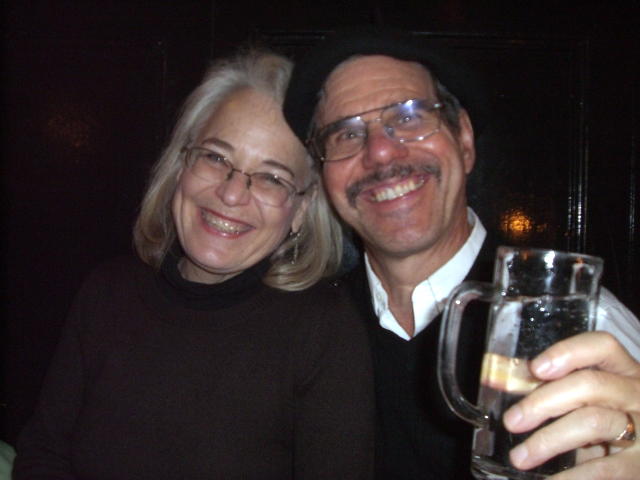 |
| Toasting with "Quaker vodka" (i.e. water) |
1) Germany is a carnivore's heaven, with bratwurst and sausages filling the winter air with sumptious aromas, tempting even the most committed vegetarian. However, Germany also is a vegetarian's delight, with beautiful organic produce available in farmer's markets in every city we visited.
2) Germans can be extraordinarily friendly and helpful. A couple of times, when we were lost driving our rented car (a bad decision since public transport is excellent and private cars unnecessary in most cases), Germans often to show us the way to our destination by leading us there in their cars. This happened three times, and each time we thanked God for our German guides!
3) On the other hand, Germans aren't hesitant to scold you in public if you do something wrong. For example, when we sample some freebies at a farmer's market and didn't use the folks provided, a man in a truck (not the owner) chided us. We've been told this is not unusual.
4) Germans are orderly and disciplined folk, except on New Year's eve and Oktoberfest, when they go crazy. (See below)
5) Germans prove that people can change dramatically if they are willing to admit their mistakes. We were impressed that the Germans ackowledged the evils of Nazism and the Holocaust so openly. In Germany you have to pay for everything, including going to the public toilets, but admission to Dachau was free. The tour was an unforgettable experience. German children are taken to the camps as part of their education. The message "Never again" comes through loud and clear. And Germans no longer idolized warriors, as we Americans still do. We went to a church in a German village that had a war memorial for the "fallen heroes" of the Great War. But German soldiers who died in WWII are simply referred to as "the fallen." In contrast, we Americans constantly refer to all our troops as heroes, even though some of them commit atrocities. If the Germans have gotten over the cult of the warrior, there is hope we Americans can do likewise. For the sake of world peace, and our nation's soul, the sooner we get over our warrior worship, the better!
6) Germans have a green economy and prosperity, thereby disproving the conservative canard that environmental laws are "job-killers." See http://www.thesolutionsjournal.com/node/981
7) Germans have good policies regarding affordable housing, including rent control. Overall, middle class Germans have a quality of life that is superior to that of most middle class Americans, and the poverty rate is much lower than ours.
Some of our impressions of Germany:
We thoroughly enjoyed celebrating Christmas in Heidelberg with Jill's family. It was fun going to the Christmas market, playing games and "lip synching" (a family tradition).

We also enjoyed wandering through the old city of Heidelberg with its cobblestone streets and its ancient castle, and taking part in the Christmas eve service at the local Protestant church, where the hymns were of course sung in German. Hearing "Stille Nacht" ("Silent Night") and other familiar hymns in German is somehow very moving. And I had learned just enough German to be able to sing along...
We had a delightful family excursion through the beautiful snow-dusted Black Forest region, where we visited quaint towns such as Frieberg and Triberg, and also Auger, the village where the Heirendt family originated. There Dwight read us the stories of family members dating back to the early 19th century.
After our family visit, Jill and I went on a trek through southern Germany. We stopped off at the ancient walled city of Rothenberg and then went to Munich, where we spent two nights in this amazing city, the heart of Bavaria. We visited museums, the beautiful Marienplatz, dined in an ancient ratskeller (and learned that "rat" has nothing to do with "rats"--it means "council," so a "rathaus" means a "city hall" and a "ratskeller" is a restaurant under a city hall). Speaking of halls, we went to a genuine Munich beer hall (or hofbrau), even though we don't drink, and had a great time conversing with some Mexican students who were studying English in England and were vacationing in Germany. We were also moved by some Russian Jewish street musicians and bought their albums--jazz and klezmer music full of Jewish soul. (Today around 10,000 Jews live in Munich, the same number as before WWII.)
We then went to Nurnberg, where we stayed in the old walled city in a hotel called the Elch that's been in business for 650 years! (Yes, it was first recorded as an inn in 1343!).
Along with seeing the beauties of German art and architecture (and the glorious landscapes of the Black Forest and Franconia), we went to Dachau and the Jewish museum in Berlin--very powerful experiences that will forever be etched in our memories.
 |
| Russian Jews playing Klesmer in Munich |
 |
| Anthony and Marga Zimmerman, a Mannheim Quaker |
 |
| Jill and Giselda Faust, a Berlin Quaker |
 |
| Anthony and Donna, Jill's mom |
The lowpoint of our trip were the fireworks in Berlin on New Year's eve. We expected to see the kind of beautiful, and controlled, fireworks you see in the states, but in Berlin, there are no safety laws and people go crazy. They shoot off fireworks everywhere, even in the metro cars! The city became like a war zone, with a haze of sulphurous smoke everywhere, and we became terrified, especially when we heard the ominous sound of ambulances making noises like the ones you hear in old movies about the Nazis. Even when we returned to our hotel, we could barely sleep for the cacophony.
The next day we went to meeting for worship with the Berlin Quakers and were grateful for the peace and quiet that prevailed. Because of the time (Jan 1), only four Friends took part--all elderly folk in their 80s and 90s. But they were very kind and made us feel welcome.
We were esp. grateful for a delighted 88-year-old Quaker nurse named Giselda Faust who escorted us to interesting places in the city. She told us about the role of Quakers in the "kindertransport" that saved the lives of 10,000 Jewish children. See http://www.quaker.org.uk/category/tags/kindertransport She also took us to the "raum der stille" (quiet room) in the Brandenberg gate, which Quakers helped to start: http://www.raum-der-stille-im-brandenburger-tor.de/english/brandenburggate.htm
 |
| Anthony and Michael Seltzer |
We could go on and on, but I think you get the picture: Germany is a fascinating place, and we are glad we had a chance to explore some of its many facets.
Monday, December 19, 2011
Holiday greetings!

Jill’s family—her Mom Donna and sister Jana and brother-in-law Dwight and their two sons Joey and Peter—came to celebrate Thanksgiving with us. We had a blast! We loved Anthony's idea of offering thanks for the various foods that our Native American brothers and sisters bestowed on us: corn, tomatoes, cactus, beans, squash, sweet potatoes, potatoes, pumpkin, wild rice, and of course, the greatest gift of all, chocolate!
The Advent season began with wonderful news. A couple with seven kids contacted us a few weeks ago, telling us that they were being evicted from their apartment due to the landlord going into foreclosure. Jill spent hours on the phone trying to help this family—we prayed—and our prayers were answered: they were accepted into the Family Promise! They entered the program on Dec. 4th--the very day they had to be out of their apartment and the day the network opened--after 3 years of organizing! Jill helped to recruit many of the 14 churches now part of the San Gabriel Valley network--the local expression of this nationwide program, whereby 2-4 homeless families are hosted by a congregation for a week, and are then rotated to the next congregation. Daily families seek jobs and housing at the Family Promise Resource Center. A full-time social worker works with them. We were blown away when 101 people came to the volunteer training Dec. 8th! We are thrilled to see such interest and how this family and others will now have a chance for a new life.
We are also grateful that the homeless survey we helped to conduct last summer has yielded good results. Twenty of the most at-risk homeless people in Pasadena have now been housed!
We are grateful that we have a warm and cozy home, and that it didn’t suffer much damage when winds up to 65 mph roared through our area on November 30. The shingles on our back roof were blown off, but they were old and needed to be replaced, and insurance will cover most of it. Anthony says: “It’s an ill wind that doesn’t blow somebody some good.”
During this unusually violent storm we offered Jill’s back house to a man who recently became homeless and was living in his car when the shelter where he was staying closed down.
Everywhere we turn, we see people who lack adequate shelter. That’s why we feel it’s important to revise Jill’s book on affordable housing. The need is huge, and churches are playing an important role to in realizing the goal of early Christians: "There was no poverty among them, because people who owned land or houses sold them and brought the money to the apostles to give to others in need." (Acts 4:34-35). Jill book will continue to encourage people to follow this example and do what it takes to “make housing happen” with the desperate need. At the Christian Community Development Association’s annual gathering this fall, Jill was humbled to learn that a young woman discovered her book in the office at Sojourner’s magazine and upon reading it decided to switch careers. She is now developing affordable housing for homeless youth in Minneapolis.
Jill published a feature article called “Seven Ways Home” in the December issue of Sojourners magazine. Anthony was very proud when Jim Wallis saw us both in an elevator and said, “Oh, you’re Jill Shook. You’re famous!” (You can read it online at http://www.sojo.net/magazine/2011/12/seven-ways-home)
Anthony has continued to be involved in his various peacemaking efforts. This year he published a book called Quakers and the Interfaith Movement and has given talks at various churches and other venues. During the summer he gave a workshop at the national Quaker gathering, Friends General Conference. One of our goals as a married couple is to host a weekly discussion series in Feb 2012 to look at biblical underpinnings of peacemaking. We will consider alternatives to war in the Bible, and how the church has been on both sides of this issue, both supporting it and playing a significant role in ending it.
On Oct 7 Anthony was arrested at a rally in front of the Los Angeles Federal Building along with 14 other religious leaders on the 10th anniversary of the US invasion of Afghanistan, the longest war in US history. He and the other religious leaders spent the afternoon in jail. When asked about this experience, Anthony said: “I used to wonder why early Christians and early Quakers were so cheerful when they were taken to jail, or worse, for their beliefs. When I was taken to jail with my good friends, I had a taste of that joy that comes when we follow our conscience, no matter what.”
For the past few weeks, Anthony has been working with various religious leaders in the LA area to have a sharing circle and worship opportunities at Occupy LA. Anthony believes that the nonviolent approach of Dr. Martin Luther King is needed at this time in order to turn America from a culture of greed to a culture of compassion and mutual accountability.
It feels as if America, and the world, is going through a time of rebirth, a process that is painful and messy as well as beautiful. (Kind of like a marriage!) We are feeling the drama of birth in other ways, too. Jill had planned to work on the revised version of her book throughout 2011, but due our meeting and wedding, we are now facing the pressure of a January deadline. Jill is deeply grateful for Anthony's many hours of help in editing and for his appreciation of the value and great need for this book at this time of the foreclosure crisis. It feels as if giving birth to a book is our first child!
During this time of Advent, we are seeing the rebirth of the One who was born to show us how to live and love with grace. We hope and pray that all of you will experience once again this amazing grace and have a truly blessed holiday!
Love, Anthony and Jill
PS. The picture below shows us when we gave a presentation together about our respective books at Honolulu Meeting. We plan to speak together at One Voice, Jill’s church, on Sunday, Dec 18, about how the birth of Jesus challenged the existing social order. You’ll be able to access this talk at Anthony’s blog at laquaker.blogspot.com.

Sunday, December 18, 2011
Where would you want your child to be born?
Jill and I are grateful to Paul Kim, pastor of One Voice church in Pasadena, for inviting us to share this Christmas message. I am also thankful to this church for being so hospitable and welcoming me into its community.
The question I posed for this congregation (and for you) to think about was:
The place were Jesus was born was not at all what you or I would necessarily choose. God had a different plan. God’s child was born in a country under foreign occupation, wracked by war and uprisings, in an impoverished village far from centers of power. His parents came from a town with such a bad reputation that when good-hearted Nathaniel was told Jesus came from Nazareth, he said: “Can anything good come from Nazareth?”
Nazareth was clearly not prime real estate It was in the northern part of what is today Israel. It was filled with many non-Jews, mostly Syrians, who had been conquered in a bloody war a hundred years before Jesus’ birth. Bethlehem was also war-torn and poor, a suburb of Jerusalem controlled by a ruthless Roman army. Today the inhabitants of Bethlehem are still under the control of a ruthless army; they can’t come or go without permission of the Israelis. That’s the kind of place that God chose for God’s son to be born into. Why would God want his child to be born in this kind of place under these circumstances?
The Bible teaches us that many great leaders were born in desperate circumstances. Moses was born a slave in Egypt, under conditions so oppressive his parents had to put him into a wicker basket and set him afloat on the Nile to prevent him from being killed by Pharaoh. David was born a humble shepherd during a time when the Israelites were at war with the Canaanites.
Why did God choose for the savior of the world to be born among poor and outcast? In every way Jesus, even at his birth, identifies with the marginalized. That is what gave him authority to speak truth to power on behalf of the powerless. And that is what gives you and I that authority. Jill would not be powerful in what she says at the city council if she didn’t know firsthand those who are being affected by the systemic issues and are not being heard or know how to speak to those who allocate the resources.
According to the Hebrew prophecies, a great Liberator would be born in Bethlehem to give folks the grace and power to speak, to free his people from oppression and to end war. Zech 9: 9-10 says,
This was joyous news for the poor, but bad news for those who live by the sword. When King Herod heard rumors that a Messiah, a King of the Jews, was born in Bethlehem, he felt so threatened he sent his soldiers to kill all the babies. Fear and lust for power controlled him and led him to violence.
Such a bloody, ruthless act revealed the oppressive system that the Jews were living under. The theologian Walter Wink calls this "the domination system," and it's still with us. Whenever the domination system is threatened, it responds with violence: arrests, imprisonment, torture, and eventually the killing of innocent people. We see this around the world today with people rising up in Syria, Egypt, Tunisia. We even see it in our own country with the our police dressed in full riot gear, to clear out unarmed Occupiers exercising their Constitutional rights.
I felt personally connected to the story of the “slaughter of the innocents” when I went to Israel/Palestine in 2005 as part of the Compassionate Listening project. The intifada or uprising of 2000 had just ended. Over 1,400 Palestinian children and 125 Jewish children had been killed—an enormous number given the small size of this country. I met Jewish and Palestinian parents whose children had been killed during this period and it was heartbreaking to listen to them. One of them was a rabbi whose son was murdered by Arabs and found in a cave near his kibbutz. Another was a Palestinian mother whose 16-year-old son was shot in the head at point blank range by an Israeli soldier during a peaceful demonstration. I can't begin to describe the pain of these grieving families.
During this trip I went to Bethlehem to visit the Church of the Nativity, where Jesus was born and was appalled to see it riddled with bullet holes. Inside the church, I found a shrine dedicated to the “slaughter of the innocents." . This was not just a story that happened 2000 years ago. It's still happening today. While there I felt empty and sad. I grieved for the children who had been killed in Israel/Palestine. I prayed for all the children being killed by war, by terrorism, by drones, by airplanes. On average two children a day died in Afghanistan in 2010. Over 500 Palestinian children were killed during the Gaza massacre in 2009.
I have vowed to do everything in my power to end this senseless slaughter. Jill and I both believe there are biblical alternatives to war and violence. God chose to have his son born in the midst of an oppressive system to show us the way.
I had come to Israel/Palestine as part of a nonviolent conflict resolution group called the Compassionate Listening Project. This group was inspired by a Quaker named Gene Hoffman who was my mentor and friend. The idea of Compassionate Listening is to teach people listening skills in places where people have been traumatized by violence. People learn to listen to their “enemies” without judging, to listen from the heart, and this builds trust and hope. While I was in Bethlehem, we did Compassionate Listening training in a school, and nearly 100 Palestinians and Israeli Jews took part. This was very inspiring since Jews were not allowed to go to Bethlehem to talk with Palestinians at this time. It was illegal! But many Jews were willing to break the law in order to build bridges of understanding with their Palestinian neighbors. When so-called “enemies” come together and listen to each other’s stories from the heart, they can become friends.
A couple of years ago, I interviewed a Palestinian boy named Yousef Bashir who lived under Israeli occupation in Gaza. When Yousef was only 12, he was shot in the back by an Israeli soldier as he was walking out of his house. He was critically hurt and almost died. Because the hospitals in Gaza are short on crucial medical supplies, his father somehow managed to get him to a first-rate Jewish hospital where Yousef spent several months recovering. Up to this time, Yousef had never encountered a Jew who wasn’t armed and threatening. In the hospital he met kind Jewish doctors and nurses, and gradually overcame his prejudices and fears. He went on to become an ardent peace maker and even persuaded an Israeli soldier to accept a t-shirt for a camp called “The Seeds of Peace.” After hearing Yousef’s story, the soldier said he would like to become a counselor at this camp after finishing his obligatory military service. Yousef’s story, titled “The Power of Forgiveness,” is being published in a book for children in Russia and Chechnya showing that there are alternatives to violence. (See http://fil.quaker.org/story_forgive_is_devine.html)
Closer to home, Jill and I witnessed examples of what compassionate listening can accomplish when we traveled together this summer to places in our own country where there is poverty and violence. We went to the slums of Washington, DC, and Philadelphia and we saw Christians who had moved into these at-risk communities and listened, deeply listened, to what the community needs and what it has to offer. These Christians had partnered with their urban neighbors to help the community to rebuild itself. Jim Dickerson, this small church has been involved in rehabbing and selling 1000 homes to low income families with an extremely low foreclosure rate. In this work, I saw signs of hope, signs that Christ was being reborn.
Many people today are being kicked out of their homes due to foreclosures, or are finding it impossible to afford a home because of our unjust economic system, where the rich get bailouts and the poor get sold out. Many young people have taken to the streets to protest the economic injustices of Wall Street. As you know, I was part of a religious group that got arrested to protest the war in Afghanistan and also went to Occupy LA to be in solidarity with the protesters. It was amazing to see hundreds of people living in tents around our City Hall. Some of them had come from Skid Row where they were already living on the streets. It was the first time in my life I have seen middle class and poor people living together in tents. What drew them together was the hunger and thirst for justice. I felt as if I was witnessing the rebirth of hope, the rebirth of the Christ spirit.
What about here in Pasadena? Where is Christ being reborn here? How can we be part of this rebirth? Jill can tell you more about this than I can. I am grateful that many of you in this church are helping with programs like Family Promise and are doing what you can to help families like Theresa's family whose children will be living in a church instead of on the street this Christmas. Jill and I are inviting you to join us in a discussion group focusing on justice and peace from a biblical perspective, and discover together the meaning of peace in ourselves, our community and world today.
We’d like to end with a beautiful song about the birth of the Prince of Peace by the great Quaker African-American activist mystic teacher Howard Thurman, who taught at my Alma mater, Boston University. Here's what Howard Thurman says about the message of Christmas:
"When the song of the angels is stilled, When the star in the sky is gone, When the kings and princes are home, When the shepherds are back with their flock, The work of Christmas begins: To find the lost, To heal the broken, To feed the hungry, To release the prisoner, To rebuild the nations, To bring peace among others, To make music in the heart."
The question I posed for this congregation (and for you) to think about was:
"If you had a choice about where your child would be born, so your child could realize its potential and have a good life, what place would you choose?”Most people would probably say, “I’d like my child to be born in a good, peaceful neighborhood, with good schools, so he or she will be safe and get a good education.”
The place were Jesus was born was not at all what you or I would necessarily choose. God had a different plan. God’s child was born in a country under foreign occupation, wracked by war and uprisings, in an impoverished village far from centers of power. His parents came from a town with such a bad reputation that when good-hearted Nathaniel was told Jesus came from Nazareth, he said: “Can anything good come from Nazareth?”
Nazareth was clearly not prime real estate It was in the northern part of what is today Israel. It was filled with many non-Jews, mostly Syrians, who had been conquered in a bloody war a hundred years before Jesus’ birth. Bethlehem was also war-torn and poor, a suburb of Jerusalem controlled by a ruthless Roman army. Today the inhabitants of Bethlehem are still under the control of a ruthless army; they can’t come or go without permission of the Israelis. That’s the kind of place that God chose for God’s son to be born into. Why would God want his child to be born in this kind of place under these circumstances?
The Bible teaches us that many great leaders were born in desperate circumstances. Moses was born a slave in Egypt, under conditions so oppressive his parents had to put him into a wicker basket and set him afloat on the Nile to prevent him from being killed by Pharaoh. David was born a humble shepherd during a time when the Israelites were at war with the Canaanites.
Why did God choose for the savior of the world to be born among poor and outcast? In every way Jesus, even at his birth, identifies with the marginalized. That is what gave him authority to speak truth to power on behalf of the powerless. And that is what gives you and I that authority. Jill would not be powerful in what she says at the city council if she didn’t know firsthand those who are being affected by the systemic issues and are not being heard or know how to speak to those who allocate the resources.
According to the Hebrew prophecies, a great Liberator would be born in Bethlehem to give folks the grace and power to speak, to free his people from oppression and to end war. Zech 9: 9-10 says,
Rejoice, O people of Zion!
Shout in triumph, O people of Jerusalem!
Look, your king is coming to you.
He is righteous and victorious
yet he is humble, riding on a donkey—
riding on a donkey’s colt.
I will remove the battle chariots from Israel
and the warhorses from Jerusalem.
I will destroy all the weapons used in battle,
and your king will bring peace to the nations.
His realm will stretch from sea to sea
and from the Euphrates River to the ends of the earth.
This was joyous news for the poor, but bad news for those who live by the sword. When King Herod heard rumors that a Messiah, a King of the Jews, was born in Bethlehem, he felt so threatened he sent his soldiers to kill all the babies. Fear and lust for power controlled him and led him to violence.
Such a bloody, ruthless act revealed the oppressive system that the Jews were living under. The theologian Walter Wink calls this "the domination system," and it's still with us. Whenever the domination system is threatened, it responds with violence: arrests, imprisonment, torture, and eventually the killing of innocent people. We see this around the world today with people rising up in Syria, Egypt, Tunisia. We even see it in our own country with the our police dressed in full riot gear, to clear out unarmed Occupiers exercising their Constitutional rights.
I felt personally connected to the story of the “slaughter of the innocents” when I went to Israel/Palestine in 2005 as part of the Compassionate Listening project. The intifada or uprising of 2000 had just ended. Over 1,400 Palestinian children and 125 Jewish children had been killed—an enormous number given the small size of this country. I met Jewish and Palestinian parents whose children had been killed during this period and it was heartbreaking to listen to them. One of them was a rabbi whose son was murdered by Arabs and found in a cave near his kibbutz. Another was a Palestinian mother whose 16-year-old son was shot in the head at point blank range by an Israeli soldier during a peaceful demonstration. I can't begin to describe the pain of these grieving families.
During this trip I went to Bethlehem to visit the Church of the Nativity, where Jesus was born and was appalled to see it riddled with bullet holes. Inside the church, I found a shrine dedicated to the “slaughter of the innocents." . This was not just a story that happened 2000 years ago. It's still happening today. While there I felt empty and sad. I grieved for the children who had been killed in Israel/Palestine. I prayed for all the children being killed by war, by terrorism, by drones, by airplanes. On average two children a day died in Afghanistan in 2010. Over 500 Palestinian children were killed during the Gaza massacre in 2009.
I have vowed to do everything in my power to end this senseless slaughter. Jill and I both believe there are biblical alternatives to war and violence. God chose to have his son born in the midst of an oppressive system to show us the way.
I had come to Israel/Palestine as part of a nonviolent conflict resolution group called the Compassionate Listening Project. This group was inspired by a Quaker named Gene Hoffman who was my mentor and friend. The idea of Compassionate Listening is to teach people listening skills in places where people have been traumatized by violence. People learn to listen to their “enemies” without judging, to listen from the heart, and this builds trust and hope. While I was in Bethlehem, we did Compassionate Listening training in a school, and nearly 100 Palestinians and Israeli Jews took part. This was very inspiring since Jews were not allowed to go to Bethlehem to talk with Palestinians at this time. It was illegal! But many Jews were willing to break the law in order to build bridges of understanding with their Palestinian neighbors. When so-called “enemies” come together and listen to each other’s stories from the heart, they can become friends.
A couple of years ago, I interviewed a Palestinian boy named Yousef Bashir who lived under Israeli occupation in Gaza. When Yousef was only 12, he was shot in the back by an Israeli soldier as he was walking out of his house. He was critically hurt and almost died. Because the hospitals in Gaza are short on crucial medical supplies, his father somehow managed to get him to a first-rate Jewish hospital where Yousef spent several months recovering. Up to this time, Yousef had never encountered a Jew who wasn’t armed and threatening. In the hospital he met kind Jewish doctors and nurses, and gradually overcame his prejudices and fears. He went on to become an ardent peace maker and even persuaded an Israeli soldier to accept a t-shirt for a camp called “The Seeds of Peace.” After hearing Yousef’s story, the soldier said he would like to become a counselor at this camp after finishing his obligatory military service. Yousef’s story, titled “The Power of Forgiveness,” is being published in a book for children in Russia and Chechnya showing that there are alternatives to violence. (See http://fil.quaker.org/story_forgive_is_devine.html)
Closer to home, Jill and I witnessed examples of what compassionate listening can accomplish when we traveled together this summer to places in our own country where there is poverty and violence. We went to the slums of Washington, DC, and Philadelphia and we saw Christians who had moved into these at-risk communities and listened, deeply listened, to what the community needs and what it has to offer. These Christians had partnered with their urban neighbors to help the community to rebuild itself. Jim Dickerson, this small church has been involved in rehabbing and selling 1000 homes to low income families with an extremely low foreclosure rate. In this work, I saw signs of hope, signs that Christ was being reborn.
Many people today are being kicked out of their homes due to foreclosures, or are finding it impossible to afford a home because of our unjust economic system, where the rich get bailouts and the poor get sold out. Many young people have taken to the streets to protest the economic injustices of Wall Street. As you know, I was part of a religious group that got arrested to protest the war in Afghanistan and also went to Occupy LA to be in solidarity with the protesters. It was amazing to see hundreds of people living in tents around our City Hall. Some of them had come from Skid Row where they were already living on the streets. It was the first time in my life I have seen middle class and poor people living together in tents. What drew them together was the hunger and thirst for justice. I felt as if I was witnessing the rebirth of hope, the rebirth of the Christ spirit.
What about here in Pasadena? Where is Christ being reborn here? How can we be part of this rebirth? Jill can tell you more about this than I can. I am grateful that many of you in this church are helping with programs like Family Promise and are doing what you can to help families like Theresa's family whose children will be living in a church instead of on the street this Christmas. Jill and I are inviting you to join us in a discussion group focusing on justice and peace from a biblical perspective, and discover together the meaning of peace in ourselves, our community and world today.
We’d like to end with a beautiful song about the birth of the Prince of Peace by the great Quaker African-American activist mystic teacher Howard Thurman, who taught at my Alma mater, Boston University. Here's what Howard Thurman says about the message of Christmas:
"When the song of the angels is stilled, When the star in the sky is gone, When the kings and princes are home, When the shepherds are back with their flock, The work of Christmas begins: To find the lost, To heal the broken, To feed the hungry, To release the prisoner, To rebuild the nations, To bring peace among others, To make music in the heart."
What did the angels mean by “Peace on earth?”
“Glory to God in the highest, and on earth peace, good will toward men.”--Luke 2:14, King James version.
This Christmas I was asked to speak about the birth of the one who has been called the “Prince of Peace.” As many of you know, my wife Jill and I met at a peace parade in Pasadena that took place on Palm Sunday, and we are both peacemakers at heart. In fact, we affirmed at our wedding that “the Prince of Peace brought us together for purpose larger than either of us can imagine.”
Peacemaking is at the heart of the Gospel. When Jesus made his triumphant march in Jerusalem on a donkey, he was fulfilling a prophesy by Zachariah which said that the Messiah would come and end all war. Just before his death, Jesus told his disciples, “My peace I leave you, not as the world gives you peace” (John 12:27).
Today we are hear to celebrate the birth of this Prince of Peace. But what Jesus mean by peace? How does the peace of Jesus differ from the “world's” notion of peace?
When the angels announced the birth of the Savior by proclaiming “Peace on earth,” they were expressing a vision of peace and of society that was totally at odds with the views of the Roman empire, and of many people today. The Roman word for peace, PAX, is related to the word “pact,” a peace treaty. For the empire, peace is simply about the cessation of war. As the Roman historian Tacitus said, “The Romans create desolation and call it peace.” The same could be said for every empire, including our own. The Hebrew word for peace SHALOM is much deeper and richer than this imperial notion of a peace treaty. Shalom comes from the root meaning wholeness and implies health, well-being, and social harmony. Peace is usually coupled with justice. In the Beatitudes Jesus says: “Blessed are the shalom-makers” and also “Blessed are those who hunger and thirst after justice.” In the Bible, shalom and justice go hand-in-hand.
So when the angels announce that the birth of Jesus will bring “shalom,” it means a world of justice, peace, and reconciliation.
There are basically two aspects of peace—inward and outward. Inner peace means more than just feeling good. You can feel good and still not have true inner peace. Many Germans felt peaceful inwardly during the Nazi period. They were going to church, doing their jobs, and being “good Germans.” But they weren’t at peace with God.
To be truly peaceful inwardly means living in harmony with God’s will. The Italian poet Dante said it beautifully: “En su voluntad esta nuestra paz.” “In Your Will, O God, is our peace.” When we live in harmony with God’s will, we are living a life of love, service, and joy. We aren’t thinking about ourselves. We aren’t resentful or angry. We feel a sense of “rightness,” of being where we are supposed to be, doing what we are supposed to be doing, with people we love.
In the Beatitudes, Jesus talks about this inward peace when he says: “Blessed are the pure in heart for they will see God.” Those who are pure in heart are free from mixed motives, from the kind of selfishness that leads to conflict and war.
In his epistle, James explains that wars are caused by our selfish desires. “You want what you don't have, so you scheme and kill to get it. You are jealous of what others have, but you can't get it, so you fight and wage war to take it away from them. Yet you don't have what you want because you don't ask God for it.” (James 4:2)
James goes on to say we don’t know how to pray for what is truly good for us, like wisdom. To learn how to pray rightly, we need to take time to be still and listen to our hearts, to what Quakers call the Inward Light. When we take time to be in holy silence, and let go of our desires and agenda, we allow space for the Christ child, the spirit of compassion, to be reborn in our hearts. This leads to what Paul calls “the peace that passeth understanding.” This spirit of peace is beautifully conveyed in the song, “Silent night.” I love the words: “All is calm. All is bright.” That’s what inner peace feels like.
Peace is more than a good feeling, however. As Pastor Paul Kim explained last week, Jesus commands us to be ethical. And he gave us two ethical commands that relate to peace: LOVE YOUR ENEMY and PRAY FOR THOSE WHO WRONG YOU.
If we follow these two commandments, it would seem we couldn't possibly go to war. In fact, we have no choice but to pursue peace actively.
These commandments seem clear, though by no means easy to follow, but many Christians have felt differently about applying them. Augustine made the argument that some wars are just, and thereby opened the door for endless “defensive” wars. Other Christians like Reinhold Niebuhr argued these commandments are intended for individuals, not for nations. According to these so-called Christian realists, Jesus’ commandments regarding peace are impossible to follow in this fallen world. They are simply ideals to be aspired to.
This is not the way early Christians interpreted these commandments, however. Until the time of Constantine in 300 AD, most Christians refused to serve in the Roman army. They refused to light incense at the altar of Caesar or the war gods. And they paid a heavy price for not pledging allegiance to the Roman empire. Many went to prison, or worse, were tortured and killed. One of my favorite stories is about St Martin, the patron saint of pacifists.
While Martin was still a soldier in the Roman army and deployed in Gaul (modern day France), he experienced the vision that became the most-repeated story about his life. One day as he was approaching the gates of the city of Amiens he met a scantily clad beggar. He impulsively cut his own military cloak in half and shared it with the beggar. That night, Martin dreamed of Jesus wearing the half-cloak he had given away. He heard Jesus say to the angels: "Here is Martin, the Roman soldier who is not baptized; he has clad me." (Sulpicius, ch 2).
After having a conversion experience and being baptised, Martin determined that his faith prohibited him from fighting, saying, "I am a soldier of Christ. I cannot fight." He was charged with cowardice and jailed, but in response to the charge, he volunteered to go unarmed to the front of the troops. His superiors planned to take him up on the offer, but before they could, the invaders sued for peace, the battle never occurred, and Martin was released from military service.[5]
As you know, I went to jail along with 14 others who oppose the endless “defensive” wars we are fighting throughout the world. When I was arrested, I had a taste of what it was like when early Christians and early Quakers went to prison cheerfully, singing hymns of praise to God. When I was handcuffed and taken to jail, surrounded by a cloud of witnesses, I felt a sense of joy, of peace, because I was following my conscience, no matter what.
There are many ways to create peace or shalom. We create shalom when we visit the sick, help the needy, comfort the afflicted, and work for justice. I hope that each of you finds your own way to bring peace and reconciliation to your family, to your community, and to the world. This is how we can best celebrate the birth of the Prince of Peace.
I'd like to end with a beautiful song by the great Quaker African-American activist mystic teacher Howard Thurman, who taught at my alma mater, Boston Univesity. Here is how Thurman sums up the message of Christmas:
"When the song of the angels is stilled, When the star in the sky is gone, When the kings and princes are home, When the shepherds are back with their flock, The work of Christmas begins: To find the lost, To heal the broken, To feed the hungry, To release the prisoner, To rebuild the nations, To bring peace among others, To make music in the heart."
This Christmas I was asked to speak about the birth of the one who has been called the “Prince of Peace.” As many of you know, my wife Jill and I met at a peace parade in Pasadena that took place on Palm Sunday, and we are both peacemakers at heart. In fact, we affirmed at our wedding that “the Prince of Peace brought us together for purpose larger than either of us can imagine.”
Peacemaking is at the heart of the Gospel. When Jesus made his triumphant march in Jerusalem on a donkey, he was fulfilling a prophesy by Zachariah which said that the Messiah would come and end all war. Just before his death, Jesus told his disciples, “My peace I leave you, not as the world gives you peace” (John 12:27).
Today we are hear to celebrate the birth of this Prince of Peace. But what Jesus mean by peace? How does the peace of Jesus differ from the “world's” notion of peace?
When the angels announced the birth of the Savior by proclaiming “Peace on earth,” they were expressing a vision of peace and of society that was totally at odds with the views of the Roman empire, and of many people today. The Roman word for peace, PAX, is related to the word “pact,” a peace treaty. For the empire, peace is simply about the cessation of war. As the Roman historian Tacitus said, “The Romans create desolation and call it peace.” The same could be said for every empire, including our own. The Hebrew word for peace SHALOM is much deeper and richer than this imperial notion of a peace treaty. Shalom comes from the root meaning wholeness and implies health, well-being, and social harmony. Peace is usually coupled with justice. In the Beatitudes Jesus says: “Blessed are the shalom-makers” and also “Blessed are those who hunger and thirst after justice.” In the Bible, shalom and justice go hand-in-hand.
So when the angels announce that the birth of Jesus will bring “shalom,” it means a world of justice, peace, and reconciliation.
There are basically two aspects of peace—inward and outward. Inner peace means more than just feeling good. You can feel good and still not have true inner peace. Many Germans felt peaceful inwardly during the Nazi period. They were going to church, doing their jobs, and being “good Germans.” But they weren’t at peace with God.
To be truly peaceful inwardly means living in harmony with God’s will. The Italian poet Dante said it beautifully: “En su voluntad esta nuestra paz.” “In Your Will, O God, is our peace.” When we live in harmony with God’s will, we are living a life of love, service, and joy. We aren’t thinking about ourselves. We aren’t resentful or angry. We feel a sense of “rightness,” of being where we are supposed to be, doing what we are supposed to be doing, with people we love.
In the Beatitudes, Jesus talks about this inward peace when he says: “Blessed are the pure in heart for they will see God.” Those who are pure in heart are free from mixed motives, from the kind of selfishness that leads to conflict and war.
In his epistle, James explains that wars are caused by our selfish desires. “You want what you don't have, so you scheme and kill to get it. You are jealous of what others have, but you can't get it, so you fight and wage war to take it away from them. Yet you don't have what you want because you don't ask God for it.” (James 4:2)
James goes on to say we don’t know how to pray for what is truly good for us, like wisdom. To learn how to pray rightly, we need to take time to be still and listen to our hearts, to what Quakers call the Inward Light. When we take time to be in holy silence, and let go of our desires and agenda, we allow space for the Christ child, the spirit of compassion, to be reborn in our hearts. This leads to what Paul calls “the peace that passeth understanding.” This spirit of peace is beautifully conveyed in the song, “Silent night.” I love the words: “All is calm. All is bright.” That’s what inner peace feels like.
Peace is more than a good feeling, however. As Pastor Paul Kim explained last week, Jesus commands us to be ethical. And he gave us two ethical commands that relate to peace: LOVE YOUR ENEMY and PRAY FOR THOSE WHO WRONG YOU.
If we follow these two commandments, it would seem we couldn't possibly go to war. In fact, we have no choice but to pursue peace actively.
These commandments seem clear, though by no means easy to follow, but many Christians have felt differently about applying them. Augustine made the argument that some wars are just, and thereby opened the door for endless “defensive” wars. Other Christians like Reinhold Niebuhr argued these commandments are intended for individuals, not for nations. According to these so-called Christian realists, Jesus’ commandments regarding peace are impossible to follow in this fallen world. They are simply ideals to be aspired to.
This is not the way early Christians interpreted these commandments, however. Until the time of Constantine in 300 AD, most Christians refused to serve in the Roman army. They refused to light incense at the altar of Caesar or the war gods. And they paid a heavy price for not pledging allegiance to the Roman empire. Many went to prison, or worse, were tortured and killed. One of my favorite stories is about St Martin, the patron saint of pacifists.
While Martin was still a soldier in the Roman army and deployed in Gaul (modern day France), he experienced the vision that became the most-repeated story about his life. One day as he was approaching the gates of the city of Amiens he met a scantily clad beggar. He impulsively cut his own military cloak in half and shared it with the beggar. That night, Martin dreamed of Jesus wearing the half-cloak he had given away. He heard Jesus say to the angels: "Here is Martin, the Roman soldier who is not baptized; he has clad me." (Sulpicius, ch 2).
After having a conversion experience and being baptised, Martin determined that his faith prohibited him from fighting, saying, "I am a soldier of Christ. I cannot fight." He was charged with cowardice and jailed, but in response to the charge, he volunteered to go unarmed to the front of the troops. His superiors planned to take him up on the offer, but before they could, the invaders sued for peace, the battle never occurred, and Martin was released from military service.[5]
As you know, I went to jail along with 14 others who oppose the endless “defensive” wars we are fighting throughout the world. When I was arrested, I had a taste of what it was like when early Christians and early Quakers went to prison cheerfully, singing hymns of praise to God. When I was handcuffed and taken to jail, surrounded by a cloud of witnesses, I felt a sense of joy, of peace, because I was following my conscience, no matter what.
There are many ways to create peace or shalom. We create shalom when we visit the sick, help the needy, comfort the afflicted, and work for justice. I hope that each of you finds your own way to bring peace and reconciliation to your family, to your community, and to the world. This is how we can best celebrate the birth of the Prince of Peace.
I'd like to end with a beautiful song by the great Quaker African-American activist mystic teacher Howard Thurman, who taught at my alma mater, Boston Univesity. Here is how Thurman sums up the message of Christmas:
"When the song of the angels is stilled, When the star in the sky is gone, When the kings and princes are home, When the shepherds are back with their flock, The work of Christmas begins: To find the lost, To heal the broken, To feed the hungry, To release the prisoner, To rebuild the nations, To bring peace among others, To make music in the heart."
Sunday, December 11, 2011
ICUJP CONDEMNS "MILITARIZED" RAID ON OCCUPY LA AND CALLS FOR PEOPLE'S TRIBUNAL
Interfaith Communities United for Justice and Peace (icujp.org), on whose board of directors I serve, issued the following statement condemning the police raid on Occupy LA. The Jewish Journal published an excellent account of what happened from an interreligious viewpoint. See http://www.jewishjournal.com/los_angeles/article/clergy_object_to_lapds_methods_of_clearing_occupy_la_20111207/
We believe that Occupy LA had a right to protest peacefully and should not have been evicted. In a time in which we often hear laments that no one cares and no one gets involved, the Occupy LA movement should be commended for getting involved and peacefully protesting a government that has become completely beholden to the interests of the rich, the military, banks, and corporations. Their involvement also inspired others to get involved, which should be celebrated as well.
Since the Occupy LA encampment was endorsed the Los Angeles City Council and its goals has the support of the majority of California voters, we feel Mayor had no legal authority to unilaterally order the LAPD to shut it down.
As religious leaders who personally observed the police crackdown have testified, protesters at Occupy LA were peacefully exercising their constitutional rights when 1400 police in riot gear descended upon them, arrested almost 300 and brutally dispersed the rest. Although the police allegedly did not use the outrageous and illegal level of violence evident in other such crackdowns, observers described the behavior of the LAPD as "violent" and "brutal," leading to abuses and injuries, which have been ignored.
This police overreaction could have been avoided. Religious leaders had made an agreement with the police department that they would be given an opportunity to meet with the protesters prior to arrests to help defuse tension. According to reliable sources, only 50 protesters had planned to commit civil disobedience. The rest were willing to disperse when requested to do so. These religious mediators were deliberately taken aside and deceptively told they were being briefed while police initiated their raid without observation. This betrayal of trust by law enforcement violates deeply held democratic values.
ICUJP also regrets that the local media, including the Los Angeles Times, betrayed the ideals of a Free Press, by failing to unflinchingly report what actually happened during the police raid on Occupy LA. A free society depends on a free press independently exposing government abuse rather than uncritically republishing the official story.
The Mayor and others have boasted that this police action was peaceful, compared with the pepper spraying and other violent behavior that has taken place throughout the United States. We also object to the use of excessive bail and jail time to intimidate the protesters.
We believe City should not only permit, but encourage its citizens to exercise their right to protest peacefully if we are to preserve our democracy.
Finally, we condemn the growing use of paramilitary tactics to suppress the exercise of First Amendment rights, including freedom of peaceful and non-violent assembly, here in the United States. A democracy cannot survive if it treats protesters as if they are "the enemy." We are appalled that the Department of Homeland Security has been advising mayors throughout the country on how to suppress the Occupy movement, thereby equating American citizens exercising their constitutional rights with terrorists.
We fully concur with former Seattle police chief Norm Stamper who has severely criticized the police for adopting a militaristic approach to dealing with demonstrators. Stamper urges the police and elected officials to remember "they are dealing with fellow Americans" and notes that the Occupy protesters are raising "issues that are vital to the entire country, and certainly to the middle class and those who have been marginalized, especially by poverty or by discrimination."
We are committed to Speaking Truth to Power. ICUJP calls for an independent People's Tribunal to fully investigate the events surrounding the raid on Occupy LA and to publicly expose the whole truth.
*******
Ever since 9/11, when Interfaith Communities United for Justice and Peace ("ICUJP") was founded, we have called on religious communities to "stop blessing war and violence" and have urged our elected officials to seek peaceful solutions to conflict at home and abroad.We believe that Occupy LA had a right to protest peacefully and should not have been evicted. In a time in which we often hear laments that no one cares and no one gets involved, the Occupy LA movement should be commended for getting involved and peacefully protesting a government that has become completely beholden to the interests of the rich, the military, banks, and corporations. Their involvement also inspired others to get involved, which should be celebrated as well.
Since the Occupy LA encampment was endorsed the Los Angeles City Council and its goals has the support of the majority of California voters, we feel Mayor had no legal authority to unilaterally order the LAPD to shut it down.
As religious leaders who personally observed the police crackdown have testified, protesters at Occupy LA were peacefully exercising their constitutional rights when 1400 police in riot gear descended upon them, arrested almost 300 and brutally dispersed the rest. Although the police allegedly did not use the outrageous and illegal level of violence evident in other such crackdowns, observers described the behavior of the LAPD as "violent" and "brutal," leading to abuses and injuries, which have been ignored.
This police overreaction could have been avoided. Religious leaders had made an agreement with the police department that they would be given an opportunity to meet with the protesters prior to arrests to help defuse tension. According to reliable sources, only 50 protesters had planned to commit civil disobedience. The rest were willing to disperse when requested to do so. These religious mediators were deliberately taken aside and deceptively told they were being briefed while police initiated their raid without observation. This betrayal of trust by law enforcement violates deeply held democratic values.
ICUJP also regrets that the local media, including the Los Angeles Times, betrayed the ideals of a Free Press, by failing to unflinchingly report what actually happened during the police raid on Occupy LA. A free society depends on a free press independently exposing government abuse rather than uncritically republishing the official story.
The Mayor and others have boasted that this police action was peaceful, compared with the pepper spraying and other violent behavior that has taken place throughout the United States. We also object to the use of excessive bail and jail time to intimidate the protesters.
We believe City should not only permit, but encourage its citizens to exercise their right to protest peacefully if we are to preserve our democracy.
Finally, we condemn the growing use of paramilitary tactics to suppress the exercise of First Amendment rights, including freedom of peaceful and non-violent assembly, here in the United States. A democracy cannot survive if it treats protesters as if they are "the enemy." We are appalled that the Department of Homeland Security has been advising mayors throughout the country on how to suppress the Occupy movement, thereby equating American citizens exercising their constitutional rights with terrorists.
We fully concur with former Seattle police chief Norm Stamper who has severely criticized the police for adopting a militaristic approach to dealing with demonstrators. Stamper urges the police and elected officials to remember "they are dealing with fellow Americans" and notes that the Occupy protesters are raising "issues that are vital to the entire country, and certainly to the middle class and those who have been marginalized, especially by poverty or by discrimination."
We are committed to Speaking Truth to Power. ICUJP calls for an independent People's Tribunal to fully investigate the events surrounding the raid on Occupy LA and to publicly expose the whole truth.
Subscribe to:
Posts (Atom)