Tuesday, October 23, 2012

The Growing Edge of the Religious Society of Friends: the Work of FGC Central Committee


This past week I went to Maryland to attend the annual gathering of the Central Committee of Friends General Conference, which serves the Religious Society of Friends (RSOF) by providing educational and other services, such as organizing the annual FGC gathering that takes place each year during the first week of July. This amazing gathering of Friends takes place in different cities around the USA (next year it will be in Greeley, Colorado) and draws from 1,100 + Friends from the US. Participants have an intensive experience of Quakerism through workshops, talks, music, and worship in small and large groups. I have been attending FGC Gatherings off and on for over 20 years, and have given a dozen or workshops; and I find the Gathering to be one of the spiritual highpoints of my life as a Friend. I have also attended Cent Com for at least five years, as a member of the Christian and Interfaith Relations Committee (CIRC); and it's always a joy to be a part of this remarkable body of seasoned Friends who are on the “growing edge” of Quakerism.

We have usually met at a Mennonite conference center in a rustic rural area of western Maryland, but this center went out of business, so we met instead at a nearby Jewish conference center called Pearlstone. This site was even more beautiful than the Mennonite one, since it has a lake, an organic garden, and even goats and chickens! It was also delightful to see vibrant evidences of Jewish spirituality displayed in many ways, in art and photos and quotations scattered around the various buildings. Pearlstone also asks its guest to observe certain shabbat rituals, such as not using cell phones and other devices in public places from sunset on Friday till sunset on Saturday. This was the most challenging part of being at Pearlstone, and I confess I was eldered by two different Friends when I inadvertently used my iphone on Friday night. I knew that some of our best Friends are Jews, but I had no idea that Friends could be such good Jews!

I'd like to share some of the highlights of the weekend for me.

One highlight was hearing about how the FGC website has been reconfigured to make it more user-friendly or “constituent-based.” $150,000 was raised to pay for this  important new online service. When you go to the new website, the focus is on you, the visitor, not us, the provider: how can the services of FGC help you to find a meeting, learn more about Quakerism, discover opportunities for service, etc. Because of this new approach, use of the website has increased by 84%!

FGC is also providing a new service for meetings and worship groups: a template that enables meetings to have a professional-looking and easily up-datable website at a very modest cost. This will make it much easier for Meetings to have an effective online presence with a very useful “toolkit,” such as an online directory, minutes, etc. that is secure and searchable. Six meetings have signed on to this service so far and it is hoped that over 100 will eventually utilize it.

Because this service was called “Quakers in the clouds,” I was reminded that Luke Howard, a birthright Friend from the 18th century, was the first scientist to create a taxonomy of clouds, thereby becoming one of the first modern meteorologists. I shared this bit of trivia with John Helding, who shared it with the body, much to everyone's delight and amusement. I am glad that this little known Friend finally received the recognition he deserves from his fellow cloud-loving Quakers!

Another exciting highlight was the “New Meetings Program,” coordinated by the prolific Quaker author Brent Bill. This program will provide support for newly emergent worship groups and for individuals who want to start a worship group. There will be a consultation on starting new meetings at Pendle Hill in January, to which yearly meeting clerks and others are being invited. This program will do research and develop educational material to help new meetings to grow and thrive.

There appears to be a growing need for this program. Around 63 meetings were started in the past decade. Brent Bill received and responded to 15 inquiries during the first month.

I am excited because I believe there is a real need for what unprogrammed Quakerism has to offer here in the USA and the world. As the Occupy movement made clear, many young people are seeking a non-dogmatic, non-hierarchical spiritual community committed to peace and justice. And belief.net surveys show a large number of respondents are already Quaker in their theological beliefs.

I had a chance to talk with Brent and was deeply impressed by his vision and experience. I'm glad that FGC has initiated this program despite financial challenges.

Barry Crosno, our new FGC exec sec, reported FGC had a $280,000 annual shortfall. This is a serious concern, but the good news is that we have experienced robust giving (unlike some other Quaker organizations) during the Great Recession. Donors to FGC have contributed 1.2 million this past year. The “Stoking the Spiritual Fires of Quakerism” campaign raised over 6.5 million over the past few years.

FGC has significant reserves and could continue to function for a dozen years or more at the current rate of deficit simply by drawing down the Cornell Fund. Nonetheless, the fiscally responsible thing to do is to have a balanced, sustainable budget. If in order to attain this goal we make cuts that are too deep, it could lead to decreased revenues.

Another option is to keep the current level of spending and try to raise an additional $280,000 yearly, but this is highly unlikely.

The 3rd option is to reduce expenses, seek additional $100,000 in fundraising, and use $100,000 of the Cornell Fund.

Barry proposed cuts such as reducing CIRC travel budget by $5,000 to $5,500; reducing budget for Bookstore and Publications, etc.

While I appreciate the need for austerity, I find it disturbing that we cut the budget of publications since FGC is the only Quaker publishing house in the USA, now that Pendle Hill has ceased to publish books. With admirable frugality FGC publications managed to publish four books last year on a shoestring budget. I spoke with Chel Avery, the director of the publications event, and she assured me that FGC's new publishing model--called "Quaker Bridge"--has ensured that worthwhile Quaker books continue to be published at minimal cost to FGC.

Overall, however, FGC's prudent but not draconian approach to deficit reduction made sense to me. Despite short-term cuts, long-term prospects for the RSOF and FGC look good. Unprogrammed Friends have seen a 4% increase in members over the past decade while the mainstream Christians like the Presbyterians have seen at 20% decline.

But if we want the RSOF to grow, it is essential that Friends continue to give generously to FGC. FGC is the body that provides educational and outreach material that help us to grow Quakerism. If you want to help insure a bright future for Quakerism, just go to fgcquaker.org.

When the treasurer gave his report, I raised a concern about FGC banking practices. I expressed the hope that FGC is not using predatory banks like Wells Fargo, Chase or BOFA, and was assured by Ken Miller that FGC uses community banks that “aren't doing bad things.” This was good news. I plan to share this news with SCQM and PYM which, I'm sorry to say, still use Wells Fargo, one of the most predatory banks in the USA (it was recently fined 120 million dollars for defrauding and misleading low-income people of color).

Speaking of people of color, FGC has a program on racial justice and reconciliation. On Friday night there was program to help raise awareness about racism among Friends. As you know, there are very few people of color among Friends—fewer than half a dozen out of 150-200 people here in this gathering. There are no Latinos I am aware of, and only a few Asians. I'd estimate that over 90% of the attendees at Cent Com are white, Anglo-Saxon and middle class. Most Friends feel badly and many feel guilty about this.

The program on racism went like this: we did skits and were asked to express our feelings about what we observed.

The first skit consisted of a white Friend who gave a message saying she was deeply depressed: “I am going through a lot of darkness right now and I'm feeling surrounded by black despair, and I don't see much light.

We were asked how we would feel if we were an African-American and heard such a message. Friends spoke about how hurtful it must be for African Americans to hear language that equates blackness with negative feelings and light (white) as something positive.

I didn't speak out. I had a very different take. I felt sorry for the depressed Friend and wondered how helpful it would be to her to point out she may have used language that may or may not have offended an African American person.

I also questioned whether the use of “darkness” and “light” needs to be considered racist. Martin Luther King (like most Christians) frequently used such language, as in his famous line: “Darkness cannot drive out darkness; only light can do that. Hatred cannot drive out hatred; only love can do that.”

Of course, if an African American attender is offended/hurt by such language, we need to be sensitive and to listen to that person's concerns and respond with respect and love, just as we would if someone were offended by using words like “God” or “Christ” or “Republican.”

We broke up into small groups and did similar skits in which white Friends made racially insensitive remarks.

At the end of the evening, I felt pretty depressed. The focus on avoiding insensitive language did not help me to see how we as Friends could reach out to people of color and form friendships and alliances with them.

During our worship sharing session, we continue to address this issue based on our personal experience. Each of us considered the query: “Talk about a time when you experienced discrimination or felt you were treated less than others.” This query seemed to be much more helpful since it enabled each of us to share our racial and sexual wounds and be listened to with compassion.

While the racial reconciliation exercises were definitely the lowpoint of the weekend for me, I later came up with a model for how we might have addressed this concern in a more positive way, one that would empower us to action. I shared this with Jean Barch and will share this in a subsequent blog, which I am tentatively entitling: “Some ideas on how to empower Friends to become more racially diverse.”

A lot of what happens at Cent Com involves forming committees to help staff to do the work of FGC, and we spend considerable time discussing governance. Since this would probably not be of much interest to anyone outside of Cent Com, I will spare you the details.

I'd like to conclude by sharing the new vision statement which John Helding shared with us with great enthusiasm and which we approved with our usual Quakerly calm:

FGC, with Divine guidance, nurtures the spiritual vitality of the Religious Society of Friends (RSOF) by providing programs and services for Friends, meetings and seekers.

We envision a vital and growing RSOF-- a faith that deepens spiritually, welcomes newcomers, builds supportive and inclusive community, and provides loving service and witness in the world.

Through FGC and led by Spirit, we see Quakers joining together in ministry to offer services that help Friends, meetings and seekers explore, deepen, connect, serve and witness within the context of our living faith.

**********

As I mentioned, I serve on the Christian and Interfaith Relations Committee (CIRC), whose main function is to make sure that Quaker representatives are sent to ecumenical and interfaith bodies like the National Council of Churches, the World Council of Churches, the Parliament of the World's Religion, as well as entities like the Historic Peace Churches and theSociety for Pentecostal Studies. Our committee includes Quakers who have theological and philosophical training, along with others who are excited by the idea of reaching out to the ecumenical and interfaith world. My role is to help publicize the work of CIRC through blogs, workshops, and my book, “Quakers and the Interfaith Movement.”

As a member of CIRC, I was very impressed with spirited report that Dot Warizer and Tom Paxson gave on the last day of Central Committee. They made a strong case for why it is important for the Quaker voice to be heard in ecumenical and interfaith circles, particularly at the World and National Council of Churches.

In my next blog I'll share with you my report and minutes on the work of CIRC. I also plan to publish CIRC annual report.

Thursday, September 27, 2012

Finding time to write and reflect, and finding a balance in my life

Over a month has passed since my last blog entry, and I am feeling quite frustrated by my inability to find time to write. Am I really too busy? Or is this just an excuse? What is happening to my usual prolific muse? These are hard questions for me since writing has been my spiritual practice for many a year, as well as one of my life's primary joys. And this blog has been an important way for me to feel connected with Spirit.

Finally, this morning, I managed to find a little time to sit down with my netbook and catch up on my blog. I am here with Jill in Minneapolis, where I am attending a conference of the Christian Community Development Association. The conference starts later today, so I decided to devote this precious bit of unplanned time to writing.

It hasn't been easy. When I settled down to write an hour ago, I received two phone calls--one from a homeless woman who calls me her "Father in Christ" and is struggling to survive on her pittance SSI allowance. Another caller was someone I met at Occupy LA who wanted to know more about Quakers and the Mennonites. Both callers needed my attention, so I couldn't ignore them.

Such is my life. Every time I try to settle down to write or meditate, phones ring or something else "urgent" comes up. I'm sure you have similar experiences.

I finally realized that if I am going to write, I will have to take drastic steps to prevent interruptions. To begin with, I am turning off my cell phone. That is a baby step towards the inner peace I need for writing.

First, let me share what's been happening over the past month. Right after my post about Ramadan, Jill and I went on a three-week "road trip in the ministry." We went to Pacific Yearly Meeting, the annual gathering of Quakers from  California, Hawaii and Mexico, and had a wonderful time. This gathering of 300 or so Quakers took place at Walker Creek Ranch, a beautiful site amid the rolling, golden hills of Marin county, a nature preserve and education center, where we saw deer as well as cattle. This was Jill's first experience with a large Quaker gathering and she loved it. She connected with my Friends, and made new friends of her own. Together we took part in daily Bible study led by Steve Matchett--something we both loved. Jill gave an interest group on affordable housing, and was even led to share vocal ministry during one of the plenary sessions. At heart, she is truly a Quaker as well as an Evangelical Christian!

We had fun tenting it, and going to sing-a-longs. Jill fits right into my Quaker world, and I also fit into her Evangelical world. We are making our odd marriage work!

After this week-long gathering, we drove north to connect with Jill's donors and friends. We went to Ukiah (CA) as well as various places in Oregon and Washington: Gold Beach (on the Oregon coast), Eugene, Portland, Seattle, and Bellingham. We stayed in a log cabin in the woods at the home of Ray Bakke, Jill's mentor and doctoral advisor. We could write a book about the amazing people and places we visited.

Perhaps that's onr reason it's so hard to write. There is too much to write about!

When we got back, we have been involved in a continuous round of peacemaking and interfaith activities. First, we attended an ICUJP event honoring Rev James Lawson. Then  I helped organize an interfaith cafe at Orange Grove Meeting. The next weekend I was facilitator at a Peace Fest in Culver City.

In the midst of all this, Jill's book, our new "baby," finally appeared in print. I have been helping her to promote her book through her new blog and facebook page.

In addition to this activism, I have felt led to take steps to reconnect with Spirit at a deeper level. Last spring I heard about Stillpoint, a program that helps train spiritual directors. Jill expressed interest in spiritual direction, and Kathleen wanted to enroll in a program to become a spiritual director just before discovering she had cancer. It became clear to me that I needed to explore this aspect of the spiritual life.

I'm pleased to report that I found a wonderful spiritual director, my old friend Jochen Strack, who just graduated from the Sillpoint Spiritual Direction program this summer. I have been meeting with him once a month and it's been very helpful.

I also took part in the first Stillpoint "Spiritual Journey" session a week or so ago. Participants in this program commit to meeting for a full day once a month to focus on their spiritual lives. It's the first stage of preparation for becoming a spiritual director. My group consists of around eight women, half of them Episcopalians. It felt good to be among people who were focusing on the question: how is Spirit/God at work in your life? Where do you experience the Divine Presence?

There are also exercises and readings (such "Hidden Wholeness" by Parker Palmer, whom I know well through his involvement with Pendle Hill, the Quaker center for study and contemplation, where I studied for a year). I'm thoroughly enjoying this book, in which Parker talks about "circles of truth" that help us to get in touch with and reveal our inner life, our soul, in a safe setting.

He explains how he first encountered such circles of trust at Pendle Hill and spends nearly an entire chapter describing how Quakers create safe spaces for spiritual discernment. I smiled, remembering what Parker once said at a talk: "I have spent my career repackaging ideas I learned from the Quakers." And I am looking forward to the next Stillpoint session where I can experience such a circle of trust.

I am praying and hoping to find balance in my life--a balance between study and contemplation, prayer and action, writing and reading. Right now I have only glimmerings of this balanced life--memories of times when my life felt more balanced, and hopes that I am on the path to finding a more balanced life in the times to come. I trust that the Spirit is leading me: I just need to make time to listen.

Sunday, August 12, 2012

Vive la Difference! Reflections on Ramadan

This is my twelfth year observing the fast during Ramadan. I began after September 11th, 2001, because I wanted to reach out to my Muslim neighbors and because fasting seemed like a valuable spiritual practice—one that would help me deepen my connection with God. It isn't easy to refrain from food and water during day light for a month each year—in fact, it gets harder each year because Muslims use a lunar calendar and Ramadan begins ten days earlier each year, and as a result, the days become longer—yet despite or perhaps because of the se challenges, I have had many signs that this fast is exactly what God wants me to do.

One of the biggest challenges of the Ramadan fast is integrating it into my life as a Quaker and Christian, and as a newly married man. Muslims give each other lots of mutual support during the fast by having special family meals and going to iftars at mosques. It is a bit harder for a non-Muslim. But Jill and I are making it work. Even though this practice seems a bit strange to her as a Evangelical Christian, she understands that my reason for doing this springs from my deep commitment to fulfill Jesus’ injunction to “love one’s enemies” (Matt 5:44). I personally don’t regard Muslims, or anyone else, as an enemy, but many misinformed people do and I therefore feel called to do whatever I can to show love and respect for my Muslim neighbors.

Rick Warren set a powerful example for Evangelical Christians when he came to the annual gathering of the Muslim Public Affairs Council in Long Beach in December, 2008, just after the election of President Obama. A leader in the Evangelical community, Rick Warren had the courage to walk past self-styled Christians holding hateful signs that read: “Islam is of the devil” and “Muslims are going to hell.” Warren began his keynote speech with heart-felt words I will never forget:

“I love Muslims, and I love Jews,” he said, his voice ringing out over the auditorium crowded with nearly 2,000 Muslims and their friends. “I love gays, and I love straights. I love Democrats, and I love Republicans.” He paused dramatically. “I love because Jesus Christ commanded me to love.”

Wow! Warren has it exactly right. Jesus not only commanded us to love (John 13:34), God also created us to love since God is love (1 John 4:8) and we are made in God's image (Genesis 1:17). The 17th century Quaker anti-slavery activist John Woolman often used the phrase “ Love is the first motion” to describe the inward impulses that led him to undertake his various ministries, such as visiting Indians (to share his faith, and to experience theirs) or “laboring with” slaveholders (to persuade them to free their slaves). Like Woolman, I feel that love is the inspiration for my peacemaking work, including my fast during Ramadan.

One of the ways to express love is to dispel hateful stereotypes that dehumanize others who, like us, are made in God's image. During the first night of Ramadan, my wife and I invited friends to our home for a fast-breaking meal and a screening of “Valentino’s Ghost,” Michael Singh's brilliant documentary about the stereotyping of Muslims and Arabs by Hollywood and the media. Two of those who came to the screening were Muslim friends who very much appreciated what we were trying to do. As the documentary revealed various ways that Hollywood and the media have distorted Arabs and Muslims, and explained why, we came to appreciate more keenly how important it is to know Muslims, not as the media depicts them—often as religious fanatics and terrorists--but as people just like ourselves, with hopes and fears, and dreams for a better world.

I’d like t share one of the highlights of an iftar I attended at the International Institute of Tolerance in Torrance (http://iitusa.org), started by Imam Ashraf Carim and his wife Athia, who are friends of mine I came to know through the South Coast Interfaith Council. The Carims came to the United States from Australia after 9/11 to serve a mosque that needed an imam. They are highly educated, articulate and thoughtful people, and soon became deeply involved in interfaith work and valued members of SCIC. It came as a shock when the INS decided to deport them for a minor technical violation of their Green Card status. The SCIC rallied round them, assuring the INS that the Carims were assets to the community and should not be deported. To no avail. The INS was obstinate, I am tempted to say, pig-headed; the Carims were deported, and we grieved over their loss.

Happily, they returned a couple of years later and now run this Institute that serves the community in countless ways: feeding the homeless, partnering with Children and Family Services, raising money for mission projects (like helping flood victims in Pakistan) and organizing interfaith events like the one I attended. Local politicians as well as civic and religious leaders attended this iftar and gave short speeches. One of them, a black pastor, spoke of his fasting experiences. A Muslim woman spoke of her work to end human trafficking. I was grateful to God that the Carims did not let the stupidity of the INS keep them away from the United States: they are clearly doing God's work and benefitting the community.

The Carims are amazing people, but they are not unique. Muslims are involved in humanitarian work like this all over the country, but this is ignored by the media, which tends to focus on wars and other acts of terrorism.

When I think of the Carims, I think of what Jesus said in Matthew 25, that God will divide the nations into the sheep and the goats based on how they treat the poor, the sick, the incarcerated. “As you do for the least of these, you do for me” (Matt 25:40). Based on these criteria, the Carims are practicing a way of life consistent with what Jesus taught..

The Best Believer is the One Who is Kindest to His Wife....

When I began my fast three weeks ago, I told Jill that my intention during this fast was to grow closer to her as well as to God. I quoted the words of the Prophet Mohammad, which I have heard Muslim husbands quote: “The best believer is the one who is kindest to his wife.”

Last year my fast during Ramadan was difficult for Jill, and understandably so. We had just met and hardly knew each other, even though we were engaged. As an Evangelical Christian, she found this practice challenging. She had trouble relating to me when I became tired or distant because of lack of food and water.

This year I was determined to be especially loving and to consider her needs during this time of fasting Jill values fasting as a spiritual practice consistent with biblical teachings—Jesus, after all, fasted for forty days in the desert. She sees that my fast is an expression of my love for God and for my neighbors, particularly my Muslim neighbors. But fasting is nonetheless difficult. It totally disrupts the rhythm of our life as a couple. I have to get up before dawn for prayers and breakfast, and that means we no longer have shared meals during breakfast and lunch. Dinner has to be postponed till 8 PM, and it becomes harder to schedule lunches with friends and family since it can be awkward when I am abstaining from food. Finally, I need to go to bed an hour or so earlier so that I can get up at 4:30 am for prayers and breakfast. All of this requires big emotional adjustment for Jill (as well as for me).

Realizing how much Jill and I enjoy socializing, we decided to enjoy this Ramadan as an opportunity for special social occasions at our home and elsewhere.. As mentioned above, on the first night of Ramadan, we scheduled a film party for several friends.. We also had a delightful party for when Jill's mom visited us. Additionally, last week we invited some of Jill's pastor friends and neighbors to watch Robert Greenwold's scathing inditement of Walmart called “The High Cost of Low Prices” (since Jill and I have been active in the anti-Walmart campaign in nearby Altadena). These social occasions have helped bring us closer to each other and to our friends and family.

A highpoint of our social life during Ramadan was meeting Jamila Ezzani, a young progressive Muslim woman, and going to a fundraising iftar at the home of my friend Ani Zonneveld, co-founder and president of Muslims for Progressive Values (MPV). Ani is a Malaysian-American singer, songwriter, activist based in LA. She has released albums of her own, including "Ummah Wake-Up," and participated in the writing of Grammy winning songs. Ani is also the editor, along with Vanessa Karam and Olivia Samad, of "Progressive Muslim Identities: Personal Stories from the U.S. and Canada," a 2011 anthology that features a diverse groups of Progressive Muslims, which had a foreword by Aasif Mandvi. (I am grateful to Wiki for these details of Ani's remarkable life.)

I came to know Ani through the South Coast Interfaith Council, where she took part in some of our events. I love her music and her courageous spirit. Her organization welcomes every Muslim, regardless of sexual orientation, and holds worship services in which men and women participate as equals. Women even lead the prayers, which she believes is consistent with the teachings of the Quran but has caused consternation among some moderate (not to mention conservative) Muslims. Despite criticism, Ani is unswerving in her commitment to what she regards as the core teaching of Islam: egalitarianism.

We went to this iftar at Ani's home because it was a fund-raiser for Family Promise, an interfaith organization that helps homeless families move out of homelessness. Family Promise has been an important part of Jill's recent ministry. She has been recruiting churches to host homeless familes, which is the core of the Family Promise model...

It's a joy to watch how God works when we set our intention and it becomes in harmony with Divine Will. I had set my intention to grow closer to Jill during Ramadan, and this intention was fulfilled in part because of a Muslim angel named Jamila, mentioned above.

I met Jamila through a young Quaker named Cody who had been active with a Quaker youth group I led fifteen years ago. Cody invited me to a work party to create an organic garden owned by Muslim woman. It was there that I met Jamila as we gathered under a grape arbor to talk and sing peace songs. Sensing a kindred spirit, I told her of my dream to organize an Interfaith Cafe in Pasadena. When Jamila heard about this, she became very enthusiastic and offered to help. Cody, Jamila and I formed a team to plan this cafe under the co-sponsorship of MPV and the local chapter of the Parliament of the World's Religions (SCCPWR).

Meanwhile, I learned that Jill had already knew Jamila due to her prior interest in Family Promise. (Coincidences such as these happen so often in our lives I can't help seeing God's hand at work.) As a result of my meeting Jamila, her interest in Family Promise was rekindled and she suggested organzing the fundraiser iftar for which was hosted at Ani’s lovely home in Hollywood.

So it came to pass (I think the biblical language is appropriate) that Jamila worked with Jill on the Family Promise fundraiser while she worked with me on an Interfaith Cafe. It was like two golden threads interweaving to create a more durable bond, a joint ministry bringing us all closer to each other and to God.

The fund-raiser was a success, attended by key people from Family Promise, . An extra bonus: Jill got to know Ani, and appreciates her courage and faith, and also her music. When Jill and I arrived home that evening, we put on Ani’s “Ummah, Wake Up”! and shared a special moment of our own version of middle easten dance moves.

The following day, the Interfaith Cafe took place at the Orange Grove Meetinghouse in Pasadena. Around 30 people showed up, half of them from SCCPWR, the rest from MPV and the community. We showed an 8-minute video, “Seeds of Peace Contemplation Conference” that SCCPWR organized in April and then broke into small groups to discuss questions such as: What religion are you, and why? What is the most misunderstood aspect of your religion? What does your religion say about peace? How does your religion help you to resolve conflict in your personal life, your community, and the world? Lively discussion took place and everyone agreed afterwards that we should have more such cafes.

Our joy was tempered by the news that a crazed white supremacist had opened fire in a Sikh temple in Wisconsin, killing six people. As the shock of this tragedy hit us, we realized how important it was for people of faith to come together and show support for the each other.

As an Evangelical, Jill had mixed feelings about our Interfaith Cafe. She appreciates the need for people of faith to get together, share their spiritual journeys and get to know each other better. This is very much in keeping with the teachings and example of Jesus, who reached out beyond his Jewish community to Samaritans and gentiles, and sometimes found them to be more faithful to God than his fellow Jews. But Jill insists (and rightly so) that all religions are not the same. As a Christian, she feels (as I do) that Jesus is unique and we should not water down or compromise his teachings.

Members of the interfaith movement sometimes speak as if all religions are the same, or as if differences don't matter. But differences do matter and should be respected. We all come to the table to share who we truly are, how we truly feel, and what we truly believe. If we disagree—and we often do—we agree to disagree agreeably. Our disagreements and conflicts can be seen as opportunities for spiritual growth, as my Jewish friend Ruth Sharone makes clear in her compellingly, honest and insightful book, Minefields and Miracles: Why God and Allah Need to Talk.

As I have learned in my wonderful but at times challenging marriage to Jill, you don't have to agree to love someone. Even though Jill and I have theological differences, we share core values—a deep love for God, for Jesus, for the Bible—and a commitment to live our lives consistent with the Great Commandments: “Love God and love your neighbor.” Despite our differences (and maybe because of them), we love each other because we have been commanded to and created to love the One who lovingly created us with infinite variety. Perhaps one of the most important lessons I have learned during this Ramadan is the old French phrase: Vive la difference!

Wednesday, July 11, 2012

A Quaker View of John’s Gospel

We just finished our home study of the "subversive wisdom" of John's Gospel, led by Bert Newton,  and it went very well, with a dozen or so people showing up at each session. Jill sent out this note of gratitude to all those who attended:

We had a wonderful four-week study on the Gospel of John. We wish to thank those of you who were able to come. I was personally very moved by Bert’s insight into the political context of the day and how subversive Jesus was, but also how wise he was…. I have never seen the parallels of lady wisdom from Proverbs 8 and how Jesus was portrayed in this book. I found it very empowering. Thank you Bert!

On the final week, I was able to share  a few "subversive" Quaker ideas about John's Gospel, based on my experience and what I learned from studying the Quaker theologian Howard Brinton:

1) The Inward Light of Christ is in everyone (John 1:9), thought not everyone recognizes or acts upon it. This means we can find the Light in those of other religions, and even our "enemies."

2) If Christ is the vine and we are branches (John 15:5), we can be one with Christ and with God so there isno need for hierarchies, or for leaders, in Christ's beloved community: we can have direct access to Christ/God, just as a branch has direct access to the vine.

3) We can become "friends" of God or Christ if we are willing to sacrifice our egos on the altar of love (John 15:15).

In addition to addressing the questions below, and having a very lively discussion, we sang two popular Quaker songs based on the Gospel of John, both composed by Sydney Carter: "Lord of the Dance" and "The George Fox Song." Cody Love Lowry, a young Friend, led us in singing these songs, accompanied by his ukulele. Our four-week bible study ended on an upbeat note, and a good time was had by all.
Howard Haines Brinton (1884–1973) was an author, professor and director of Pendle Hill (a Quaker center for Study and Contemplation) whose work influenced the Religious Society of Friends movement for much of the 20th century. His books ranged from Quaker journal anthologies to philosophical and historical dissertations on the faith, establishing him as a prominent commentator on the Society of Friends. His most important work was  Friends for 300 Years (published in 1952 to commemorate the 300th anniversary of Quakerism), which is still the most widely read and influential book about Quakerism among liberal, unprogrammed Friends. Brinton was a student of Rufus Jones, trained in physics as well as philosophy and religion. During his final years he wrote three seminal pamphlets examining the theology/philosophy of John's Gospel from a Quaker perspective. The following handout is based on ideas by Howard Brinton and examples from my own experience and readings.

“The true light that enlightens everyone was coming into the world” (John 1:9).
 What do you think John means by the “true light that enlightens everyone?” How have you experienced this light in yourself, and/or in others?

The so-called “Quaker text” (John 1:9) was interpreted by Quakers to mean that the Christ light/logos shines, with varying degrees of intensity, in everyone, though many do not recognize or follow it. According to Quakers, Jesus is the most complete expression of the Christ light/logos (as George Fox said, Christ possessed this light “without measure”), but glimmerings of this light can be found in every person and religion (e.g. “the Golden Rule”).

Practical applications: George Fox called Quakers to “answer [respond to] ‘that of God’ in everyone,” whether Christian, pagan, Jewish, Muslim, Buddhist, etc. by being “patterns and examples” of Christ’s love.

Quakers believe that if we “live in the power and life that takes away the occasion of war,” we should never kill anyone through war, public execution, or other means because everyone, even someone who hates and persecutes us, has the Christ light (“that of God”) within him or her.
 Quaker missionaries do not “import” Christ, but “reveal” Christ to those who haven’t heard of him. Hence Zablon Isaac Malenge, one of the leading theologians of Kenya and former General Secretary of Nairobi Yearly Meeting, had this remarkable take on missionaries and the universal basis of Quakerism (and of Christianity): “I will tell you a mystery. Many people in this world are practicing Quakerism without being aware of it. Some have never heard of it and yet they are practicing it. Even our great-grandparents might have practiced Quakerism long before missionaries came here. Quakerism is a religion of the soul, the indwelling Spirit, the light within, the light of Christ, the Seed. Missionaries did not bring it to us, but the missionaries revealed it to us and said, ‘This is Quakerism.’” (Early Christianity Revised in the Perspective of Friends in Kenya, Diana’s Book Library Services,Kenya, 2003, rev. 2012, p. 79).

Other biblical passages used by Brinton and George Fox to explain Quaker Universalism: “the gospel which ye have heard and which was preached in [less exactly rendered ‘to’] every creature which is under heaven” (Col 1:23) and “for the grace of God that bringeth salvation hath appeared to all” (Titus 2:11).

“I am the vine and you are the branches. Those who remain in me, and I in them, will produce much fruit. For apart from me you can do nothing.” (John: 15:5)

What do you think that Jesus is saying about the relationship between Christ and his followers by using the metaphor of a vine? How is this relationship different from the way that the relationship between God and human beings is conventionally/traditionally understood? What kind of community/society is implied by this “organic” metaphor? How is this kind of community “subversive” or counter to the dominant culture?

 This passage relates to the Quaker “testimony” of Community   (a “testimony” is an outward expression of an inward  experience of the Light). Brinton argued that while traditional Protestant promoted individualism and capitalism, Quakerism promoted communitarianism. Quaker worship fosters “group mysticism” which gives the group an “organic” (inward) sense of unity and connectedness with Spirit and each other. This is the experiential basis behind John's words: “I am the vine and you are the branches.” Quakers believed that Christ lives within us, and through us, and is (or should be) our primary Guide (rather than some external authority like scripture or tradition).

 “This is my commandment, That ye love one another, as I have loved you. Greater love hath no man than this, that a man lay down his life for his friends. Ye are my friends, if ye do whatsoever I command you. Henceforth I call you not servants; for the servant knoweth not what his lord doeth: but I have called you friends; for all things that I have heard of my Father I have made known unto you.” John 15:15.

What does Jesus mean by love? What kind of relationship does he want with us? What kind of religious community/society would this kind of relationship with God/Christ and with other people lead to?

Early Friends practiced this kind of love in powerful ways. During the 17th century, a time when over 15,000 Quakers were imprisoned for their beliefs, and many died in prison,  164 Friends signed this petition and sent to Parliament in 1659:

We, in love to our brethren that lie in prisons and houses of correction and dungeons, and many in fetters and irons, and have been cruelly beat by the cruel gaolers, and many have been persecuted to death, and have died in prison, and many lie sick and weak in prison and so straw, so we, in love to our brethren, do offer up our bodies and selves to you, for to put us as lambs into the same dungeons and houses of correction....For we are willing to lay down our lives for our brethren, and to take their sufferings upon us

How do we in our current age demonstrate our commitment to the kind of love that Christ commanded? How do we become “friends of God” as well as genuine friends of each other?

Friday, July 6, 2012

Hypocrisy of July 4th

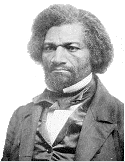
At today's meeting of Interfaith Communities United for Justice and Peace (ICUJP),  our President Steve Rohde read, in his booming lawyer's voice, the famous fiery speech that Frederick Douglas gave in Rochester, NY, on the 4th of July in 1852. Here's an account of this speech, which includes the interesting but little known fact that Quakers helped Douglass raise the money to gain his freedom:

Frederick DouglassFrederick Douglass (1817-1895) was the best known and most influential African American leader of the 1800s. He was born a slave in Maryland but managed to escape to the North in 1838.

He traveled to Massachusetts and settled in New Bedford, working as a laborer to support himself. In 1841, he attended a convention of the Massachusetts Antislavery Society and quickly came to the attention of its members, eventually becoming a leading figure in the New England antislavery movement.

In 1845, Douglass published his autobiography, "The Narrative of the Life of Frederick Douglass: an American Slave." With the revelation that he was an escaped slave, Douglass became fearful of possible re-enslavement and fled to Great Britain and stayed there for two years, giving lectures in support of the antislavery movement in America. With the assistance of English Quakers, Douglass raised enough money to buy his own his freedom and in 1847 he returned to America as a free man.

He settled in Rochester, New York, where he published The North Star, an abolitionist newspaper. He directed the local underground railroad which smuggled escaped slaves into Canada and also worked to end racial segregation in Rochester's public schools.

In 1852, the leading citizens of Rochester asked Douglass to give a speech as part of their Fourth of July celebrations. Douglass accepted their invitation.

In his speech, however, Douglass delivered a scathing attack on the hypocrisy of a nation celebrating freedom and independence with speeches, parades and platitudes, while, within its borders, nearly four million humans were being kept as slaves:

What to the American slave is your Fourth of July? I answer, a day that reveals to him more than all other days of the year, the gross injustice and cruelty to which he is the constant victim. To him your celebration is a sham; your boasted liberty an unholy license; your national greatness, swelling vanity; your sounds of rejoicing are empty and heartless; your shouts of liberty and equality, hollow mock; your prayers and hymns, your sermons and thanksgivings, with all your religious parade and solemnity, are to him mere bombast, fraud, deception, impiety, and hypocrisy - a thin veil to cover up crimes which would disgrace a nation of savages. There is not a nation of the earth guilty of practices more shocking and bloody than are the people of these United States at this very hour.


http://www.historyplace.com/speeches/douglass.htm

Fortunately, American still has voices willing to speak out like Frederick Douglas against the hypocrisy of our Fourth of July hoopla. Shahid Buttar is a civil rights lawyer, hip-hop MC, independent columnist, grassroots community organizer, singer and poet. Professionally, he directs a program combating racial & religious profiling at a non-profit legal advocacy and educational organization representing the American Muslim community.

Our only hope for change is to be honest about what is really happening in our country and in the world, and then do what we can to live up to our highest ideals. This, for me, is what ICUJP is all about.

What Do We Celebrate this July Fourth? July 4, 2012 by

http://www.constitutioncampaign.org/blog/wp-content/uploads/2012/07/statue-of-liberty-crying315.jpegWhen the United States championed democracy, freedom, and opportunity, it made sense to celebrate the Fourth of July. But are we still promoting those values? If we are paragons of neither opportunity nor freedom, what exactly do we celebrate today?
 
Our Statue of Liberty bears an inscription welcoming the world’s “tired and poor…huddled masses yearning to breathe free.” Our open arms which once greeted strangers (on whose backs our country was built), however, have been replaced by laws like Arizona’s SB 1070, copycat laws around the country, and the recent Supreme Court decision upholding provisions that encourage racial profiling.
Liberty itself is a fading memory, a lyric in an anthem that few Americans today understand, even as millions sing it at sporting events and during today’s holiday.
Robert Samuelson’s Is the U.S. a land of liberty or equality? reviews a duality within America’s political culture. Samuelson writes that “Americans’ self-identity springs from the beliefs on which this country was founded,” including values of equality and liberty that often stand in tension. He correctly notes that “in today’s politically poisoned climate, righteousness is at a premium and historical reality at a discount,” which in turns helps “explain[] why love of country has become a double-edged sword, dividing us when it might unite.” While Samuelson’s observation of political dysfunction is compelling, his analysis is flawed. It examines a conflict between two values, neither of which is visible in today’s United States.

Samuelson first addresses equality, reflected in our repudiation of aristocracy. Whereas “[i]n most societies, people are marked by where they were born….[Americans are united in] belief that no one is automatically better than anyone else simply by virtue of birth.”
As an immigrant, brought to the US to pursue freedom and economic opportunity unavailable in the land of my parents’ birth, I deeply appreciate this history. But we must recognize it as historical, rather than contemporary.

Birth doesn’t matter in America? Tell that to Steve Forbes, or the late Ted Kennedy, or other politicians who coast to office on the heels of familial wealth or reputation. Writing alongside Samuelson in the Washington Post, Harold Meyerson notes that:
As to economic equality and the political equality with which it is inextricably intertwined, the picture is bleak. The mega-banks that plunged us into deep recession have had the political power to forestall their breakup. A handful of billionaires continues to donate unprecedented sums to election campaigns. The share of national income and wealth [secured by] the vast majority of Americans continues to decline.
Opportunity is not the only value that we’ve resigned in recent years. America’s reputation as the “land of the free” has also faded, withering under a bipartisan consensus since 9/11 that federal authority to protect national security must trump individual rights, as well as checks & balances on executive power.

The American vision of liberty that brought democracy and human rights to the world has dimmed, clouded by executive secrecy (demonstrated by Samuelson’s and Meyerson’s colleague Dana Priest and researcher William Arkin), torture with impunity, assassination without trial, pervasive dragnet surveillance, and unapologetic racial & ethnic profiling pervading the wars on drugs, terror, and immigration.

We may remain a land of many things, but freedom is not among them.
Mass incarceration has decimated minority communities, creating a humanitarian crisis apparent in the overwhelming proportion of the world’s prisoners held on our shores.
Congress authorized the National Security Agency in 2008 to secretly capture and datamine all your emails and phone calls, and now prepares to extend that power again this year. A law signed by President Obama on New Year’s Eve gives the military authority to kidnap and detain any American without trial. Congress had already given the Pentagon power to withhold evidence of its human rights abuses.

Meanwhile, the line between military and police is blurring, as SWAT teams, aerial drones, armored personnel carriers, and fusion centers transform local police departments from public safety agencies into a militarized occupation force deployed across the country.
Never in human history has a state enjoyed such unfettered access to the minds of its subjects (ahem, citizens). And rarely in our nation’s history have agencies, and the officials who command them, wielded such dramatic power.

Information omniscience, combined with the authority to monitor, detain, torture or kill at whim — each of which has been the object of bipartisan consensus across the Bush & Obama administrations — will be a terrifying combination when those powers inevitably fall into the hands of less conscientious leaders.

Between the liberty and equality values that have long contended for our nation’s legacy, we have managed to lose both. Having forgotten the ideals that once defined our nation, what do we celebrate this Fourth of July? This is no time to merely sing the national anthem, or mouth empty slogans about freedom. This is a time to take action to restore the promise of liberty our Founders attempted, by writing our Constitution, to bequeath to us.

Our flag is still there. But where is the nation it once inspired?


Wednesday, July 4, 2012

Celebrating Interdependence Day

It's been three years since I started this blog on what I called "Interdependence Day." I was still grieving for the loss of my beloved wife Kathleen, but I was also looking forward hopefully to a new chapter of my life--one in which I could devote myself full-time and wholeheartedly to peace and justice in a way that would honor my wife's memory.  I am grateful to God that I have had this opportunity and to be joined in this work by my new wife Jill, who is also deeply committed to peace and justice. Together we have become a dynamic duo!

As I reflect on this year's 4th of July, a time in which our country still spends more of its resources on war and prisons than on education and health care, I feel it is fitting to honor those who have truly stood for freedom and peace.

I want to begin by honoring the Quakers who, in 1776, came to unity that it was un-Christian to own slaves and that any Quaker who owned slaves would be disowned by the Religious Society of Friends. A year earlier, Quakers in Philadelphia formed the first abolitionist society. These are events that deserve to be more widely known and celebrated.

I also want to honor my dear friend Stephen Longfellow Fiske, a gifted singer/songwriter who wrote this beautiful "Earth Anthem" to the tune of "The Star-Spangled Banner," transforming a song about "bombs bursting in air" to a song about the "clear skies of freedom":

Earth Anthem
O say can we see
by the one light in all
our Earth to embrace
at the call of all nations
where our children can play
in a world without war
where we stand hand in hand
in the grace of creation
where the rivers run clean
through the forests of green
where the cities stand tall
in the clear skies of freedom
O say do our hearts sing
for harmony and love forever
on the planet of our birth
blessed with peace on Earth. (See http://www.fiskemusic.com/earthanthem/)

Thirdly, I want to honor Stephen Rohde, president of ICUJP and one of the founders of Progressive Jewish Alliance. During the dark days of  the Bush ear, this fearless Constitutional lawyer and activist wrote this powerful response to the escalating "war on terror" which was read  at the ICUJP Rally in Support of the National Moratorium to Stop the War on Iraq (March 5, 2003). Sadly, what he says about Bush's foreign policy and human rights record applies also to the Obama administration:
 
A New Declaration of Independence
from King George W. Bush

227 years ago, faced with a tyrant named King George, the American people declared their independence.

Today faced with another tyrant named George, who acts like a King, the people must once again declare our independence.

We reaffirm that all men and women are created equal. That we are endowed with certain unalienable Rights, including Life, Liberty and the pursuit of Happiness.

That to secure these Rights, Governments are instituted among Men and Women deriving their just powers from the consent of the governed.

That whenever any Form of Government becomes destructive of these ends, it is the Right of the People to alter or to abolish it.

When a long train of abuses and usurpations evinces a design to reduce the People under absolute despotism, it is their right, it is their duty to throw off such Government and to provide new Guards for their future security.

The history of the present King George is a history of repeated injuries and usurpations, all having in direct object the establishment of an absolute Tyranny

This King George has detained citizens and non-citizens alike, incommunicado, without charging them with any crimes and without affording them the right to legal counsel.

This King George has eavesdropped on suspects consulting with their attorneys.

This King George has entered homes and offices for unannounced "sneak and peak" searches.

This King George has authorized his FBI to seize personal records from libraries and bookstores.

This King George has reinstated Cointelpro to resume the infiltration and surveillance of domestic religious and political groups.

This King George has banned the press and public from all deportation hearings.

This King George has recruited Americans to spy on citizens and non-citizens alike.

This King George lured students and visitors from predominately Muslim nations to submit to special INS registrations and then rounded them up and held them in detention, without access to their lawyers and families.

This King George has empowered Admiral John Poindexter to invade the privacy of all Americans by collecting their telephone records, credit card records, medical records and e-mail messages.

This King George has ordered his Justice Department to design new laws stripping Americans of their U.S. citizenship.

This King George has threatened those who object to his abuses that they are only aiding the terrorist and giving ammunition to America's enemies.

At every stage of these Oppressions we have Petitioned for Redress yet we have been answered only by repeated injury.

A Prince, whose character is thus marked by every act which may define a Tyrant is unfit to be the ruler of a free People.

In all this, he has set the Bill of Rights aflame, leaving our sacred charter in ashes.

With a firm reliance on the Protection of Divine Providence and Human Rights, we mutually pledge to each other our Lives, our Fortunes and our sacred Honor.


(See icujp.org)

*******

Finally, I'd like to end on a positive note by honoring that dynamic duo of philosophic liberalism, Ariel and Will Durant. In  1945, they wrote something called the "Declaration of Interdependence" which captures the highest ideals of this time and is still relevant to our own--displaying a spirit of cooperation, tolerance and good will that is the essence of today's interfaith movement. The story of this amazing document is told at the Durants' website:

On April 8, 1944, Pulitzer Prize-winning philosopher Will Durant was approached by two leaders in the Jewish and Christian communities, Mr. Meyer David and Dr. Christian Richard, about collaborating on a project of social significance. Recalled Durant:
Dr. Richard and Mr. David came to me with suggestions to organize a movement, to raise moral standards. I talked them out of it, and suggested, instead, they work against racial intolerance. I outlined the argument, and proposed a Declaration of Interdependence. I thought the phrase was original with me, but found it had been used before -- however, only in regard to international political independence. I asked them to draw up such a Declaration, and promised to sign it if I liked it.

Durant, David, and Richard outlined their plans for the movement and drafted a declaration that represented their core beliefs. This document Durant called "A Declaration of Interdependence". In Ariel and Will Durant's dual autobiography, Will Durant expressed his reasoning for his recommendation:

Just as independence has been the motto of states and individuals since 1750, so the motto of the coming generations should be interdependence. And just as no state can now survive by its own unaided power, so no democracy can long endure without recognizing and encouraging the interdependence of the racial and religious groups composing it.


Here's what their Declaration of Interdependence says:


Human progress having reached a high level through respect for the liberty and dignity of men, it has become desirable to re-affirm these evident truths:

  • That differences of race, color, and creed are natural, and that diverse groups, institutions, and ideas are stimulating factors in the development of man;
  • That to promote harmony in diversity is a responsible task of religion and statesmanship;
  • That since no individual can express the whole truth, it is essential to treat with understanding and good will those whose views differ from our own;
  • That by the testimony of history intolerance is the door to Violence, brutality and dictatorship; and
  • That the realization of human interdependence and solidarity is the best guard of civilization.
  • Therefore, we solemnly resolve, and invite everyone to join in united action.
  • To uphold and promote human fellowship through mutual consideration and respect;
  • To champion human dignity and decency, and to safeguard these without distinction of race, or color, or creed;
  • To strive in concert with others to discourage all animosities arising from these differences, and to unite all groups in the fair play of civilized life.

ROOTED in freedom, bonded in the fellowship of danger, sharing everywhere a common human blood, we declare again that all men are brothers, and that mutual tolerance is the price of liberty.

Note: The Declaration of Interdependence was introduced into the Congressional Record on October 1, 1945 by Hon. Ellis E. Patterson. (If you'd like to sign on to this document, see http://www.willdurant.com/interdependence.htm)

Wednesday, June 27, 2012

Why Quakers did not celebrate the Fourth of July


The Missing Peace: The Search for Nonviolent Alternatives
in United States History
by James Juhnke and Carol Hunter,
 (2004) discusses the nonviolent approach of the Quakers
during the American Revolution
As a child, I loved the Fourth of July and look forward each year to going to the fireworks display at Nassau Stadium in Princeton. But when I grew up and became a Quaker, I began to question  the pervasive violence of July 4th--the orgy of fireworks that makes some parts of our cities seem like war zones. When I hear the line "Bombs bursting in air gave proof through the night that our flag was still there," I don't think of the British attacking Washington, DC; I think of Hiroshima, Dresden, the carpet bombing of Vietnam, and the drones that now are permitted to kill anyone, anywhere in the world, as long as our President gives his imperial seal of approval. That's why I never stand up for the National Anthem.

As the Fourth of July approaches, it is worth noting that Quakers did not celebrate this holiday, and it cost them dearly:

"The First official Fourth of July celebration did not happen until 1781, but on July 4th, 1776 there was some celebration in Philadelphia (Wood 121-122). In 1777 there were more celebrations than that of the first year (122). That day was also marked by violence. That year some homes of the Quakers were vandalized because others believed the Quakers were not patriotic because they did not celebrate the Fourth of July (122). The Quakers did not celebrate the Fourth of July because of their religious beliefs (122). Quakers did not “celebrate holidays that commemorated military victories” (122). http://americanwiki.pbworks.com/w/page/12595391/The%20Fourth%20of%20July


We are a nation that imagines itself to be peaceful, yet is the "largest purveyor of war in the world," as Martin Luther King once said, referring to the US arms trade (where we are still number 1). Americans believe passionantely in the myth of redemptive violence, and equate freedom with violence, because we imagine our nation could not have become free without a bloody revolution.

The Quakers in Philadelphia believed otherwise. They sent emissaries to negotiate with the British. They refused to accept tea that had been taxed, but instead of throwing it into the Delaware River, they quietly paid the British merchants to take it back to England. They did what they could to avoid war, and I believe the Quakers were right.

The example of Canada and Australia show that it was possible to achieve independence without bloodshed. It took time and patience, and I'm sure, a bit of cunning, but think of all the lives that were saved.

The Quaker historian and theologian Howard Brinton once wrote an article called "What If," imagining what might have happened if the Quaker emissaries had been successful and the Americans hadn't fought the British. We cannot know for sure how history might have unfolded absent "the shot heard round the world," but Brinton imagines the world might have been more peaceful if the Americans and British had stayed on more congenial terms. Perhaps slavery could have been abolished without a Civil War. And perhaps the Germans would not have launched the Great War if the English and Americans were more closely allied. One thing I know for certain: Francis Scott Key would never have written a national anthem about "bombs bursting in air."

Another thing I know for certain: my fellow countrymen have strayed far from the teachings of the one who said,  "The truth will set you free."

I am grateful to Lowell Noble, author of "From Oppression to Jubilee Justice," who recently wrote a meditation on the Fourth of July that speaks to me as a Quaker. I make it a practice never to say the "Pledge of Allegiance" or sing the "Star-Spangled Banner" because I have already pledged allegiance to a higher authority, the Prince of Peace.


 A Fourth of July Meditation on the Pledge of Allegiance

by Lowell Noble

What does "one nation, under God" do? It provides "liberty and justice for all" its citizens. This remarkable phrase "with liberty and justice for all" is a concise and precise summary of both the Jubilee/Sabbatical laws (Lev. 25) and the New Testament kingdom of God (Isa. 9:6-7; 61:1-4; and Luke 4:18-19).

 The famous cracked Liberty Bell has this biblical inscription: "Proclaim liberty through all the land unto all the inhabitants." The full message of the Jubilee ties liberty (freedom for the poor and oppressed) with doing justice (restoring land to the poor). The Liberty Bell precedes the Pledge by 140 years. Both the Liberty Bell (1752) and the Pledge (1892) emphasize the same point---liberty---, as does the Declaration of Independence (1776)---"Life, Liberty and the Pursuit of Happiness." But only the Pledge specifically ties liberty and justice together. If I were given permission to change one word in the Declaration, I would make the following change: "Life, Liberty and the Pursuit of Justice."

 What would the priorities be of one nation, under God, that pursues justice; the needs of the poor and oppressed, widows and orphans, immigrants and ethnic groups (our equivalent to the despised Samaritans and Gentiles). Pure religion, according to James, is reaching out to oppressed and neglected widows and orphans. Contrary to the practice of the Pharisees, one nation, under God, does not "neglect justice and the love of God." (Luke 11).

 Are we, as Americans "neglecting justice and the love of God" or are we pursuing "justice and the love of God" as Job did (Job 29:12-17; NIV and Noble paraphrase):

I rescued the poor who cried for help
and the fatherless who had none to assist him;
The man who was dying blessed me;
I made the widows heart to sing
I put on righteousness as my clothing;
justice was my robe and turban.
I took up the case of the immigrant
I broke the fangs of the oppressor.

If Job were living today, he might add:

I will stop unjust mass incarceration.
I will organize the church to close the racial wealth gap.

A nation of Pharisees would emphasize justice and the law of God---a legalistic justice. A nation under God would emphasize justice and the love of God---a loving justice.