Wednesday, January 28, 2015

Do we Americans care more about stray animals than homeless people?

When we did the homeless count this year in Pasadena, I noticed that seven homeless people were sleeping in front of the posh SPCA Animal Shelter near Central Park. It seemed ironic that animals were being sheltered in a warm, safe place while human beings were out in the cold. What’s wrong with this picture?
During a recent meeting of my interfaith spiritual practice group, we talked about how people are more likely to take in stray animals than stray people. You often hear heart-warming stories of families who’ve provided a home for dogs or cats that have been abused, or are starving. Seldom do we hear stories of Americans opening their homes to homeless people.
My wife and I are the exception: we took in a stray kitten and homeless person, and we feel very fortunate and blessed to have done so. The kitten turned out to be an excellent mouser (we call her Dr Pepper) and she keeps our yard and house mouse-free. The homeless man who now resides with us was sleeping in his car and almost died of pneumonia two years ago. We invited him to recuperate and he now lives in our back house. He is an excellent handyman and does odd jobs for us (for which we pay him). He also takes care of our home when we travel. Having him as our guest is a win-win. 
History shows that Americans are more inclined to show compassion to animals than to people, even children. Societies for the Prevention of Cruelty to Animals were founded before Societies for the Prevention of Cruelty to Children. John Myers explains how organized child protection began in the United States:

Organized child protection emerged from the rescue in 1874 of nine-year-old Mary Ellen Wilson, who lived with her guardians in one of New York City's worst tenements, Hell's Kitchen. Mary Ellen was routinely beaten and neglected. A religious missionary to the poor named Etta Wheeler learned of the child's plight and determined to rescue her. Wheeler consulted the police, but they declined to investigate. Next, Wheeler sought assistance from child helping charities, but they lacked authority to intervene in the family. At that time, of course, there was no such thing as child protective services, and the juvenile court did not come into existence for a quarter century. Eventually, Wheeler sought advice from Henry Bergh, the influential founder of the American Society for the Prevention of Cruelty to Animals. Bergh asked his lawyer, Elbridge Gerry, to find a legal mechanism to rescue the child. Gerry employed a variant of the writ of habeas corpus to remove Mary Ellen from her guardians. 12 Following the rescue of Mary Ellen, animal protection advocate Henry Bergh and his attorney Elbridge Gerry lamented the fact that no government agency or nongovernmental organization was responsible for child protection. Bergh and Gerry decided to create a nongovernmental charitable society devoted to child protection, and thus was born the New York Society for the Prevention of Cruelty to Children (NYSPCC), the world's first entity devoted entirely to child protection. Gerry became president of NYSPCC and served in that capacity into the twentieth century. (http://www.americanbar.org/content/dam/aba/publishing/insights_law_society/ChildProtectionHistory.authcheckdam.pdf)

I am pleased that Pasadena is a city where many care deeply about homeless people as well as stray pets. Once a year hundreds of volunteers go around the city of Pasadena and survey  those who living on the streets. The purpose of the survey is to identify the needs of the unhoused so we can apply for funds and provide needed services. Our city has excellent homeless services compared to many neighboring cities, and our homeless population has declined as a result of policies like Housing First, but there are still far too many people on the street. Here are some statistics:

 According to The City of Pasadena 2012 Homeless Count, on a given night there are more than 900 homeless adults and children who are either sleeping on the streets or in a residential program that serves homeless persons;

According to 2010 U.S. Census data, there are more than 21,000 adults and children that make up nearly 8,000 households that have an annual income of $15,000 or less (The Network considers these households to be the-most-at-risk-to-homelessness).

Also, according to 2010 U.S. Census, approximately 19,000 14 percent of Pasadena residents were in poverty. Nineteen percent of related children under 18 were below the poverty level, compared with 13 percent of people 65 years old and over. Thirteen percent of all families and 23 percent of families with a female householder and no husband present had incomes below the poverty level.

Poverty is a stark and troubling reality in America that politicians seldom mention, and most Americans are in denial about. The wealthy keep getting wealthier, and their homes keep getting bigger, while the poor keep getting poorer and many are homeless. As homeless populations increased, the average size of American homes has doubled in the last 50 years. Most homeowners have far more space than they need. When we open our hearts, and our homes, to the poor, we could not only relieve their plight, we also save our souls and the soul of our city.
Jesus makes it clear in his parable of Lazarus and the Rich Man that helping the poor is not simply an option, it is a requirement if we want to enter the kingdom of heaven (in this life and in the life to come). The Book of Acts makes it clear that one of the top priorities of a truly Christian community is to end poverty and homelessness. (The other priority is to provide free health care to all.) The early Christian community is described as a place where “there were no needy persons among them. Those who owned properties or houses would sell them, bring the proceeds from the sales, and lay them at the apostles' feet, and they would be distributed to each as any had need.” In Act 4:34 it defines "believers" by their actions, not by their theological beliefs: "All those who had believed were together and had all things in common;  and they began selling their property and possessions and were sharing them with all, as anyone might have need.” Acts 2:45.

Ending poverty was not merely an ideal for early Christians, it was a clear demonstration of their living faith. We need to take to heart their example. We can end homelessness and poverty in America. Programs like Housing First show that ending chronic homelessness is not only doable, it is cost effective. We are a rich nation, and Pasadena is becoming an increasingly rich city We who have means have a moral obligation to put our faith into practice and end homelessness. Si, se puede! 

Monday, January 19, 2015

Dr. Jill Shook speaks out for justice at the IMA's Martin Luther King Day celebration


Yesterday my wife Jill, aka Dr. Shook, spoke at the Martin Luther King Day celebration at the Metropolitan Baptist Church in Altadena. This event was sponsored by the Interdenominational Ministerial Alliance (IMA), Pasadena's oldest association of African American Pastors. Even though Jill is not a pastor or African American, she has formed such a deep relationship with the African American community that she was entrusted with the responsibility to speak out on issues of social justice. (Jill has been involved with the IMA for over 17 years!) I am very proud of Jill and want others to be able to read  her important message, which is why I am including it in this blog The only other woman speaker at this event was Judy Chu, our local Congressional representative, who spoke out about the need to restore portions of the Voting Rights Act that was gutted by the Supreme Court, thereby enabling states like Texas to pass voter ID and other laws that have disenfranchised hundreds of thousands of people, many of them poor, people of color, the elderly, etc. The spirit of MLK was definitely present at this year's IMA event!

Here is the message that Jill shared:
       I grew up in lily white Orange County. Not one black attended any of my schools from Kindergarten through high school. Since embracing Christ as my Savior in high school, I have attended countless churches in many states and countries where I’ve lived and the color of most of these congregations are not much different than during in my school years, including some a number of the churches and schools here in Pasadena little to no diversity. In Ephesians 2 we are commanded by the love of Christ to break down this divide. 
Today I feel deeply honored to be here today to help bridge that divide. I have been a member of the Interdenominational Ministerial Alliance for over 15 years. I love these pastors and I feel genuine love from them. I am so much richer now by having African American friends. I want that same rich experience for everyone so that hearts across this nation will see the beauty, know the courage and feel love I have experienced by being part of this community.
But simply getting to know and love each other is only a start. A very important start, but not enough. Love dictates that we both seek to understand the issues that divide us and to break down those barriers.
As I began to research the history of US housing policy I was amazed at how racial covenants that disallowed people of color were prominte in Pasadena as well as red lining by the bank, preventing people of color from obtaining loans and mortgage insurance. When the 210 freeway sliced right through middle of a thriving African American business district hundred of family were displaced without sufficient money to replace their homes. These same policies affect every city across the US. The long shadows of those neighborhood patterns set years ago, continue today, perpetuating stereotypes, fears and unspoken dividing walls between NW and the rest of the city.
I will never forget the day that I was trying to make a left turn from Washington onto Fair Oaks and a funeral procession was passing. The signal changed about ten times before I could turn. I was first in line and could see the faces of each person who turned in front of me. Not one was white. I couldn’t imagine how someone could live their entire lives in Pasadena and not know one white person well enough to attend their funeral. But then I recall my own segregated upbringing and the more I come to know and love the African American community, I better understand some of the oppressive and unjust policies, the disenfranchisement and cultural dynamics that keep us divided.
Dr. King also spoke about signals. He said that, “There is nothing wrong with a traffic law which says you have to stop for a red light. But when a person is bleeding, the ambulance goes through those red lights at top speed… Disinherited people all over the world are bleeding to death from deep social and economic wounds. They need brigades of ambulance drivers who will have to ignore the red lights of the present system until the emergency is solved.”[i]
Right now our nation is bleeding. The hemorrhage needs to stop. Dr. Martin Luther King has demonstrated to us that it can be stopped, Fair housing and Civil rights laws can be passed. Just as Jesus and MKK stood with the most vulnerable in our city, today the IMA is standing for justice.  With the love of Christ and the power of God and community we can change these very systems that are broken. Those standing with the police shooting of unarmed Michael Brown have helped bring to light a blind spot in our nation. We need God’s light to bring changes to police policies and culture. Like people across the nation standing with the people of Ferguson I thank God for the IMA’s willingness to stand with the family of Kendric McDade.
In 2012, Kendric McDade, a 19 year old black man was shot seven times by the Pasadena police with all their surveillance equipment turned off.  To prevent this from happening again, over the past year, the IMA has played a key role in the Coalition for Increased Oversight of the Pasadena Police (CICOPP). In this group’s research they have concluded that the best plan to prevent these unnecessary shootings if is for the city to hire a police auditor. Please turn to page ___ in your programs and take time read more about IMAs involvement in this and other justice concerns, for example, the PUSD adopt a school program, support for a Housing Commission to increase the number of affordable housing units and support the nurses at Huntington Hospital to organize so they can provide better patient care.  Please consider how you can play a supporting role, perhaps call you council representative, organized other in your church to so.  And as you leave today, please take time to talk with those in the back supporting the nurses. I want to know if you are a nurse or know a nurse. Please raise your hand. Now I ask that you stand with me for the nurses in our city.
To honor Dr. Martin Luther King and stand with his commitment a spirituality that led to non-violent social change, I ask you again stand with me now if you support real change in police oversight. 
In closing I want to say that I am also very proud of the IMA for being listed among those on lawsuit to make public the independent review of what happened that night that Kendric was shot. For this full report to be released, God will need to move in many hearts. Pastor A.K. Brown, who has been the pastor for Anya Slaughter, the mother of Kendric McDade since she was three, will close my time with a very brief prayer the courage and wisdom for IMA to continue to stand strong on the side of justice.

Saturday, January 17, 2015

WWKD? What would King do?


How terrible it will be for you! You build monuments for the prophets, and it was your ancestors who killed them! Luke 11:47

On this day honoring Rev Dr Martin Luther King, one of America’s great prophets, I think of this quotation from Jesus which we recently pondered in our neighborhood Bible study. Invited to dine with the religious elite, Jesus challenged the hypocrisy of those who liked to quote the prophets but lived in complicity with the Roman empire. Today many religious leaders and politicians like to memorialize King with platitudes about the American dream but carefully avoid mentioning the “radical revolution of values” which Rev King advocated.
Jesus’ quote is also apt because many (including Martin Luther King’s family) believe that King was assassinated with the complicity from the US government because of his views on Vietnam and economic justice.
So on this special day I’d like to honor those I feel are truly living in the spirit of MLK.

 Those who are advocating for police oversight. In his sermon at Riverside Church (1968), King made himself very unpopular in government circles with this statement: “I realized I could never again raise my voice against the violence of the oppressed in the ghettos without having first spoken clearly to the greatest purveyor of violence in the world today - my own government.” Those in power don’t like to be reminded how state power is being abused by the police and the military. For this reason, I’d like to lift up local efforts to provide oversight for the police in Pasadena and other parts of the country. Here in Pasadena Kris Ockhauser, Michelle White and others have started the Coalition for Increased Civilian Oversight of Pasadena Police (CICOPP).  which is advocating for an independent “Police Auditor” to investigate charges of police misconduct and report directly to the City Council. The Interdenominational Ministerial Alliance, a coalition of black pastors (including my wife Jill, who is neither a pastor nor black!), has joined the ACLU, NAACP and others calling for the full disclosure of an independent report about the police killing of Kendrec McDade, an unarmed 19-year-old African American. (The Pasadena Police Union is fiercely fighting to prevent this report from being made public and is doing its utmost to influence religious leaders.) Jill will be speaking about the need for police oversight at the IMA Martin Luther King event on Sunday. King would be pleased: he was always on the side of those who want accountability for those who wield power!

Those who are advocating for systemic change to end homelessness. Given the obscene disparities of wealth and the history of oppression, King felt that more than charity was needed:  True compassion is more than flinging a coin to a beggar; it is not haphazard and superficial. It comes to see that an edifice which produces beggars needs restructuring.” King would be pleased by efforts not simply to alleviate homelessness with shelters and feedings, but to end homelessness through affordable housing and programs like Housing First.  

Those who are working for a living wage. King came to realize that we need to do more than simply provide equal opportunity for all people, we also need to address systemic economic injustice: ”We are on the side of the wealthy and the secure while we create hell for the poor.” Here in Pasadena, Francisco Garcia and others are leading a coalition to bring a living wage ordinance, similar to the one that Mayor Garcetti is proposing for Los Angeles. This is a small, but much needed step towards alleviating poverty.

Those who are opposing militarism. King realized that we couldn’t end poverty as long as half of our taxes went to support war: “A nation that continues year after year to spend more money on military defense than on programs of social uplift is approaching spiritual death.” I especially want to lift up Interfaith Communities United for Justice and Peace which was founded after 9/11 and works tirelessly to end war and torture, and has as its slogan: "Religious Communities Must Stopping Blessing War and Violence." One of the founders of our organization was Rev James Lawson, who helped teach Dr. King the nonviolent methods of Gandhi.

The phrase "What would Jesus do?" (often abbreviated to WWJD) became popular in the United States in the 1990s as a personal motto for adherents of Evangelical Christianity. For Christians who care about the Prince of Peace, I’d like to suggest “WWKD?” (“What would King Do?”) as a motto for those seeking to live in the spirit of Dr. King. For example would Martin Luther King be pleased by the presence of the military bands and units in a parade supposedly honoring him? This is what happens every year in Los Angeles, and probably other parts of the US as well.  (See http://articles.latimes.com/2003/jan/21/local/me-king21). King’s radical message of peace and justice has been watered down, whitewashed and “neutered” (a word used by Randy Christopher, Director of Pasadena’s Pace and Justice Academy). I am grateful for those who truly understand the spirit of King and speak out prophetically, as did several teenagers at the Martin Luther King event in Pasadena two years ago. At that time, I wrote the following blog entry:
Madeline Cameron, a 16-year-old high school student from the Pasadena Peace and Justice Academy…spoke about Martin Luther King's commitment to peace, his courage in speaking out against the Vietnam war, and how we have been embroiled in wars in Iraq and Afghanistan that have cost countless lives and taken money away from needed social programs. She also brought up the infamous wall separating the United States and Mexico, and how US economic policies have left Mexican farmers destitute and forced many to come here to earn a liveliness. She spoke with great feeling of the hundreds who have died trying to cross the border to find work in the United States.
She spoke from the heart, and with real knowledge, about issues that Dr King would cared deeply about.
"She truly understands Dr. King," I thought, my eyes brimming with tears. http://laquaker.blogspot.com/2013/01/a-prophetic-word-from-sixteen-year-old.html http://laquaker.blogspot.com/2013/01/a-prophetic-word-from-sixteen-year-old.html
I am pleased that I now teach “Faith Studies” at the Peace and Justice Academy, a school that seeks to embody the spirit of King, Gandhi and Jesus. What a blessing it is to share the radical gospel of King and Jesus with the rising generation!

PS All of the quotes in red from Dr. King were read to my middle school class at the Peace and Justice Academy. After we read these quotes aloud, a twelve-year-old said, "Is that why they killed him?" It was clear to him that challenging the war system in America could get you killed!

Wednesday, December 17, 2014

Wishing you a very merry green Christmas!


Dear Friends,


In addition to wishing you a "green Christmas" (see below), we'd like to share with you some of the highlights of our year. As those of you who read my blog know, our most recent joint project has been "greening our home." Our hope has been to set an example and encourage others to go green and advocate for green policies. A week ago Jill and I had a "green Christmas" party which over 50 people attended.  Steve Scauzillo, a journalist for the Pasadena Star News who is deeply committed to environmentalism, heard about our green initiative and decided to feature us in his weekly column. He interviewed us and wrote a lovely article about the faith basis of our project which you can read about by clicking here: Steve Scauzillo's article

Here is a holiday poem I wrote, commissioned by Jill, and our Christmas newsletter for 2014. Enjoy!


We wish you a very merry Christmas,
And a holiday that’s full of cheer.
This note is to let you know
That you are so very dear.
We’re dreaming of a green Christmas.
That is the kind we’d like to see:
Where the skies are clear
Throughout the year
And the  world is pollution-free.
In faith park come and rest.
See  how our garden’s blessed--
With bird and bee and butterfly
Descending from on high!
Come check out books for free
In our little library.
Drink water from our fountain.
Gaze up and see the mountains.
Come chat with us a while.
Your stories make us smile.
As we cruise down the street
In our electric hybrid car,
We’re a little like the ones
Who followed yonder star
Foretelling peace on earth….
We’re grateful for the birth
Of the child who saved us all,
Creatures great and small.
May your year be full of peace
And joys that never cease. 

Anthony: “Blessed are the peacemakers!” That phrase rang true for me when Jill and I began the year by attending a wonderful gathering of peace activists committed to ending war. This gathering at the Ben Lomond Quaker Center was organized by David Hartsough, one of the foremost Quaker peace activists of our time,  who is convinced (as I am) that we need to do our utmost to end the threat of war, just as people of faith once worked to make slavery illegal.

 This summer I became the clerk (coordinator) of the Pacific Yearly Meeting Peace Committee and published a new book called Transformative Quakers about Bill Lovett, Bob Vogel and Josephine Duveneck. (You can order the book via Amazon. See  Transformative Quakers) I was gratified by the enthusiastic reception this book received, and am grateful that Jill nudged and encouraged me to write a bio of Bill Lovett, who served three years in prison as a war resister in WWII and helped start Self-Help Enterprises to build affordable homes for farm workers.  I continue to work with Interfaith Communities United for Justice and Peace and with Friends Committee on National Legislation (FCNL). In November I attended Quaker Lobby Day along with 400 others in Washington, DC. This year we lobbied Congress to support diplomacy with Iran.

The family high point of the year was spending Easter with Jill and my Greek family on Andros, the Greek island where my father was born. What a joy it was to journey through Italy to Greece, my spiritual heart land, with Jill! It was also a joy to celebrate Thanksgiving with Jill’s family—her  delightful Mom and sister and many kids and grand kids. I feel blessed that I am part of such a loving family, and I thank God that I can dedicate my life to working for justice and peace with Jill as my partner!


Jill: As a catalyst, my greatest joy is connecting people with each other and with God. I stand amazed at how God weaves together every detail and expands this ministry in our home, our neighborhood, our city, as well as nationally and internationally. Despite my struggle with health issues, it blows my mind how God multiplies these efforts.  We serve an awesome God!
Home: This year God enabled us to lower our carbon footprint by 80%!! With the help of rebates, we’ve installed solar panels and replaced our turf with decomposed granite and mulch. We’ve also installed a gray water system to recycle water to our fruit trees—could this be one solution to California’s drought?  A article about the greening of our home was published in the local newspaper explaining how we seek to be good stewards of God’s creation.
Neighborhood: We’ve had neighborhood watch meetings, Bible studies, and lots of fun encounters through our new “Little Free Library.”  The police assigned to our area say the level of engagement in our “hood” doesn’t exist in others.
City: Because we live in a largely African American corner of Pasadena, we are keenly aware of the racial attitudes that affect police behavior. In the aftermath of Ferguson, I have reached out to the mother of a 19-year-old unarmed African American youth, shot seven times by Pasadena police two years ago. I am working with the churches to bring healing and more police accountability.
Also, after much prayer, a team is emerging with the local school district to consider a unique model of affordable homeownership for district employees on their surplus land—universities like Westmont and Harvard do this.
I continue with a city-sponsored Faith Committee to End Homelessness, as well as our Greater Pasadena Affordable Housing Group that among other things, has helped our city win an award for the best Housing Element planning document in the state of CA. We are  now negotiating with city leaders how to best assure this plan to house all citizens—including the homeless—is implemented.
State: In October I had the joy of going to Sacramento for a gathering  of 75 experts t convened by the Western Center on Law and Poverty to discern affordable housing policy priorities for 2015.

National: In September Anthony and I attended  Christian Community Development Conference (CCDA) in North Carolina. It was a joy to bond with a small group of folks from across the US on weekly conference calls (since February) to plan a Housing Symposium (looking at best practices) and an Action Tank (looking at policies to prevent housing displacement caused by increased housing cost) for the 3,000+ CCDA conference attendees. I  thank God for an emerging partnership between CCCA and Right to the City to curb housing displacement!
In June 2015, if enough students sign up, I will be teaching a two-week Master’s level course on Housing Justice in Denver, CO. Pray. Interested? We also get to attend my nephew’s wedding while there.
International: With considerable experience in book publishing, Anthony suggested we publish a Spanish translation of one chapter in my book: “Ownership, Land and Jubilee Justice.”  We plan to share this bilingual booklet at an international gathering of Latin American Quaker pastors and leaders in March, held in Mexico City.  God has  raised up a “read team” of Latinos enthusiastic about this project. Patricia, a local school teacher, Grecia from Guatemala and Josh, her boyfriend have been especially helpful. Not knowing how to begin this project, I hired someone who seems to have used google translate (translating just the words without fully understanding the concepts). As we comb through and correct the translation, we’ve  had many belly laughs over crazy syntax and words choices!

To nurture my soul this year I began a women’s group with key leaders and pastors in our city. They are a joy! Anthony and I also nurtured our souls in a little cottage on the Oregon coast while attending my friend Janet and Wayne’s incredibly meaningful Christ-centered wedding. While there I met a Portland, Oregon, pastor whose church members arrive on bicycles. We met with his staff who were reading and discussing my book!!

At Thanksgiving our family celebrates by performing “lip syncs.” Anthony and I wore lion T-shirts as we sang and danced Elton John’s “Circle of Life”…. So totally fun!!!


Friday, December 5, 2014

Lighting Candles in the Dark: Reflections on FCNL and Healing the Heart of Democracy

One of the spiritual high points of my year is going to DC to take part in Friends Committee on National Legislation (fcnl.org). For my ICUJP (icujp.org) reflection this morning, I’d like to share about FCNL, our keynote speaker Parker Palmer, and finally a couple of stories that give me hope.
California delegation at Senator Feinstein's office
First, it was a pure joy to be among over 400 activists, half of them non-Quaker, who care enough about the state of our society that they are willing to fly to DC to take part in influencing legislators. We made over 100 visits to Congressional offices in 41 states. For four days I got to hang out with amazing people, some of whom are old friends, and some I met for the first time and became old friends with fast. It was also a joy to see that FCNL has a staff of nearly 40 people, most of them under 30, who are committed and knowledgeable. What a delight it was to be among these young activists!
Katherine Philipson, FCNL staff
The heart of Quaker lobbying is the belief that “there is that of God in everyone,” including those we disagree with. During our training sessions we not only learn about issues and the complexities of the political scene in DC, we also learn about how to relate to elected officials who don’t share our views. How do we reach out to them, find common ground, and help create opportunities for meaningful change? We learn is that in order to change others, we must also be willing to listen and be changed. Parker Palmer, the keynote speaker at this year’s FCNL gathering, told us we need to have the hutzpah to believe we have something worth saying, and the humility to realize that our opponent also has insights worth listening to. To bring about real change, we need to listen as well as speak from the heart.
Image result for parker palmerParker Palmer used to be the dean at Pendle Hill, the Quaker study for study and contemplation near Philadelphia where I was a student in 1989. It was at Pendle Hill that I first got to know Parker as a remarkable Quaker educator. He has gone on to publish influential books on education, spiritual discernment, and most recently, politics. Trained in sociology, Parker began his career as a community organizer so politics is not something new. His latest book, entitled Healing the Heart of Democracy: The Courage to Create a Politics Worthy of the Human Spirit, looks at the current political malaise in our country from both a deeply human and a deeply spiritual perspective.
Parker is convinced that we must move beyond ideology and recognize our need to connect at a human level, if we hope to heal our deeply ailing democracy. We must be willing to disagree, to express our views with conviction, and yet not demonize the other. This is the guiding principle of Quaker lobbying. We take into consideration the pragmatic concerns of politics—what bill is likely to pass if there is enough pressure from constituents—but we are also concerned with building relationships that will last and grow over the long haul. FCNL has been doing faith-based lobbying since 1942; its long term goal is to transform a culture of violence into a culture of peace, one person at a time.
I need to keep being reminded of this perspective since I am apt to lapse into the “us” vs. “them” mentality that ultimately gets us nowhere.
I took part in a lobby visit to Feinstein’s office. There were over 30 people in our delegation, and we prepared carefully for our visit. We knew that Feinstein supported diplomacy with Iran, but we were surprised by how knowledgeable and committed her aide was to this position. I was supposed to ask him if he had any questions of us, but when my turn came, I said: “You know so much about the situation in Iran, maybe could you help give us some ideas of what we can do to support the Senator around this issue.” He gave us some excellent advice and talking points.

This kind of friendliness works even with those who disagree with us. A Texas Senator we met believes that war with Iran is probably inevitable, but after talking with us, he finally admitted, “When we are talking, at least we’re not fighting.” A Quaker tweeted this comment, which I think could become the next slogan for FCNL!
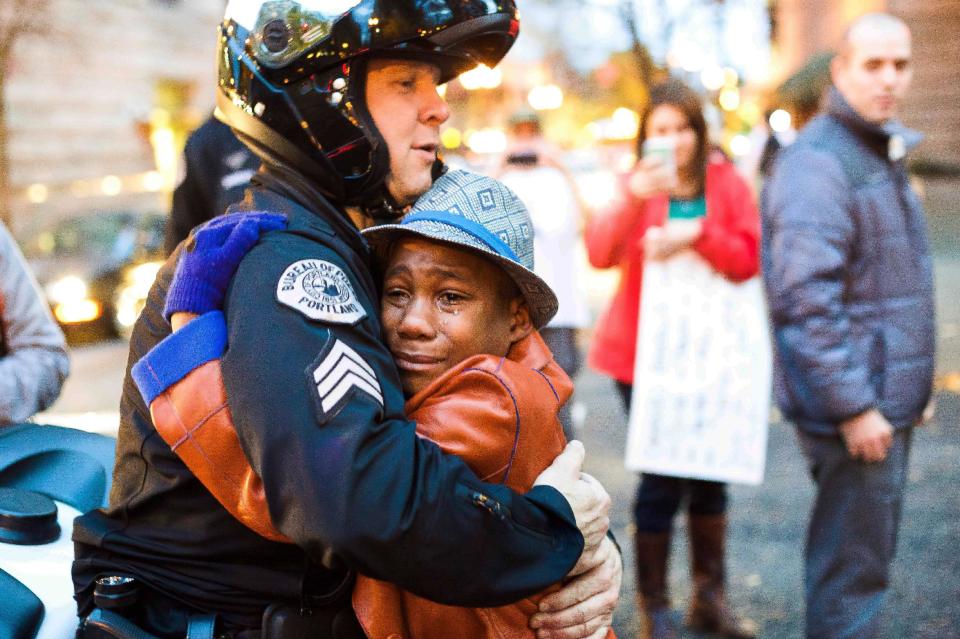
In this Tuesday, Nov. 25, 2014 photo provided by Johnny Nguyen, Portland police Sgt. Bret Barnum, left, and Devonte Hart, 12, hug at a rally in Portland, Ore., where people had gathered in support of the protests in Ferguson, Mo. (AP Photo/Johnny Huu Nguyen)
I’d like to close this reflection with some stories that give me hope. First, the story of Devonte Hart, a twelve-year-old African American kid from Portland, OR. Adopted by a white family, he became upset when he heard what happened to Darren Wilson and feared for his future as a black male. He wanted to do something positive so he decided to carry a sign that said “Free Hugs.” When he went with his parents to downtown Portland with this sign, he was spotted by a police officer named Barnum. Barnum noticed the boy was crying and wondered what was wrong. So he motioned for him to come up to his motorcycle.

The officer asked for his name and shook his hand. He also asked Devonte where he went to school (he is homeschooled), what he did this summer (he traveled around the U.S. with his family), and what he likes to do (art). The tears stopped.

Barnum has two teenage sons and has worked for Portland's police force for 21 years. While continuing to talk to Devonte, he looked at the "Free Hugs" sign on the ground and asked if he might get a hug as well.

Devonte put his arms around the officer. A photographer happened to be present and caught this moment digitally. The picture went viral on the social media. Barnum told reporters how much Devonte meant to him.

"Knowing how he struggled with police, his bravery and courage to catch my eye and approach me were impressive," Barnum said. "And it's a blessing for me that I didn't miss an opportunity to impact this child."

Barnum said the moment was about "listening to each other, facing fears with an open heart."

I was reminded of a similar story that occurred at the Quaker school in Ramallah, which was bombed by Israelis during the second Intifada. IDF soldiers ransacked the school and then began searching the homes of teachers. When one Israeli soldier knocked on the door of a teacher’s home, she let him in and asked if he would do her a favor.

“What kind of favor?” asked the young soldier.

“I have a four-year-old son who is terrified of Israeli soldiers,” she said. “He has never seen a Jewish person out of uniform and I think he is coming to feel that Jews aren’t human, they are some kind of robot. Would you mind going over to my child and talking to him and maybe shake his hand so he will know you are human.”

The young Israeli soldier was very moved and greeted the child warmly and soon was sharing about his family and his children.

Such stories speak to our deep human need to connect, heart to heart, to affirm our common humanity. These are the kinds of stories that my friend Janet Riley, who lives near Washington, DC, collected into a children’s book called “Lighting Candles in the Dark.” This book was translated into Russian and Chechen and is used to teach peace to kids. She hopes this book can be translated and used in many other languages. (See http://www.power-of-goodness.org/

In the 1980s Janet and I worked together on a joint Soviet-American book project called "The Human Experience." The purpose of this collection of poetry and fiction, which was edited and published in both countries, was to dispel stereotypes. Our work, and that of other citizen diplomats, helped to hasten the end of the Cold War. 


I hope that as we do our prophetic work, speaking truth to power, we remember the power of stories, and of love….the power that draws people together and reminds that each person is precious, made in the Divine image, and at the same time, all too human and in need of forgiveness and grace. Let us go forth and light candles in the dark!