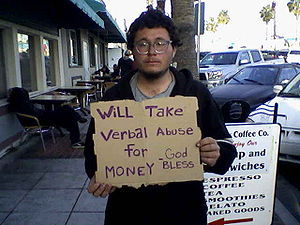
Our City Council is concerned about "aggressive panhandling" in the business district and wants to take steps to curb it. Some of their programmatic ideas are excellent. They are investing $250,000 in such things as an emergency shelter fund, rapid rehousing, a case manager at the library, cops specially trained to work with the homeless, etc. They are also aware of the need for permanent supportive housing and recognize that housing the homeless will eliminate most of the problems. But as an immediate response to a perceived crisis, the City is also looking to law enforcement and is considering "anti-camping" and anti-panhandling ordinances. Arresting, fining and jailing "aggressive" panhandlers might placate business interests, but I feel these measures will do little to solve the problem.
To deal with panhandling, we need to know who is panhandling, and why. Ideally, the City should survey the panhandlers in our City to find out more about them. Meanwhile I did some
online research and found articles that I think could help our City Council
come up with effective policies.
What is the profile of the typical
panhandler in San Francisco, how much do they make, and how do they spend their
money?
Conservatives like Stossel at Fox News and New York Post spread the idea that panhandlers are making lots of money and are using it mainly for drugs and alcohol. In an article called “Everything
you thought about panhandlers is wrong,” Scott Keyes gives the results of a survey of panhandlers conducted in San Francisco that shows this is simply untrue for the vast majority of panhandlers. Here’s the summary:
“In
San Francisco’s Union Square, the typical panhandler is a disabled middle-aged
single male who is a racial minority and makes less than $25 per day despite
panhandling seven days a week for more than five years. Though [Fox News
commentator] Stossel was insistent that panhandlers just use the money for beer
and pot, the majority of those surveyed did not. In fact, 94 percent used the
meager funds they raised for food.”
Of course,
panhandlers also use some of their money for alcohol, drugs and cigarettes,
just like other Americans do.
Is it better to give money to panhandlers
or to social service organizations?
Derek Thompson argues
it is better to give money to organizations that provide services for the
homeless rather than directly to panhandlers, which is basically true:
“The
upshot: The homeless often need something more than money. They need
money and direction. For most homeless people, direction means a job and a
roof. A 1999 study from HUD polled
homeless people about what they needed most: 42% said help finding a job; 38%
said finding housing; 30% said paying rent or utilities; 13% said training or
medical care.”
I
agree with Thompson but I have a caveat: suppose the City isn’t providing what
homeless and poor people need to survive, much less thrive. If there isn’t
enough housing, jobs, medical assistance, food, etc. shouldn’t a homeless
person have the right to ask for help through panhandling? It may not be the
best solution, but in some cases, it’s necessary. Take, for instance, my friend
Melissa who received $900 in SSI, which was not enough for rent, much less
food. She had to panhandle for food and rent.
As the Toronto study cited below indicates, there sometimes aren’t enough funds for housing and social services
to insure that very low income people get the food and housing they need. Some
low-income people have to supplement what they receive in social services with
some other income source, like panhandling, recycling or doing odd jobs. Here’s
how a Canadian study addresses this question:
Do panhandlers like panhandling and do
they need the money? How do they use it?
A Toronto study
indicates that 70% of panhandlers would prefer a job (even a minimum wage job) and those who
panhandle and live in apartments would probably be on the street if they didn’t
panhandle:
“In
conclusion, the majority of panhandlers in Toronto are homeless and living in
extreme poverty. We found that the amount of money panhandlers spend on alcohol
and illicit drugs is significant, but much lower than some have suggested. The
health effects of a loss of panhandling income are uncertain, because
panhandlers might reduce their food intake, reduce their substance use or find
other sources of income. For the one-fourth of panhandlers who rent a room or
apartment, however, any loss of income could easily lead to homelessness.
Future studies of panhandlers should attempt to verify income and spending
patterns objectively and examine differences in these variables by sex, housing
status and health status.”
http://www.ncbi.nlm.nih.gov/pmc/articles/PMC121964/
How much do panhandlers make?
I was intrigued to read this article by a formerly homeless
person. Based on her informal survey, she estimates around $10 – 100 per day. This is anecdotal, but interesting
because it gives a picture of what panhandlers are like in California.
Aggressive Panhandling: A police policy
perspective
This is the most detailed
and comprehensive study I’ve found, from a website called “Center for
Policy-Oriented Policing.” http://www.popcenter.org/problems/panhandling/print/  It deals with a whole range of issues, including
best practices for police. This is a “must read” for policy makers. This
passage suggests that police need to be trained to be thoughtful in enforcement
of aggressive-panhandling laws by knowing the street culture. This study assumes that panhandlers are not
mentally ill and acting out, but rational individuals trying to survive by
panhandling.
It deals with a whole range of issues, including
best practices for police. This is a “must read” for policy makers. This
passage suggests that police need to be trained to be thoughtful in enforcement
of aggressive-panhandling laws by knowing the street culture. This study assumes that panhandlers are not
mentally ill and acting out, but rational individuals trying to survive by
panhandling.
Police need not heavily enforce aggressive-panhandling laws in
order to control panhandling; the informal norms among most panhandlers
discourage aggressive panhandling anyway.75 Panhandlers
exercise some influence over one another's behavior, to minimize complaints and
keep police from intervening.76 Enforcing
aggressive-panhandling laws can serve to reinforce the informal norms because
aggressive panhandling by the few makes panhandling less profitable for others.77
Enforcement Responses
Whether or
not you emphasize enforcement of laws that regulate panhandling, it is
important that the laws be able to survive legal challenge. Police should have
valid enforcement authority to bolster other responses they use, including
issuing warnings to panhandlers.60 Laws that
prohibit aggressive panhandling or panhandling in specified areas are more
likely to survive legal challenge than those that prohibit all panhandling. If
enforcement of panhandling laws will be a key component of your strategy, and
if you think the panhandling laws you rely on are vulnerable to legal challenge
(or if you want to draft a new panhandling law), you should consult legal
counsel to help you draft and propose new legislation. There are a number of
model panhandling ordinances61 and legal
commentaries on the constitutionality of panhandling laws62 in the
literature. See Appendix A for a list and brief summary of some of
the leading cases on the constitutionality of panhandling and laws that
regulate it.
Warning
panhandlers and ordering them to ”move along“ are perhaps the most common
police responses to panhandling.63 Many police
beat officers develop working relationships with regular panhandlers; they use
a mix of formal and informal approaches to keeping panhandling under control.64 Most officers
do not view panhandling as a serious matter, and are reluctant to devote the
time necessary to arrest and book offenders.65 Moreover, even
when they have the authority to issue citations and release the offenders, most
officers realize that panhandlers are unlikely to either appear in court or pay
a fine.66 Prosecutors
are equally unlikely to prosecute panhandling cases, typically viewing them as
an unwise use of scarce prosecutorial resources.67
Panhandler arrests are rare,68,† but
when they occur, this is the typical scenario: An officer issues a panhandler a
summons or citation that sets a court date or specifies a fine. The panhandler
fails to appear in court or fails to pay the fine. A warrant is issued for the
panhandler's arrest. The police later arrest the panhandler after running a
warrant check during a subsequent encounter. The panhandler is incarcerated for
no more than a couple of days, sentenced to time already served by the court,
and released.69
† Goldstein (1993) estimated that
police made arrests for panhandling in only about 1 percent of all police/panhandler
encounters.
Because
prosecutors and judges are unlikely to view isolated panhandling cases as
serious matters, it is advisable to prepare and present to the court some
background information on panhandling's overall impact on the community. A
problem impact statement can help prosecutors and judges understand the overall
negative effect the seemingly minor offense of panhandling is having on the
community.70 In the United
Kingdom, police can apply to the courts for an ”antisocial behavior order“
against individuals or groups as one means of controlling their persistent
low-level offending.71Violations of the
orders can result in relatively severe jail sentences.† It is unknown
how effective the orders have been in controlling panhandling.
† British antisocial behavior orders
are similar in some respects to American restraining and nuisance abatement
orders.
1. Prohibiting
aggressive panhandling. Laws that prohibit aggressive
panhandling are more likely to survive legal challenge than laws that prohibit all panhandling, and are therefore to be
encouraged.72 A growing
number of jurisdictions have enacted aggressive-panhandling laws, most within
the past 10 years.†† Enforcing aggressive-panhandling laws can be
difficult, partly because few panhandlers behave aggressively, and partly
because many victims of aggressive panhandling do not report the offense to
police or are unwilling to file a complaint. Police can use proactive enforcement
methods such as having officers serve as decoys, giving panhandlers the
opportunity to panhandle them aggressively.73 Some agencies
have provided officers with special legal training before enforcing
aggressive-panhandling laws.74 Enforcing
other laws panhandlers commonly violate—those regarding drinking in public,
trespassing, disorderly conduct, etc.—can help control some aspects of the
panhandling problem.
†† Among the jurisdictions to have
enacted aggressive-panhandling laws are the states of Hawaii and California,
and the cities of San Francisco; Seattle; Minneapolis; Albuquerque, N.M.;
Atlanta; Baltimore; Cincinnati; Dallas; Tulsa, Okla.; and Washington, D.C.
Police need not heavily enforce aggressive-panhandling laws in
order to control panhandling; the informal norms among most panhandlers
discourage aggressive panhandling anyway.75 Panhandlers
exercise some influence over one another's behavior, to minimize complaints and
keep police from intervening.76 Enforcing
aggressive-panhandling laws can serve to reinforce the informal norms because
aggressive panhandling by the few makes panhandling less profitable for others.77
Aggressive-panhandling
laws typically include the following specific prohibitions:
·
confronting someone in a way that
would cause a reasonable person to fear bodily harm;
·
touching someone without his or her
consent;
·
continuing to panhandle or follow
someone after he or she has refused to give money;
·
intentionally blocking or
interfering with the safe passage of a person or vehicle;
·
using obscene or abusive language
toward someone while attempting to panhandle him or her; and
·
acting with intent to intimidate
someone into giving money.78
2. Prohibiting
panhandling in specified areas. Many courts have held that laws can
restrict where panhandling occurs. Panhandlers are increasingly being
prohibited from panhandling:
·
near ATMs;
·
on public transportation vehicles
and near stations and stops;
·
near business entrances/exits;
·
on private property, if posted by
the owner; and
·
on public beaches and boardwalks.79
One legal commentator has proposed a
novel approach to regulating panhandling: zoning laws that would strictly
prohibit panhandling in some areas, allow limited panhandling in other areas,
and allow almost all panhandling in yet other areas.80 The literature
does not report any jurisdiction that has adopted this approach as a matter of
law, though clearly, police officers informally vary their enforcement
depending on community tolerance levels in different parts of their
jurisdiction.
3. Prohibiting
interference with pedestrians or vehicles. Some
jurisdictions have enacted laws that specifically prohibit impeding
pedestrians' ability to walk either by standing or by lying down in the way.
Enforcement can be difficult where such laws require police to establish the
panhandler's intent to obstruct others. The city of Seattle drafted a law that
eliminated the need to establish intent, and that law survived a legal
challenge.81 Where
panhandling occurs on roads, as car window-washing usually does, enforcing laws
that prohibit interfering with motor vehicle traffic can help control the
problem.82
4. Banning
panhandlers from certain areas as a condition of probation. Because
panhandling's viability depends so heavily on good locations, banning
troublesome panhandlers from those locations as a condition of probation, at
least temporarily, might serve to discourage them from panhandling and,
perhaps, compel them to consider legitimate employment or substance abuse
treatment.83 Convicted
panhandlers might also be temporarily banned from publicly funded shelters.84 Alternatively,
courts could use civil injunctions and restraining orders to control chronic
panhandlers' conduct, although actual use of this approach does not appear in
the literature.85 Obviously,
police will require prosecutors' endorsements and judicial approval to advance
these sorts of responses.
5. Sentencing
convicted panhandlers to appropriate community service. Some
jurisdictions have made wide use of community service sentences tailored to the
particular offender and offense.86For example,
officers in St. Louis asked courts to sentence chronic panhandlers to community
service cleaning the streets, sidewalks and alleys in the area where they
panhandled.87
6. Requiring
panhandlers to obtain solicitation permits. Some
cities, including Wilmington, Del., and New Orleans, have at some time required
panhandlers and window washers to obtain solicitation permits, just as permits
are required from street vendors and others who solicit money in public.88,† Little is
known about the effectiveness of such permit schemes.
†
Licensing schemes for beggars reportedly have existed in England as far back as
1530 (Teir 1993)[Full Text]. The Criminal Justice Legal Foundation
(1994) has published guidance on drafting laws enabling permit systems, though
the language seems designed to inhibit panhandling, rather than allow it.
Public Education Responses
7. Discouraging
people from giving money to panhandlers, and encouraging them to give to
charities that serve the needy. In all likelihood, if people
stopped giving money to panhandlers, panhandling would cease.89 Public
education campaigns are intended to discourage people from giving money to
panhandlers. They typically offer three main arguments: 1) panhandlers usually
use the money to buy alcohol and drugs, rather than goods and services that
will improve their condition; 2) giving panhandlers small amounts of money is
insufficient to address the underlying circumstances that cause them to
panhandle; and 3) social services are available to meet panhandlers' food,
clothing, shelter, health care, and employment needs. Some people do not
understand the relationship between panhandling and substance abuse, or are
unaware of available social services, however obvious these factors may seem to
police.90 Public
education messages have been conveyed via posters, pamphlets, movie trailers,
and charity collection points.91 A poster
campaign was an important element of the New York City Transit Authority's
effort to control subway panhandling.92 In Nashville
and Memphis, Tenn., special parking meters were used as collection points for
charities that serve the needy.93 Some police
officers have invested a lot of their own time making personal appeals to
discourage people from giving money to panhandlers.94 Some cities,
such as Evanston, Ill., have hired trained civilians to make such appeals.95 Not everyone
will be persuaded by the appeals; some will undoubtedly perceive them as
uncaring.
8. Using
civilian patrols to monitor and discourage panhandling. In
Baltimore, a business improvement district group hired police-trained,
uniformed, unarmed civilian public-safety guides to intervene in low-level
disorder incidents, and to radio police if their warnings were not heeded.96 Portland,
Ore., developed a similar program,97 as did
Evanston.98
9. Encouraging
people to buy and give panhandlers vouchers, instead of money. Some
communities have instituted programs whereby people can buy and give
panhandlers vouchers redeemable for food, shelter, transportation, or other
necessities, but not for alcohol or tobacco.† Typically, a private
nonprofit organization prints and sells the vouchers and serves as the broker
between buyers and merchants. Some vouchers are printed in a way that makes
them difficult to counterfeit. Vouchers are often accompanied with printed
information about where they can be redeemed and what social services are
available to the needy. Window signs and flyers are commonly used to advertise
voucher programs. There is some risk, however, that panhandlers will exchange
the vouchers for money through a black market,99 or that few
people will buy the vouchers, as has been reported in some jurisdictions.100
†
The earliest reported program was in Los Angeles. Other cities where voucher
programs have been instituted include Berkeley, Santa Cruz and San Francisco,
Calif.; Nashville; Memphis; New Haven; Portland, Ore.; Chicago; Seattle;
Boulder, Colo.; New York; and Edmonton, Alberta (Ellickson 1996; New York Times
1993; Wall Street Journal 1993). Some communities have considered and rejected
voucher programs (Evanston Police Department 1995).[Full Text]
I hope this
information is helpful and would like to share it with those on the City
Council who are wondering what to do about the homeless residents in our city.
I’d also like your input.


 J
J