ICUJP board member Anthony Manousos will share about ways the Friends Committee on National Legislation (FCNL) is encouraging us to urge legislators to stand for peace and social justice during the COVID-19 crisis.
We'll hear inspiring words from FCNL executive director Diane Randall and view clips of the organization's online spring lobby weekend, in which hundreds of young adults lobbied for climate-related bills. We'll tour the FNCL website and learn how to contact elected officials to tell them how we stand on issues of war and social justice.
Anthony is a Quaker peace activist, a retired college professor, and an author. Cofounder of Making Housing and Community Happen, a Pasadena nonprofit dedicated to housing justice, he chairs MHCH's Homeless Housing Committee. Its goal is to convince Pasadena to build enough housing to reduce homelessness by 50% in the next five years.
ICUJP Board Members: Following the Forum, please stay on Zoom for the April meeting.
-----
Start your morning with us!
Reflection: Rose Leibowitz
Facilitator: Dave Clennon Zoom host: Daryn Kobata
* Link to this week's agenda. We encourage you to print this out and bring your own copy. *
** Meetings begin promptly at 7:30 am. **
-----
Here's how to join the online meeting:
To participate by video conference, you'll need to first download the Zoom app on your computer or mobile device. When you log in, you'll then enter the Meeting ID number. The video conference will allow you to see slides and video, as well as speakers and other attendees.
If you prefer to join by phone, you'll be prompted to enter the Meeting ID number. (If you join using your mobile phone, use the One Tap option and the ID is automatically input for you.) You won't be able to see the visuals during the presentation, but you can view them on the meeting video recording afterward.
If you're new to Zoom and would like to use the video option, we recommend you download the app well ahead of time. If you have questions, please email Daryn Kobata, ICUJP Communications Director.
ICUJP Friday Forum 4/17
07:30 AM Pacific Time (US and Canada)
+1 (669) 900-6833 US (California)
Meeting ID: 652 601 524
(To find a dial-in number closer to you, go here.)
-----
Please note: Our Friday Forums and other events are open to the public. By attending, you consent to having your voice and likeness recorded, photographed, posted on ICUJP's website and social media, and included in ICUJP materials and publications for noncommercial purposes. If you don't want to be photographed or recorded, please let the facilitator know.
UPCOMING EVENTS
SUNDAY, JUNE 7: Save the date for ICUJP’s virtual conference, One World: Ending Endless War and and Creating a Just, Peaceful, Healthy Planet. Details coming soon!
FRIDAY FORUMS
APR 24: TBD
Please assist ICUJP in fulfilling its mission:Religious Communities Must Stop Blessing War and Violence 
You are receiving this email because you are a part of the ICUJP Mailing List.
You cannot reply to everyone through this email. If you wish to send something to the entire discuss list, email: icujp-discuss-list@googlegroups.com. |
Interfaith Communities United for Justice and Peace · 3300 Wilshire Blvd, Los Angeles, CA 90010, United States
This email was sent to interfaithquaker@aol.com. To stop receiving emails, click here. You can also keep up with Interfaith Communities United for Justice and Peace on Facebook. |

Tuesday, April 14, 2020
Join us for a Zoom meeting on taking legislative action during the pandemic: a Quaker approach

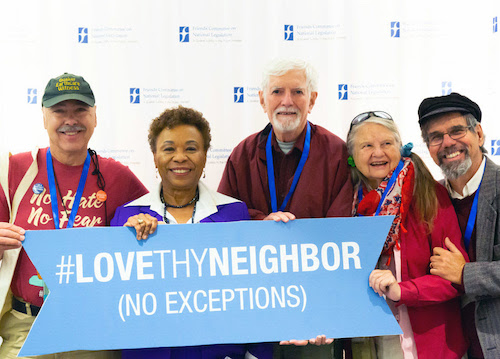 Anthony Manousos (right) with FCNL colleagues
Sunday, April 12, 2020
Zooming in on the Family During Easter
In his novel La Peste (The Plague) [1947], French novelist Albert Camus describes a fictional plague that took place in the Algerian city of Oran during the 1940s. When people realize that they are facing a plague, they "shelter in place" and feel a deep sense of isolation caused by an inability to communicate with family and friends. They can't even write letters because the postal service is afraid that letters might carry the disease. Phone service is limited to essential calls about deaths, births, and marriages. People can send telegrams which, like Twitter, are limited--in this case, to 10-word message like:: "Doing fine. Thinking of you with tenderness." Some write letters to loved ones over and over again, knowing they will never be sent, until the words become meaningless. Camus compares this experience to being "exiled."
Jill and I often turn to dancing when we need to cheer up. For example, when we heard the dismal news that Trump was elected, we felt deeply depressed. How could so many fall for a someone who seemed to us unfit for this office? What would become of our country under his leadership? Rather than succumb to despair, I decided to play the final scene of "Zorba the Greek." (If you haven't seen it for a while, you can check it out on youtube: https://www.youtube.com/watch?v=4UV6HVMRmdk).
Seeing Zorba dance on the beach after all his well laid plans fell apart, Jill and followed his example and danced together until we felt a little more hopeful.
When Greeks dance, they often exclaim "opa," a word rich with meaning. I found this definition of "Opa" online and it captures the Greek spirit, and explains the strange Greek custom of breaking plates, in a way that brought a smile to my face, and I hope to yours:
Fortunately, most of us are not as limited in our communication during this 21st century pandemic. We may be isolated physically but we can still stay in touch electronically if we have iphones and computers. We can connect via Skype and Zoom in ways that our ancestors could only dream about.
During the past few weeks Jill and I spent so much time on Zoom connecting with our fellow advocates it occurred to me: why not connect with my Greek family via Zoom. So I put out the word on the Manousos facebook page (yes, there is such a page!) and called and emailed a few family members and lo and behold! seven of them took part in a Zoom call this morning and we had a blast.
Three of my first cousins took part, along with my sister and two second cousins. My sister Elizabeth lives in Hamilton, NJ (near Princeton, our hometown) with her husband Richie and her two kids: Emily and Demetrios. My cousins Alexandra Manos and Irene Fotos live in Atlanta, Georgia. My cousin Veronica Xenos lives in Coral Springs, Florida. My second cousin Michael Manousos also lives in NJ, with his son Anthony (named after his father, my first cousin). My other second cousin Tino Petalas lives in Montreal. None of my relatives living in Greece took part in this call, unfortunately, but since several are on Facebook, I am hoping they will participate in future calls. Connecting to Zoom isn't that hard.
 |
| Jill with my cousin Alexandra in front of Dr. King's Ebenezer Baptist Church in Atlanta, GA |
Many of my relatives hadn't seen each other for decades, or some had never seen each other before. So it was fun getting acquainted and seeing each other's faces and laughing and having fun together.
I was reminded of how important Easter has been for me as a Greek immigrant's son. When I was growing up, my parents would take me to Yonkers
during Easter to spend time with my Uncle Andrew and Aunt Helen and their three daughters Veronica, Irene and Alexandra. I confess that I wasn't terribly excited about spending Easter with three female cousins. We had little in common. (I was pleasantly surprised last summer when I connected with my cousin Sandy and her husband and felt like we were old friends.) My Uncle Andrew and Aunt Helen were very gracious hosts and their Easter party was amazing. My uncle ran a restaurant and would cook up a whole lamb and invite family members and friends into his small apartment for a feast. The lamb was delicious, the best that I have ever tasted, and so was the rest of the food. Greeks love to celebrate Easter and they do it with "opa" (more about that later).
 |
| Jill and I with Peter Manos, Alexandra's husband, at the Greek Orthodox Church in Atlanta, GA |
Four years ago Jill and I were blessed to experience Easter on the Greek island of Andros where my father was born. It was one of the most memorable Easters of my life, and Jill loved it as much as I did. We love to share stories about our Greek Easter experience with our friends, and I wrote about it on my blog so I won't say more here. See https://laquaker.blogspot.com/2014/05/greece-from-peace-activists-perspective.html
During this time of pandemic, it is important to remember how much it helps to connect with family and friends.
It can also be helpful to remember the message of Easter. After the horrific death of Jesus, the disciples were fearful and "sheltered in place," afraid to go out lest they would be arrested and put to death like their leader. Much to their amazement, their leader returned with a message of hope. Love had triumphed over death, and the Light triumphed over darkness. The story of Jesus the Christ was not a tragedy but what the great Italian poet Dante called "a divine comedy"---a story with a gloriously happy ending.
Skeptics may say this was a mass delusion, but I would counter by saying it was a real experience that transformed the lives of his disciples in unprecedented ways and has transformed countless Christians ever since. Fearful men and women became full of hope and confidence, believing in the power of love and willing to risk their lives to share this good news. They experienced and witnessed something that changed their world view forever. Quakers called this "the living Christ" or the "Christ within."
It can also be helpful to remember the message of Easter. After the horrific death of Jesus, the disciples were fearful and "sheltered in place," afraid to go out lest they would be arrested and put to death like their leader. Much to their amazement, their leader returned with a message of hope. Love had triumphed over death, and the Light triumphed over darkness. The story of Jesus the Christ was not a tragedy but what the great Italian poet Dante called "a divine comedy"---a story with a gloriously happy ending.
Skeptics may say this was a mass delusion, but I would counter by saying it was a real experience that transformed the lives of his disciples in unprecedented ways and has transformed countless Christians ever since. Fearful men and women became full of hope and confidence, believing in the power of love and willing to risk their lives to share this good news. They experienced and witnessed something that changed their world view forever. Quakers called this "the living Christ" or the "Christ within."
Greeks are familiar with disasters (after all, they invented the word "tragedy") but they also invented another word that can help us get through dark times. That word is "opa." It is usually said when dancing or when one is feeling exuberant.
Jill and I often turn to dancing when we need to cheer up. For example, when we heard the dismal news that Trump was elected, we felt deeply depressed. How could so many fall for a someone who seemed to us unfit for this office? What would become of our country under his leadership? Rather than succumb to despair, I decided to play the final scene of "Zorba the Greek." (If you haven't seen it for a while, you can check it out on youtube: https://www.youtube.com/watch?v=4UV6HVMRmdk).
Seeing Zorba dance on the beach after all his well laid plans fell apart, Jill and followed his example and danced together until we felt a little more hopeful.
When Greeks dance, they often exclaim "opa," a word rich with meaning. I found this definition of "Opa" online and it captures the Greek spirit, and explains the strange Greek custom of breaking plates, in a way that brought a smile to my face, and I hope to yours:
OPA is a Greek word or pronouncement of celebration, the celebration of life itself.
It is another way of expressing joy and gratitude to God, Life, and others, for bringing us into the state of ultimate wisdom; that all that really matters is health, family, and friends.
It is the Greeks’ way of stating they have come to a level of serene exuberance able to enjoy life as children. … In a state where having been fed, and having quenched our thirst, and having enjoyed the pleasure of uniting with others, we have filled with hope and confidence that life abounds with all that we need, … and that food will always be there, … and so, we break the plates, … because tomorrow there will be more. … And we light a fire and dance around it as a symbol of the warmth that surrounds us. … and..
We break the plates as a way of saying thank you to those that helped us reach a state of celebrating our life, … as a way of saying thank you to the music that brought peace to the world, … and we break them to honor the one that’s dancing, as we kneel in front of them and look up to them exclaiming : Oooopa !!!
We may not be able to unite physically with each other during the Covid 19 crisis, but we can unite via phone and Zoom. And when things seem dark and hopeless, we can always dance and say, "Ooopa!"
Μεταφράσαμε αυτό μέσω του google translation. Παρακαλώ συγχωρήστε τα λάθη!
We may not be able to unite physically with each other during the Covid 19 crisis, but we can unite via phone and Zoom. And when things seem dark and hopeless, we can always dance and say, "Ooopa!"
Μεταφράσαμε αυτό μέσω του google translation. Παρακαλώ συγχωρήστε τα λάθη!
Στο μυθιστόρημα La Peste [1947], ο Γάλλος
μυθιστοριογράφος Albert Camus περιγράφει μια πλασματική πανούκλα που έλαβε χώρα
στην αλγερινή πόλη Oran κατά τη δεκαετία του 1940. Όταν οι άνθρωποι
συνειδητοποιούν ότι αντιμετωπίζουν μια πανούκλα, «καταφύγουν στη θέση τους» και
αισθάνονται μια βαθιά αίσθηση απομόνωσης που προκαλείται από την αδυναμία
επικοινωνίας με την οικογένεια και τους φίλους. Δεν μπορούν ούτε να γράψουν
γράμματα επειδή η ταχυδρομική υπηρεσία φοβάται ότι τα γράμματα μπορεί να φέρουν
την ασθένεια. Η τηλεφωνική υπηρεσία περιορίζεται σε βασικές κλήσεις σχετικά με
θανάτους, γεννήσεις και γάμους. Οι άνθρωποι μπορούν να στείλουν τηλεγραφήματα
τα οποία, όπως και το Twitter, είναι περιορισμένα - σε αυτή την περίπτωση, σε
μήνυμα 10 λέξεων όπως: "Κάνει καλά. Σκέφτομαι με τρυφερότητα".
Ορισμένες γράφουν γράμματα στους αγαπημένους ξανά και ξανά, ξέροντας ότι δεν θα
σταλούν ποτέ, μέχρι να μην έχουν νόημα τα λόγια. Ο Camus συγκρίνει αυτή την
εμπειρία με την "εξόριστη".
Ευτυχώς, οι περισσότεροι από μας δεν είναι
τόσο περιορισμένοι στην επικοινωνία μας κατά τη διάρκεια αυτής της πανδημίας
του 21ου αιώνα. Μπορεί να είμαστε σωματικά απομονωμένοι, αλλά μπορούμε ακόμα να
μείνουμε σε επαφή ηλεκτρονικά. Δεν έχουμε μόνο iphones, έχουμε επίσης
υπολογιστές που μπορούν να μας συνδέσουν μέσω του Skype και του Zoom με τρόπους
που οι πρόγονοί μας θα μπορούσαν μόνο να ονειρεύονται.
Τις τελευταίες εβδομάδες, η Jill και εγώ
ξοδέψαμε πολύ χρόνο στο Zoom που συνέδεε με τους συναδέλφους μου ακτιβιστές που
συνέβη σε μένα: γιατί να μην συνδεθώ με την ελληνική οικογένειά μου μέσω του
Zoom. Έτσι έβαλα τη λέξη στη σελίδα facebook του Μανούσου (ναι, υπάρχει μια
τέτοια σελίδα!) Και κάλεσε και έστειλε με ηλεκτρονικό ταχυδρομείο μερικά μέλη
της οικογένειας και βέβαια! επτά από αυτούς συμμετείχαν σε κλήση Zoom σήμερα το
πρωί και είχαμε μια έκρηξη.
Τρεις από τους πρώτους ξαδέρφους μου πήραν
μέρος, μαζί με την αδελφή μου και δύο ξαδέλφια. Η αδελφή μου, Elizabeth, ζει
στο Hamilton, NJ (κοντά στο Princeton, την πατρίδα μας) με τον σύζυγό της Richie
και τα δύο παιδιά της: την Emily και τον Δημήτριο. Οι ξαδέλφες μου Αλεξάνδρα
Μάνος και Ειρήνη Φωτός ζουν στην Ατλάντα της Γεωργίας. Ο ξάδερφος μου Βερόνικα
Ξένος ζει στο Coral Springs της Φλώριδας. Ο δεύτερος μου ξάδελφος Μιχαήλ Μάνος
έζησε επίσης στο NJ, μαζί με τον γιο του Anthony (ονομάστηκε από τον πατέρα
του, τον πρώτο μου ξάδερφό μου). Ο άλλος δεύτερος ξάδερφος Τίνο Πεταλάς ζει στο
Μόντρεαλ. Κανένας από τους Έλληνες συγγενείς μου δεν έλαβε μέρος στην κλήση
αυτή, δυστυχώς, αλλά επειδή αρκετοί είναι στο Facebook, ελπίζω ότι θα
συμμετάσχουν σε μελλοντικές κλήσεις. Η σύνδεση στο ζουμ δεν είναι τόσο δύσκολη.
Πολλοί από τους συγγενείς μου δεν είχαν δει
ο ένας τον άλλον για δεκαετίες, ή κάποιοι δεν είχαν δει ποτέ ο ένας τον άλλο
πριν. Γι 'αυτό ήταν διασκεδαστικό να εξοικειωθούμε και να βλέπουμε τα πρόσωπα
του άλλου και να γελάμε και να διασκεδάζουμε μαζί.
Μου θυμήθηκε πόσο σημαντικό ήταν το Πάσχα
για μένα ως γιος του Έλληνα μετανάστη. Όταν μεγαλούσα, οι γονείς μου θα με
πήγαιναν στο Yonkers κατά τη διάρκεια του Πάσχα για να περάσω χρόνο με τον θείο
μου Andrew και τη θεία Ελένη και τις τρεις κόρες τους Βερόνικα, Ειρήνη και
Αλεξάνδρα. Ομολογώ ότι δεν ήμουν τρομερά ενθουσιασμένος που περνούσα το Πάσχα
με τρεις γυναίκες ξαδέρφια. Δεν είχαμε τίποτα κοινό. (Ήμουν ευχάριστα έκπληκτος
το περασμένο καλοκαίρι όταν συνδεόμουν με τον ξάδερφο Sandy και τον σύζυγό της
και ένιωσα σαν παλιούς φίλους.) Ο θείος μου Andrew και η θεία Helen ήταν πολύ
ευχαριστημένοι οικοδεσπότες και το πάρτι του Πάσχα ήταν εκπληκτικό. Ο θείος μου
έτρεξε ένα εστιατόριο και θα μαγειρέψει ένα ολόκληρο αρνί και θα καλέσει μέλη
της οικογένειας και φίλους στο μικρό του διαμέρισμα για μια γιορτή. Το αρνί
ήταν νόστιμο, το καλύτερο που έχω δοκιμάσει ποτέ, και το υπόλοιπο φαγητό. Οι
Έλληνες αγαπούν να γιορτάσουν το Πάσχα και το κάνουν με "ώπα"
(περισσότερα για αυτό αργότερα).
Πριν από τέσσερα χρόνια η Jill και εγώ
ήμασταν ευλογημένοι να βιώσουμε το Πάσχα στο ελληνικό νησί της Άνδρου όπου
γεννήθηκε ο πατέρας μου. Ήταν ένα από τα πιο αξιοσημείωτα Πασχαλιά της ζωής
μου, και η Jill το αγάπησε τόσο πολύ όσο και εγώ. Μας αρέσει να μοιραζόμαστε
ιστορίες για την ελληνική εμπειρία του Πάσχα με τους φίλους μας και έγραψα γι
'αυτό στο blog μου, γι' αυτό δεν θα πω περισσότερα εδώ. Δείτε
https://laquaker.blogspot.com/2014/05/greece-from-peace-activists-perspective.html
Κατά τη διάρκεια αυτής της περιόδου
πανδημίας, είναι σημαντικό να θυμόμαστε πόσο βοηθάει να συνδεθεί με την
οικογένεια και τους φίλους.
Μπορεί επίσης να είναι χρήσιμο να θυμάστε
το μήνυμα του Πάσχα. Μετά τον φρικτό θάνατο του Ιησού, οι μαθητές φοβούνταν και
«προστατευόταν στη θέση τους», φοβούμενοι να βγουν έξω από το να μην συλληφθούν
και να δολοφονηθούν σαν τον αρχηγό τους. Σε μεγάλο βαθμό στην έκπληξή τους, ο
ηγέτης τους επέστρεψε με ένα μήνυμα ελπίδας. Η αγάπη είχε θριαμβεύσει πάνω από
το θάνατο και το Φως θριάμβευσε πάνω από το σκοτάδι. Η ιστορία του Ιησού
Χριστού δεν ήταν τραγωδία αλλά θεϊκή κωμωδία.
Οι σκεπτικιστές μπορούν να πουν ότι
πρόκειται για μαζική αυταπάτη, αλλά αντιτίθεμαι λέγοντας ότι ήταν μια
πραγματική εμπειρία που μετασχηματίζει τις ζωές των μαθητών του με πρωτοφανείς
τρόπους και έχει μεταμορφώσει αμέτρητους χριστιανούς από τότε. Οι φοβισμένοι
άνδρες και γυναίκες έγιναν γεμάτοι ελπίδα και εμπιστοσύνη, πιστεύοντας στη
δύναμη της αγάπης και πρόθυμοι να διακινδυνεύσουν τη ζωή τους για να μοιραστούν
αυτά τα καλά νέα. Έζησαν και είδαν κάτι που άλλαξε την άποψή τους για πάντα. Οι
Κουάκερ χαρακτήρισαν αυτό το "ζωντανό Χριστό" ή τον "Χριστό
μέσα".
Οι Έλληνες είναι εξοικειωμένοι με τις
καταστροφές (τελικά, εφευρέθηκαν η λέξη "τραγωδία"), αλλά εφευρέθηκαν
επίσης μια άλλη λέξη που μπορεί να μας βοηθήσει να περάσουμε από σκοτεινούς
χρόνους. Αυτή η λέξη είναι "opa." Συνήθως λέγεται όταν χορεύεις ή
όταν αισθάνεσαι φουσκωμένος.
άρρωστοι και συχνά γυρίζω να χορεύω όταν
χρειαζόμαστε να χαρούμε. Για παράδειγμα, όταν ακούσαμε τα θλιβερά νέα που
εκλέχτηκε ο Trump, αισθανθήκαμε βαθιά κατάθλιψη. Πώς θα μπορούσαν οι Αμερικανοί
να είναι τόσο ανόητοι; Πώς θα μπορούσαν πολλοί να πέσουν για έναν conman όπως
αυτόν; Τι θα γίνει με τη χώρα μας υπό την ηγεσία του; Αντί να πέσω στην
απελπισία, αποφάσισα να παίξω την τελική σκηνή του "Ζορμπά του
Έλληνα". (Αν δεν το έχετε δει για λίγο, μπορείτε να το ελέγξετε στο
YouTube: https://www.youtube.com/watch?v=4UV6HVMRmdk).
Βλέποντας τον χορό Zorba στην παραλία αφού
όλα τα καλά σχεδιασμένα σχέδιά του έπεσαν στο αποκορύφωμα, η Jill ακολούθησε το
παράδειγμά της και χόρευε μαζί μέχρι να αισθανόμαστε λίγο πιο ελπιδοφόρα.
Όταν ελληνικό χορό, αναφωνούν συχνά
"ώπα", μια λέξη πλούσια σε νόημα. Βρήκα αυτόν τον ορισμό του
"ώπα" σε απευθείας σύνδεση και συλλαμβάνει το ελληνικό πνεύμα με τρόπο
που έφερε ένα χαμόγελο στο πρόσωπό μου και ελπίζω να σας:
"ώπα" είναι μια ελληνική λέξη ή μια δήλωση εορτασμού, ο εορτασμός της ίδιας της ζωής.
Είναι ένας άλλος τρόπος να εκφράσουμε τη χαρά και την ευγνωμοσύνη στον Θεό, στη Ζωή και σε άλλους, για να μας φέρει στην κατάσταση της απόλυτης σοφίας. ότι όλα όσα πραγματικά έχουν σημασία είναι η υγεία, η οικογένεια και οι φίλοι.
Είναι ο τρόπος που οι Έλληνες δηλώνουν ότι έχουν φτάσει σε ένα επίπεδο γαλήνιας ευφορίας που μπορούν να απολαμβάνουν τη ζωή τους ως παιδιά. ... Σε μια κατάσταση όπου έχουμε τροφοδοτηθεί και έχουμε σβήσει τη δίψα μας και έχοντας απολαύσει την ευχαρίστηση να ενώσουμε με άλλους, έχουμε γεμίσει με ελπίδα και σιγουριά ότι η ζωή αφθονεί με όλα όσα χρειαζόμαστε ... και ότι το φαγητό θα είναι πάντα εκεί, ... και έτσι, σπάμε τα πιάτα, ... γιατί αύριο θα υπάρξουν περισσότερα. ... Και φωτίζουμε φωτιά και χορεύουμε γύρω του ως σύμβολο της ζεστασιάς που μας περιβάλλει. … και..
Σπάμε τις πλάκες ως τρόπο να πούμε ευχαριστώ σε εκείνους που μας βοήθησαν να φτάσουμε σε μια κατάσταση γιορτάζοντας τη ζωή μας ... σαν τρόπο να σας πω ευχαριστώ στη μουσική που έφερε την ειρήνη στον κόσμο, ... και τους σπάσαμε για να τιμήσουμε ένα που χορεύει, γονατίζουμε μπροστά τους και κοιτάζουμε προς τα πάνω φωνάζοντας: ώπα !!!
Μπορεί να μην είμαστε σε θέση να ενωθούμε
φυσικά ο ένας με τον άλλον κατά τη διάρκεια της κρίσης Covid 19, αλλά μπορούμε
να ενωθούμε μέσω τηλεφώνου και Zoom. Και όταν τα πράγματα φαίνονται σκοτεινά
και απελπιστικά, μπορούμε πάντα να χορεύουμε και να πούμε, "ώπα!"
Thursday, April 2, 2020
What if we thought of the pandemic as a sacred time?
 As we enter the third week of California's "Safer at Home" policy, we are hunkered down in our cozy little Craftsman home and enjoying our garden and pets, including our 15-year miracle chicken named Checkers, who continues to lay egg despite her longevity. She wakes us every morning with her cockledoodoing, as if to say: What a joy it is to be alive!
When we venture out for walks, we can't help noticing that the skies are bluer, the air cleaner, and the streets quieter. I am reminded of my childhood in Princeton, NJ, when Sundays were actually a "day of rest." Businesses closed down, people went to church in the morning and spent their afternoon and evenings with family. This was a a true sabbath time.
This "never on Sunday" approach to what Quakers call First Day changed when a shopping center opened up in Princeton and stores began doing business on Sundays. Sunday became just another work day for many, and even for those who had a day off, it was often spent shopping rather than relaxing at home.

There is the ominous feeling that this is the "quiet before the storm." We realize that in the next few weeks, we could see a catastrophic rise in deaths here in our city and throughout the country. How will we respond? Will we panic like the people in the movie "Contagion" and start looting stores? Or will we come together and witness to our higher values?
So far, my neighborhood has responded with kindness. We've received flowers and other

While sheltering in place is the best way to respond to this crisis at this time, we will probably need to stay home much longer than we would like. Perhaps even months. We need to develop strategies to cope with this crisis at the emotional as well as practical level.
One of the strategies to cope with this crisis is to see it as an opportunity for spiritual growth. Not in the sense of an arduous spiritual discipline, like fasting. But to see this period as a true Sabbath in the Jewish sense--a sacred time when we cease from work and worry and enjoy the blessing of being alive.
This poem captures beautifully how we can experience this pandemic in a truly novel way:
Pandemic
What if you thought of itas the Jews consider the Sabbaththe most sacred of times?Cease from travel.Cease from buying and selling.Give up, just for now,on trying to make the worlddifferent than it is.Sing. Pray. Touch only thoseto whom you commit your life.Center down.And when your body has become still,reach out with your heart.Know that we are connectedin ways that are terrifying and beautiful.(You could hardly deny it now.)Know that our livesare in one another’s hands.(Surely, that has come clear.)Do not reach out your hands.Reach out your heart.Reach out your words.Reach out all the tendrilsof compassion that move, invisibly,where we cannot touch.Promise this world your love--for better or for worse,in sickness and in health,so long as we all shall live.
--Lynn Ungar 3/11/20
Wednesday, April 1, 2020
Letter to Governor Newsome calling for bold measures to address the Covid 19 and housing crisis
This letter written by Housing Now! has
widespread support from progressive leaders and organizations throughout the
state. GPAHG hasn't yet taken a stand supporting this letter, but I am supportive of much of it. My main qualm is about rent suspension: it is an idea worth considering but probably wouldn't stand up in court. A more pragmatic and feasible approach would be to give people subsidies and/or several years to repay missed rent payments. If the crisis turns into a Great Depression and 30% of people are out of work for an extended period of time, it may be necessary to consider rent suspension. See LA TIMES real eviction moratorum .
Dear Governor Newsom:
While we appreciate the intent and the declarations in your recent
executive order, we feel that there are both problems and limitations to it
that do not rise to the level of action needed to protect both homeowners and
renters and help stop the coronavirus from exacerbating California's housing
crisis. With regards to renters, the current order only encourages an
ineffective patchwork of approaches across the state. The ensuing confusion
from the myriad levels of city and county protections exposes renters to the
dangers of appearing in crowded courthouses, and many renters will have a
difficult time providing the required documented loss of income described in
the executive order. We need simple, effective solutions that apply to all
Californians equally.
Californians take care of each other. In moments of crisis,
Californians know how to pull together. Whether helping our neighbors during an
earthquake or opening our homes during a wildfire, we show up for one another.
We know that our families and neighborhoods are stronger, safer, and healthier
when we show up and represent for one another in moments of illness and crisis.
No matter what we look like, where we live, or what's in our
wallets, getting sick reminds us that we're all human and that we’re all
interconnected. But today, as you know, due to the lack of preparation by the
Trump administration, which has been putting the interests of Wall Street above
the needs of people, most of us do not have access to the testing, vaccines,
and treatment we need to get and stay well.
We must stand with and for each other, against anything used to
divide us, to demand the care and paid time off every one of us needs, no
exceptions. Only by standing united can we rewrite the rules to ensure better
health for all.
In light of this public health crisis, when it’s imperative that
families be stably housed, we call on you, Governor Newsom, to enact the
following measures for as long as Californians are substantially affected by
COVID-19:
1. An
Immediate Moratorium on Rent Increases, All Evictions, Foreclosures &
Cease Executing Writs of Possession - We need an immediate
statewide ban on rent Increases, evictions and foreclosures and cease executing
writs of possession. The need to protect residents that live paycheck to
paycheck from the economic fallout of this virus includes protecting them
against facing price gouging, eviction and homelessness. Rent increases, even
minimal ones, during this time is tantamount to price gouging given the
potential for lost wages, and would make renters more vulnerable to evictions. Eviction and foreclosure
would only further spread this virus and make its containment harder because
people would not have a home to care for the health, safety and welfare of
their families. In addition, forcing renters to defend themselves in crowded
eviction courts at this time is directly at odds with government guidance
emphasizing the critical importance of social distancing to contain the spread
of the virus. We request the governor immediately direct all County and City
Marshals and Sheriffs to cease executing writs of possession until further
notice. We applaud the included request in your executive order for financial
institutions to implement a moratorium on foreclosures.
2. Moratorium on Encampments Sweeps, Closure and Vehicle Tows - We support Western
Regional Advocacy Project's call to end the enforcement/displacement actions
against encampments of the unhoused during this crisis due to the necessity for
sustained public health outreach and disease control as has been done in cities
such as San Jose. Sweeps pose a serious health risk as they disrupt consistent
access to services and ability for outreach and health workers to provide
continuous care. These services are critical at this time. Shelters are not a
solution for many people as they pose an increased risk of contracting
illnesses due to close contact with others. Many will choose to stay on the
streets where one can have more space, open air, and better ways to avoid
contact spread of the virus. Forcing people to live in close quarters is not an
acceptable solution. We also support the increased urgency to allow placement
of unhoused community members in safe, sanitary places where they can maintain
their social networks and personal belongings. The state should also provide
rental assistance to people experiencing homelessness since the only way for
someone to stabilize, remain healthy, and prevent exposure is in a home.
3. Emergency
Rental or Mortgage Assistance - We must provide support for workers
who have to forgo work at no fault of their own due to the coronavirus
outbreak. Government should step in by providing emergency rental or mortgage
assistance to “backfill” a substantial share of any income lost to any worker
during this crisis, whether or not they become sick themselves, and regardless
of classification as an employee or contractor. This also encourages workers to
stay home when sick rather than risking spread of the virus by continuing to work to prevent income loss. We suggest this is done via a sliding scale so that
4. Suspension of rents and mortgages- The state must call on banks and lenders to suspend
mortgages providing financial relief for homeowners and landlords, including
supporting non-profit housing providers to remain sustainable, and, in turn,
all of their tenants. Mortgages and rents should be suspended and forgiven
immediately (April 1st, 2020 at the latest) and continuing for the duration of
this crisis, including a recovery period after the state of emergency is
lifted. Mortgages shouldn't be accruing interest either. Even before this
crisis, millions of Californians were already severely rent burdened, living
paycheck to paycheck, and on the brink of eviction and homelessness. With no
current plan in place for Californians with no paid leave, no savings, no job
security and being laid off as we speak, the recommended public health social
distancing measures are, at best, delayed de facto eviction orders. Even
temporary foreclosure and eviction moratoriums will require homeowners and
renters to pay back, what may become, insurmountable debts. We can't afford
these interconnected economic and health crises! The only holistic solution
that will actually protect renters and homeowners alike is to suspend and
forgive mortgage and rental payments now, the way that France has.
5. Prohibit
Utility Shut-Offs and Rate Increases, Halt Application of Late Fees, and
Reinstitute Services Immediately- Widespread loss of income will cause some of the most
vulnerable individuals and families to fall behind on payments for basic
services including water, gas, internet, phone service and electricity. All
public and private utilities and service providers should be prohibited from
shutting off service, increasing rates, or applying late fees during the public
health crisis. Shutting off utilities will increase suffering and economic
instability while also undermining public health goals by preventing
appropriate sanitation and dislocating people from homes. Accordingly, all
public and private utilities doing business in the state should halt all utility shut-offs and related fees during this crisis.
We applaud the action recently taken by the CPUC to halt customer
disconnections for non-payment, and we hope that your office can encourage
utility companies and service providers outside of their jurisdiction to follow
suit.
As organizations representing Californians affected daily by our
housing stability and homelessness crisis, we agree with these measures and
sign in support. Tenants and homeowners across California need answers before
April 1st to ensure stability for millions of families. We are prepared to take
collective action to protect ourselves in this moment of crisis.
Governor Newsom, help us stop the coronavirus from exacerbating
California's housing crisis!
Respectfully,
Housing Now!- Sponsor
West Hollywood
Subscribe to:
Posts (Atom)