Friday, October 27, 2023

The Quaker witch trial and the socio-political context of witch hunts


With Hallowe'en just around the corner, I'd like to reflect on the socio-political context of witches and witch hunts. I'd like to start my reflection on witch hunts with a true story about the only Quaker witchcraft trial known to have occurred. The year was 1684, and the name of the woman accused of witchcraft was Margaret Mattson. Margaret and her husband arrived in what is today called Pennsylvania before William Penn, and they were Swedish, and along with their neighbors, made up the first group of immigrants to settle along the lower Delaware River. They soon would be displaced by the ever more numerous English settlers who followed Penn. Their being “foreigners” was probably a significant cause of this accusation.

Margaret’s neighbors accused her of being a witch and she was brought before William Penn who served as magistrate. Penn didn’t believe in witches, but there was a law against witchcraft in England and he was legally required to question her, so he asked: “Do you fly on a broomstick?” She didn’t understand his question so she said, “Yes.” Penn responded, “That isn’t a crime. Case dismissed.”

This story illustrates how Quakers did not buy into the myth that women who are different are somehow evil. Perhaps that’s why so many powerful women leaders have emerged from the Quaker movement.

Historically, witch hunts have been a way for the patriarchy to target women who are “different” and challenge the norms.  

Historian Christina Larner  estimates that about 80 percent of those accused of witchcraft in the European witch hunts of the 16th and 17th centuries were women. At the same time, the witch hunters were overwhelmingly male.

According to Erin Cassese, McCarthy’s anti-communist witch hunts also tended to target women. Women were overrepresented among defendants in federal loyalty cases, and agencies that employed a disproportionately large share of women were often singled out for close scrutiny. Historian Landon Storrs notes that evidence presented against female defendants took on a distinctively gendered tone. For example, keeping one’s maiden name, “needlessly” holding a high-paying job while married, and having a “dominant personality” were all grounds for suspicion of communist sympathizing, ostensibly because communists eschewed traditional gender roles.

Today the term “witch hunt” has renewed cultural and political resonance, largely because it’s one of President Trump’s preferred strategies for deflecting criticism and mobilizing his base. Since assuming office, Trump has tweeted some variant of the phrase “WITCH HUNT!” innumerable times.

As  so common in Trump world, Trump inverts the conventional usage and casts himself as the victim. Unlike in the past, the term “witch hunt” is often invoked defensively by men in positions of power and authority. Recent events show that men with political and economic power can often rely on the idea of witch hunts to work for them, not against them. The witch hunt still uses institutional authority to enforce traditional gender norms and power relations.

I think that Hallowe’en is a good time to unmask the ugly face of patriarchy which has persecuted women throughout history for being different, for defying gender norms, and for challenging accepted beliefs. Let’s not allow these perpetrators of violence against women to portray themselves as the victims.  


Thursday, October 26, 2023

Building Housing on Faith Lands: How Congregations Can Take Action for Housing in CA: Friday Forum


Please join us online

ICUJP Friday Forum
October 27th, 7:30-9:30 am Pacific  

Building Housing on Faith Lands: How Congregations Can Take Action for Housing in CA 

Join video conference here:
https://us02web.zoom.us/j/84519726689

Call in by phone: +1 669 900 6833* 
Meeting ID: 845 1972 6689
PASSCODE: 742119

*Meeting controls for call-in attendees:
To mute/unmute yourself: *6
To raise hand: *9

Brooke Wirtschafter, Director of Community Organizing at IKAR, a Jewish Spiritual Community will speak about IKAR's efforts to build affordable housing on their site and advocate for housing in Los Angeles and California.

Join the conversation with our speaker:


Brooke Wirtschafter is Director of Community Organizing at IKAR, a Jewish spiritual community
in Los Angeles. At IKAR, Brooke works with community members to build effective teams and
cultivate leaders, to identify shared values and goals and work toward a better, more just, more
humane city, county, and state, with partners from across Los Angeles. Brooke has been proud
to support IKAR's work in coalitions advocating for immigrants' rights, justice system
transformation, environmental justice, climate action, and housing. She helped IKAR lay the
groundwork for building a permanent supportive housing development for formerly homeless
seniors as part of its new building, with plans to break ground in 2024.

In 2022, she led IKAR’s successful effort to draft and pass a state law (AB 2244) that reduced parking requirements for faith communities that choose to build affordable housing. Brooke also serves as a member of the City of Los Angeles Human Relations Commission.

Learn More/Here's how YOU can help:

7:30 - 7:35  Log in and socialize
7:35 - 7:45  Welcome and introductions 
7:45 - 7:50  Reflection (5 min. maximum)
7:50 - 9:15  Program and Q&A
9:15 - 9:20  Announcements
9:20 - 9:30  Closing circle and prayer

Start your morning with us!

Facilitator and Reflector: Anthony Manousos

** Meetings begin promptly at 7:30 am Pacific. **
-----

Here's how to join the online meeting:

To join by video conference, you'll need to download the Zoom app on your computer or mobile device. Click on the link to join the meeting and then enter the Meeting ID number and passcode. You'll be able to see slides and video, as well as speakers and other attendees.

If you prefer to join by phone, you'll be prompted to enter the Meeting ID number and passcode. You won't be able to see the visuals or attendees, but you can view them on the meeting video recording afterward. 

If you're new to Zoom and would like to use the video option, we recommend you download the app well ahead of time.

ICUJP Friday Forum 10/27/23
Time: 07:30 AM Pacific Time (US and Canada)

Option 1: Join video conference 
https://us02web.zoom.us/j/84519726689

Meeting ID: 845 1972 6689
PASSCODE: 742119

Option 2: Dial in by phone only:
+1 669 900 6833 US (California)
Meeting ID: 845 1972 6689
PASSCODE: 742119

*Meeting controls for call-in attendees:
To mute/unmute yourself: *6
To raise hand: *9

(To find a dial-in number closer to you, go here.)

-----

Please note: Our Friday Forums and other events are open to the public. By attending, you consent to having your voice and likeness recorded, photographed, posted on ICUJP's website and social media, and included in ICUJP materials and publications for noncommercial purposes. If you don't want to be photographed or recorded, please let the facilitator know.

_________________________________________

22nd Anniversary of ICUJP: 22 years of working for Justice and Peace

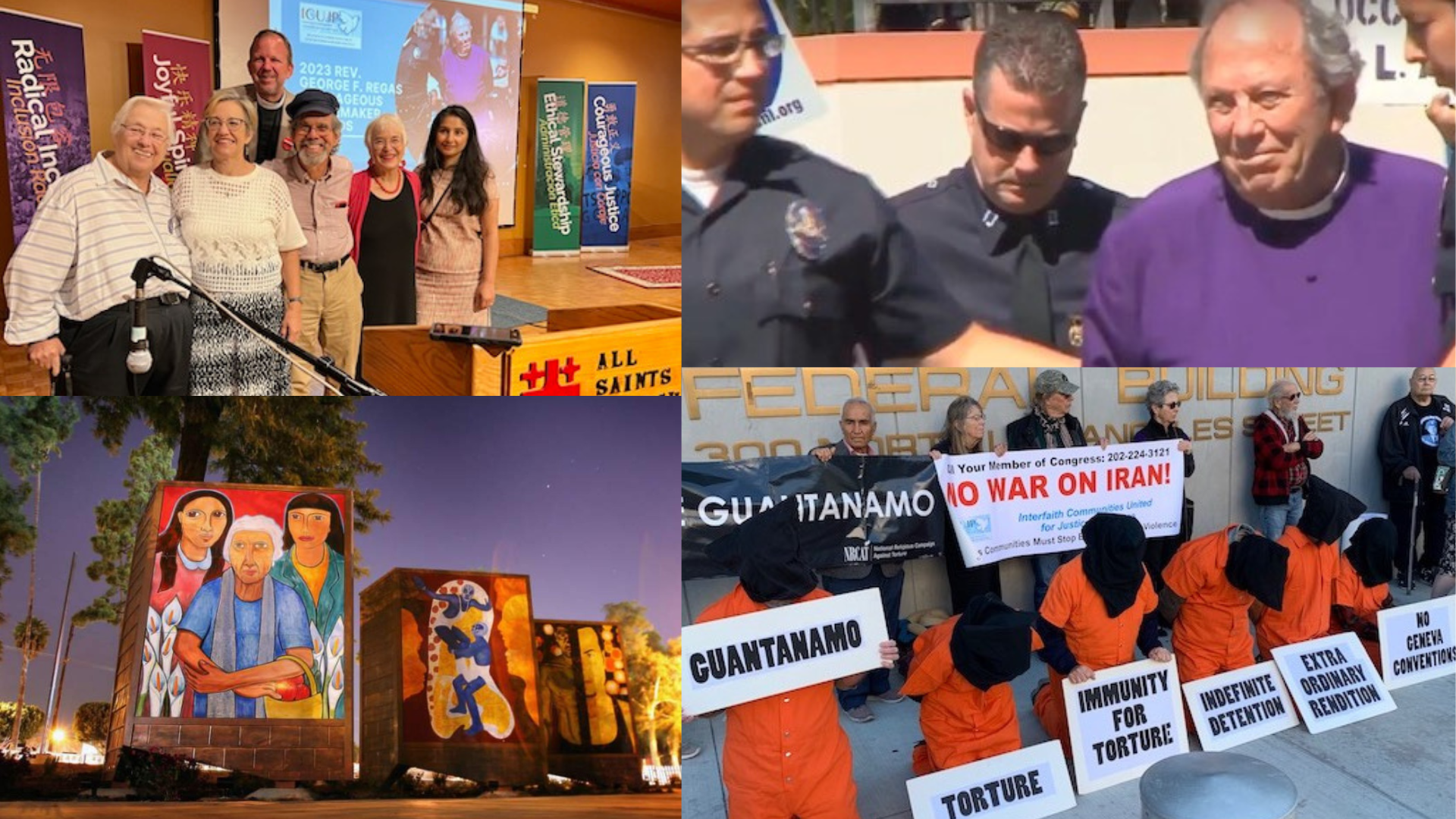
Twenty-two years ago, Rev. George Regas of All-Saints Episcopal Church in Pasadena reached out to clergy, community leaders, and laypeople to come together to seek an alternative to the fear-mongering and vengefulness sweeping much of our nation in the wake of September 11. The message that they wanted to convey was coherent and powerful: “Religious Communities Must Stop Blessing War and Violence.” On that day, Interfaith Communities United for Justice and Peace was born.

These past 22 years have been a journey for ICUJP - five Presidents, four California Governors, and numerous crisis and issues that would shake the resolve of even the most devout and dedicated of activists. But through it all, we go forward in our mission to be the voice for "the least of these", and our determination to create the change we want to see in the world.

On Sunday, September 10th, 2023, ICUJP honored Rev. George Regas's life and legacy, and recognized deserving organizations with the 2023 George F. Regas Courageous Peacemaker Award. As our theme was "Housing is a Human Right", we were glad to shine a light on the work of Making Housing and Community HappenAll-Saints Church Safe Haven Bridge to Housing, the Office of Mayor Karen Bass of Los Angeles, and the Jerusalem Legal Aid and Human Rights Center.

Thank you for your part in keeping the vision of George F. Regas alive as we continue creating a place to gather, organize, pray, and act together united by the fundamental principle that Religious Communities Must Stop Blessing War and Violence.

Please consider helping Interfaith Communities United for Justice and Peace in its mission. ICUJP operates as a largely volunteer organization with a small part-time paid staff. We have survived for over 20 years through the generosity of individuals and organizations like you. Like so many other organizations, our ability to raise donations has been hampered during the COVID pandemic.  


War and Housing Insecurity Go Hand in Hand: Micah 4-4


This past Tuesday, at our monthly MHCH Housing Justice Forum, I gave a reflection focusing on the motto of MHCH, which is taken from the prophet Micah, who declared that  “Everyone beneath their vine and fig tree shall live in peace and unafraid.”

In other words, it is God’s intention that everyone should have secure, decent and affordable housing. Micah also states that “nations shall turn their swords into ploughshares and study war no more.” He makes the connection between war and housing insecurity and displacement.

During the past few weeks, we’ve seen the devastating effects of war not only on women and children and families, but also on their homes. Over100,000 Armenians fled their homes in Nagorno-Karabakh, fearing “ethnic cleansing.” Nearly 170,000 residences were damaged and nearly 16,000 homes destroyed in Gaza since October 7. One third of Ukrainians have been displaced since the Russian invasion two years ago. That’s nearly twelve million people. According to a UN report, world-wide 108 million people lost their homes due to war by the end of 2023. And 35 million had to leave their homeland due to war.

These numbers are staggering and mind-numbing, but we need to face the fact that our country bears a responsibility for these wars since we are by far the largest arms exporter, or as Dr. King put it, “purveyor of violence,”  in the world. We produce and sell 40% of the world’s weapons!

So, I’d like to close by asking us to reflect on how war is affecting not only the world but also our homeland. President Eisenhower gave a famous speech in 1953 in which he said, thatEvery gun that is made, every warship launched, every rocket fired signifies, in the final sense, a theft from those who hunger and are not fed, those who are cold and are not clothed.”

These are prophetic words, especially when you consider that President Biden is asking for over $100 billion in additional military aid to Ukraine and Israel, and many in Congress are eager to allocate these funds. $100 billion could pay for 200,000 homes and end chronic homelessness in our nation!

So let’s pray that our leaders take to heart the words of the prophet Micah and spend our tax dollars not on weapons of war, but on basic human needs like education, medical care, and housing.

Please click here to let your elected officials know that you support a ceasefire and humanitarian aid to Gaza


Thursday, October 12, 2023

Israel and Palestine: Yes, there IS a Path to Peace: ICUJP Forum this Friday at 7:30 am

 Interfaith Communities United for Justice and Peace <communications@icujp.org>

To:Anthony Manousos
Thu, Oct 12 at 10:32 AM

Please join us online

ICUJP Friday Forum
October 13th, 7:30-9:30 am Pacific  

Israel and Palestine: Yes, there IS a Path to Peace 

Join video conference here:
https://us02web.zoom.us/j/86278308583

Call in by phone: +1 669 900 6833* 
Meeting ID: 862 7830 8583
PASSCODE: 033009

*Meeting controls for call-in attendees:
To mute/unmute yourself: *6
To raise hand: *9

It is hard at this time to see a way to peace in many parts of our world, especially now in the Middle East. But how did we come to this place in time, and how can we forge a path to compassion and understanding?

Join us as we take a serious look at the root causes of the ongoing violence in the Middle East, and do the work of healing our world one person at a time.

Join the conversation with our speakers:


Estee Chandler is a longtime film and media professional who now focuses her work on human rights. In 2010 she founded the Los Angeles chapter of Jewish Voice for Peace (JVP), and now proudly serves on the JVP and JVP Action boards of directors. Along with Nagwa Ibrahim she is a Host/Producer of KPFK’s long running radio show Middle East in Focus.


Benjamin Kersten is a member-leader with Jewish Voice for Peace at UCLA. He is a graduate student in the UCLA Department of Art History and the Graduate Student Fellow at the UCLA Alan D. Leve Center for Jewish Studies. He also works as a youth educator.


Dr. Ahlam Muhtaseb is a professor of media studies at California State University, San Bernardino (CSUSB). She is the recipient of the 2020 CSUSB Outstanding Scholarship, Research and Creative Activities Award and was one of the 2019-20 Outstanding Research and Creative Activity Faculty Mentor Awardees. She has an M.A. in Journalism and a Ph.D. in Digital Communication from the University of Memphis, Tennessee. Her research interests include digital communication, digital resistance & decolonization, social justice and diasporic communities. Dr. Muhtaseb is also the co-director and producer of the film 1948: Creation and Catastrophe.

Learn More/Here's how YOU can help:

7:30 - 7:35  Log in and socialize
7:35 - 7:45  Welcome and introductions 
7:45 - 7:50  Reflection (5 min. maximum)
7:50 - 9:15  Program and Q&A
9:15 - 9:20  Announcements
9:20 - 9:30  Closing circle and prayer

Start your morning with us!

Facilitator: Dave Clennon
Reflector: Rubi Omar

** Meetings begin promptly at 7:30 am Pacific. **
-----

Here's how to join the online meeting:

To join by video conference, you'll need to download the Zoom app on your computer or mobile device. Click on the link to join the meeting and then enter the Meeting ID number and passcode. You'll be able to see slides and video, as well as speakers and other attendees.

If you prefer to join by phone, you'll be prompted to enter the Meeting ID number and passcode. You won't be able to see the visuals or attendees, but you can view them on the meeting video recording afterward. 

If you're new to Zoom and would like to use the video option, we recommend you download the app well ahead of time.

ICUJP Friday Forum 10/13/23
Time: 07:30 AM Pacific Time (US and Canada)

Option 1: Join video conference 
https://us02web.zoom.us/j/86278308583

Meeting ID: 862 7830 8583
PASSCODE: 033009

Option 2: Dial in by phone only:
+1 669 900 6833 US (California)
Meeting ID: 862 7830 8583
PASSCODE: 033009

*Meeting controls for call-in attendees:
To mute/unmute yourself: *6
To raise hand: *9

(To find a dial-in number closer to you, go here.)

-----

Please note: Our Friday Forums and other events are open to the public. By attending, you consent to having your voice and likeness recorded, photographed, posted on ICUJP's website and social media, and included in ICUJP materials and publications for noncommercial purposes. If you don't want to be photographed or recorded, please let the facilitator know.

Oct. 20th Forum: Dr. Richard Davenport - Interspirituality
_________________________________________

22nd Anniversary of ICUJP: 22 years of working for Justice and Peace

Twenty-two years ago, Rev. George Regas of All-Saints Episcopal Church in Pasadena reached out to clergy, community leaders, and laypeople to come together to seek an alternative to the fear-mongering and vengefulness sweeping much of our nation in the wake of September 11. The message that they wanted to convey was coherent and powerful: “Religious Communities Must Stop Blessing War and Violence.” On that day, Interfaith Communities United for Justice and Peace was born.

These past 22 years have been a journey for ICUJP - five Presidents, four California Governors, and numerous crisis and issues that would shake the resolve of even the most devout and dedicated of activists. But through it all, we go forward in our mission to be the voice for "the least of these", and our determination to create the change we want to see in the world.

On Sunday, September 10th, 2023, ICUJP honored Rev. George Regas's life and legacy, and recognized deserving organizations with the 2023 George F. Regas Courageous Peacemaker Award. As our theme was "Housing is a Human Right", we were glad to shine a light on the work of Making Housing and Community HappenAll-Saints Church Safe Haven Bridge to Housing, the Office of Mayor Karen Bass of Los Angeles, and the Jerusalem Legal Aid and Human Rights Center.

Thank you for your part in keeping the vision of George F. Regas alive as we continue creating a place to gather, organize, pray, and act together united by the fundamental principle that Religious Communities Must Stop Blessing War and Violence.

Please consider helping Interfaith Communities United for Justice and Peace in its mission. ICUJP operates as a largely volunteer organization with a small part-time paid staff. We have survived for over 20 years through the generosity of individuals and organizations like you. Like so many other organizations, our ability to raise donations has been hampered during the COVID pandemic.  


Friday, September 8, 2023

Greece: A War and Peace Report


As many of you know, I’ve just returned from a fabulous three-week trip to Greece with my sister, my cousins, and two dear friends from Pasadena who are African American and wanted to have a genuine Greek experience. We not only saw the amazing sites—Delphi, Olympia, Meteora, the Acropolis, Patmos, Ephesus, Rhodes, and much more--we also spent a weekend on Andros, the island where my Dad was born, went to the church where he was baptized and hung out with my delightful Greek relatives. We experience Greek hospitality at its finest. This was my fourth trip to Greece, and each time I go, I love Greece and the Greek people more and more.
 

What I’d like to reflect on today is the Greek attitude towards war and peace. Like most people of their time, the ancient Greeks were a warrior as well as a trading culture. Even Socrates was a war hero. Their national epic, the Iliad and the Odyssey, is all about a ten-year war between the Greeks and the Trojans that didn’t end well for either side.


The Greeks honored warriors, but did they glorify war? Just as World War II was breaking out, French writer Simone Weil wrote a powerful essay about the Iliad that was published by the Quakers as a Pendle Hill pamphlet. Simone Petrement, a friend of Weil, wrote that the essay provided a new perspective for viewing the Iliad. Whereas previously the Iliad had often been regarded as a stirring tale of heroic deeds, after the essay it could be seen as an accurate and compassionate depiction of how both victors and victims are harmed by the use of force.

The scene in the Iliad that I find most compelling is the one in which Priam, the King of Troy, goes to the camp of his enemy the Greeks to beg Achilles, the man who killed his son Hector, to give him his son’s body for a proper burial. During their painful conversation, Achilles grieves over the death of his best friend Patrocles, who was murdered by Hector, Priam grieves over the death of his son, who was murdered by Achilles, and both men weep so loudly they can be heard throughout the Greek camp. For Homer, and most Greek dramatists, war is tragic.

The ancient Greeks fought many wars, including the war against Persia that changed the course of history, but they also engaged in peaceful trade most of the time. One of the high points of my trip was going to Cnossus, in Crete, the center of the Minoan civilization that flourished from 2000-1400 BC. The Minoans were a peaceful people. Their art focused on fashionably dressed women and men, not warriors, and depicted bull fights in which men did not kill bulls but performed acrobatics on their backs. The Minoans had weapons—beautiful, ornate swords—but were more interested in trade and making jewelry than in war and piracy. One anthropologist stated that: "The stark fact is that for the prehistoric Aegean we have no direct evidence for war and warfare per se.”


Judith Hand, an evolutionary biologist and a friend of the Quakers, wrote a fascinating novel called The Voice of the Goddess depicting the Minoan civilization as peace-loving and matriarchal, until the advent of war-like mainland Greeks. I highly recommend this book for its fascinating depiction of a matriarchal society.

The Greeks found in athletic contests an alternative to violence that has had a profound influence on the world. Every four years, from 776 BC to 394 AD, participants across the entire Hellenic world engaged in organized competition as part of a shared religious tradition honoring Zeus and honoring the glory and beauty of the human body and

spirit. If the Greek city states were at war, they would cease fighting until the Olympic games ended. So compelling was that Olympic spirit of human excellence and peaceful competition, that it lasted more than 11 centuries, and was reinitiated in 1896 at the modern Olympic Stadium in Athens.

Some of the best antiwar plays ever written were composed during the later phases of the devastating war between Athens and Sparta (431–404 BCE)  Euripides' The Trojan Women (performed in 415 BCE) showed the tragic impact of war on women, and Aristophanes' Lysistrata (411 BCE) showed the power of women to end war.


Aristophanes’ comedy depicts a sex strike undertaken by the women of Athens and Sparta to compel men to stop their senseless war-making. It is a bawdy comedy that was very popular during the Vietnam War era. (I highly recommend Sarah Ruden's translation.)

This work may have influenced the Liberian women who also adopted a sex strike as one of their tactics to compel their men to come to the peace table.

In 2003 my wife Kathleen and I went on journey in the footsteps of St. Paul with a boat load of Methodists and other Christians just as the United States was about to bomb and invade Iraq. I was the lone Quaker in this group of religious pilgrims. When we took the ferry to Patmos, the island where John had his revelation, we heard over the loudspeaker that the US had started bombing Baghdad. Distraught by this news, I burst into tears. A Methodist pastor asked me, “Are you alright?” I responded, “How can I be alright when my country is bombing Iraq?”

After this cruise, Kathleen and I went to Athens and took part in the largest antiwar demonstration in Europe. Tens of thousands of Greeks marched in protest, condemning the US for this invasion. Some of their language was so anti-American it worried Kathleen, so I reassured her. “The Greeks love Americans, but they don’t like what our government is doing.”

This outpouring of antiwar sentiment makes me curious about the peace movement in modern Greece. Unfortunately, I know little about it. Once I learn more, it could be a topic for another reflection.

Tuesday, August 8, 2023

Save the Date: ICUJP George Regas Award event on Sept 10: Housing is a Human Right


SAVE THE DATE!

 Pursuing Justice and Peace
ICUJP 2023 Rev. George F. Regas Courageous Peacemaker Awards - 

Housing Is A Human Right 

GeorgeRegas

Sunday, September 10, 2023 • 1:00-3:00 pm, All-Saints Church, Pasadena 

132 N Euclid Avenue, Pasadena, CA 91101 (Also Live Streamed Online)

Only days after the devastating 9/11 attacks, the late Rev. George F. Regas brought together Christians, Jews, Muslims, Quakers, humanists and people of many faiths and beliefs to establish Interfaith Communities United for Justice and Peace, with the mission that Religious Communities Must Stop Blessing War and Violence.

Since its founding 22 years ago, ICUJP has remained true to George's vision, holding over 1,000 Friday Forums with speakers from all over the world, and engaging in a wide range of activities to advance the struggle for justice and peace.

To celebrate the ongoing work of ICUJP, to honor George's life and legacy, and to recognize deserving individuals and organizations, please join us at:

Housing Is A Human Right

ICUJP 2023 George F. Regas Courageous Peacemaker Awards   

Sunday, September 10, 2023 • 1:00-3:00 pm All-Saints Church, 132 N Euclid Ave, Pasadena, CA 91101 and live streamed online

The event is free, but we would appreciate voluntary donations of $25, $50 or  $100 per person.   See below regarding Sponsorship packages. 


We're delighted to recognize the following remarkable individuals as 2023 George F. Regas Courageous Peacemakers:

Watch for the announcement of additional special guests!

Thursday, August 3, 2023

The Power of the Peace Movement vs. The Folly of Scientists: A Quaker Perspective


The Power of the Peace Movement vs. The Folly of Scientists: A Quaker Perspective


My wife and I went to see “Oppenheimer” with some friends and were deeply moved by its complex portrayal of the “Father of the Atomic Bomb.” Oppenheimer’s story is profoundly tragic, as most war stories are. He is portrayed with all his ambiguity: brilliant, full of hubris, and morally conflicted. He realizes too late that he has released the genie of mass destruction from its bottle, and his effort to curtail the consequences of this act of hubris leads to his political downfall.

The movie assumes that the dropping of the bombs on Nagasaki and Hiroshima was a necessary evil to end the war with Japan and saved countless lives. This claim has been disputed by “revisionist” historians like Gar Alperovitz, author of “The Decision to Use the Atomic Bomb,” and a former fellow of King’s College, Cambridge, and Martin J. Sherwin, professor of history at George Mason University and author of “Gambling With Armageddon: Nuclear Roulette From Hiroshima to the Cuban Missile Crisis.”

In 2020 these historians wrote an op ed piece in the LA Times showing that even the military questioned the necessity of using the atomic bomb on Japan.[1] The National Museum of the U.S. Navy in Washington, D.C., states unambiguously on a plaque with its atomic bomb exhibit: “The vast destruction wreaked by the bombings of Hiroshima and Nagasaki and the loss of 135,000 people made little impact on the Japanese military. However, the Soviet invasion of Manchuria … changed their minds.” Furthermore, the authors point out that “seven of the United States’ eight five-star Army and Navy officers in 1945 agreed with the Navy’s vitriolic assessment. Generals Dwight Eisenhower, Douglas MacArthur and Henry “Hap” Arnold and Admirals William Leahy, Chester Nimitz, Ernest King, and William Halsey are on record stating that the atomic bombs were either militarily unnecessary, morally reprehensible, or both.

What the movie portrays instead is the frenzied jubilation of most Americans when they learned that the atomic bomb had been dropped on the Japanese, who surrendered the next day. In a dramatic scene, Oppenheimer boasts that the bomb has been dropped on the Japanese, and should have dropped on the Germans, and everyone applauds wildly. During the deafening and uncontrollable applause, Oppenheimer has a horrific vision of the room consumed with atomic fire. This ambivalence is what makes Oppenheimer a tragic figure, and the movie worth watching.

The movie ends on an apocalyptic note, with Oppenheimer realizing that he has started an arms race that could lead to the destruction of all life on the planet.

The power of the atomic bomb is seen as god-like through the eyes of Oppenheimer and also the film maker, Christopher Nolan. In a best-selling biography of Oppenheimer, Kai Bird and Martin J. Sherwin compare him to Prometheus, the Greek god who gave humans fire and was punished by Zeus by being chained to a rock and tortured for eternity.  Oppenheimer names the first atomic test “Trinity,” in reference to a poem by John Donne called “Batter my heart, three-personed God.” When Oppenheimer witnessed the awesome power of the atomic bomb, he recalled a line from his favorite scripture, the Bhagavad-Gita: “Now I am become death, the destroyer of worlds.”

In reality, Oppenheimer is all too human. His efforts to prevent the US from building hydrogen bombs prove ineffective. He never expressed regret for having developed the atomic bomb or its use against Japan; and
rather than consistently oppose the "Red-baiting" of the late 1940s and early 1950s, Oppenheimer testified against former colleagues and students, before and during his hearing. He symbolized for many the folly of scientists who believed they could control the use of their research, and the dilemmas of moral responsibility presented by science in the nuclear age
.

I’d like to contrast this tragic and morally ambiguous story with that of the unsung heroes of the peace movement who helped to end the Cold War and reverse the arms race. I am thinking of Albert Bigelow, a naval commander who had a change of heart after he went to Hiroshima and witnessed the devastation caused by the atomic bomb. He quit the Navy a month before being eligible for a pension, joined the peace movement and became a Quaker. In 1958 he set sail on a boat aptly named “The Golden Rule” with the intention of entering the nuclear test site in the Marshall Islands. He and his crew were arrested in Hawaii, but his action inspired others like Earl and Barbara Reynolds and Greenpeace. What a great movie his life would make!

The American Friends Service Committee and the Quakers began reaching out to the Soviets in the early 1950s to build trust and dispel stereotypes, with the hope of ending the Cold War. They persisted in this effort for the next thirty some years and in the 1980s their efforts bore fruit. When Gorbachev came to power, he wanted an end to the Cold War and the nuclear arms race. Reagan was a staunch anti-Communist and Cold Warrior, but he was willing to meet with Gorbachev, thanks in part to pressure from the peace movement.

The Nuclear Freeze movement not only garnered the support of most American peace organizations but also was endorsed by numerous public leaders, intellectuals, and activists. Former public officials, such as George Ball, Clark Clifford, William Colby, Averell Harriman, and George Kennan, spoke out in favor of a nuclear freeze. Support also came from leading scientists, including Linus Pauling, Jerome Wiesner, Bernard Feld, and Carl Sagan.

Reagan was also influenced by the “citizen diplomacy movement,” of which I was a part. Because of glasnost, Gorbachev’s policy of “openness,” thousands of Americans went to the Soviet Union to meet the Russians, build relationships and advocate for peace. This had a profound impact on Reagan and Gorbachev. They eventually met at the Reykjavík Summit in October 1986, and came very close to agreeing to ban all nuclear weapons by 2000. Both men wanted nuclear abolition, but the American generals persuaded Reagan not to go that far. While Reagan and Gorbachev didn’t ban all nuclear weapons, their meeting paved the way for the 1987 INF (Intermediate-Range Nuclear Forces) and the 1991 START I (Strategic Offensive Arms Reductions) Treaties, as well as limitations on nuclear testing. There were over 60,000 nuclear weapons in the world in the 1980s, and today there are 12,500. Far, far too many, but this reduction wouldn’t have happened without the peace movement.

Hollywood buys into the myth that Great Men are the ones who make history, but I believe that lasting and positive change usually happens at the grass roots. I agree with Margaret Mead who said, “Never doubt that a small group of thoughtful, committed citizens can change the world; indeed, it’s the only thing that ever has.”

As people of faith, committed to peacemaking, we shouldn’t underestimate our power. Around the world there are thousands of groups like ours working for peace. Our efforts are generally not reported in the media or portrayed in movies, but we are nonetheless influential. I believe that with God’s help, we can change the world for the better. As Quakers say, we just need to be "persistent, passionate, and prophetic."


[1] https://www.latimes.com/opinion/story/2020-08-05/hiroshima-anniversary-japan-atomic-bombs