The Parliament of the World’s Religions is an amazing gathering
of between seven and nine thousand religious leaders, activists, scholars,
mystics, idealists and seekers from around the globe who have been coming
together every six or seven years in a major world city since 1993. These
inspiring events have a huge effect on countless people but receive little or
no attention in the media. This unique gathering deserves to be better known.
Despite
having had a wonderful experience at the Parliament gathering in Melbourne, and
having written a book called Quakers and
the Interfaith Movement, I was initially hesitant about going to this
year’s Parliament in Salt Lake City. I am no longer very active in local
Parliament activities. This is partly because my new wife Jill is an
Evangelical Christian who works tirelessly for social justice, but doesn’t see
the point of interreligious dialogue. She wants to see action, not mere words.
(The Dalai Lama agrees with her and keeps insisting that the Parliament move
beyond talk.)
In
addition, I have taken to heart what the theologian Marcus Borg once said
during a national Quaker gathering I attended: “The real challenge is not
interfaith dialogue, but intra-faith
dialogue.” This is sadly true of Quakers as well as other Christians. In the
1820s American Quakers split into two opposing groups—Hicksite and Orthodox—and
continued to fissure throughout the nineteenth century. Ironically, when the
first Parliament of the Religions took place at the Chicago World's Fair in 1893, two delegations of
Quakers showed up, and they weren't on speaking terms! The division between
Hicksite and Orthodox Quakers wasn’t healed until 1953—around the same time
that the World and National Council of Churches were formed. Today there are
still deep divisions among many Christ-centered and Universalist Quakers over
matters of theology and issues such as homosexuality and abortion. For this
reason, my wife and I are part of an effort (led by the Friends World Committee
for Consultation) to foster understanding and dialogue among these diverse
Friends.
This
is just one of my many commitments. Since “retiring” six years ago, I have been
active full-time, working for peace and justice on various boards and for
numerous causes. I wasn’t sure I had the time or energy for one more mega
conference.
But
my heart (and Spirit) knew better. A couple of months ago I went to a gathering
of interfaith friends at the home of Rev. Jeff Utter, a dear friend, to meet
the new director of the Parliament. We met under a great spreading live oak
tree and had wonderful conversations—Jews, Muslims, Sikhs, Bahais, and
Buddhists laughing and gossiping and sharing stories like a big family reunion.
Finding myself among old friends who mean so much to me, I realized that if I
did not go to the Parliament, I would feel a huge loss. My heart yearned to
connect with my interfaith world once again.
After registering, I had the opportunity to travel to the Conference with Ignacio
Castuera, a retired Methodist pastor who is involved in the Process Theology
Center in Claremont and helped organize a conference called “Seizing the
Alternative: Towards an Ecological Civilization.” Over 2000 people from all
over the world, including China, attended this gathering. As a follow-up, many
of its attendees (including me) contributed essays to a book responding to
“Laudato Si,” the Pope’s encyclical on the climate crisis. So we had lots to talk about during our eleven hour drive. Ignacio is Mexican
who is brilliant and a great storyteller. Andrew Schwartz, a grad student involved in process studies, also had fascinating things to share during our long road trip.
The landscape was also endlessly interesting. As we drove from Claremont, California, to Salt Lake City, Utah, we saw breathtakingly beautiful desert country from predawn almost to sunset:
red rock mesas, drifting clouds of deep rich colors that countless artists have tried in vain
to capture, shadows moving across the desert floor, sudden cloudbursts, and grateful cactus and sage turning from gray blue to pale green.
And then the works of man: giant bill boards and
arrogant golden skyscrapers in Vegas, and small oasis desert towns along riverbeds
blossoming with greenery.
And finally, heavenly sunsets that are to die for!
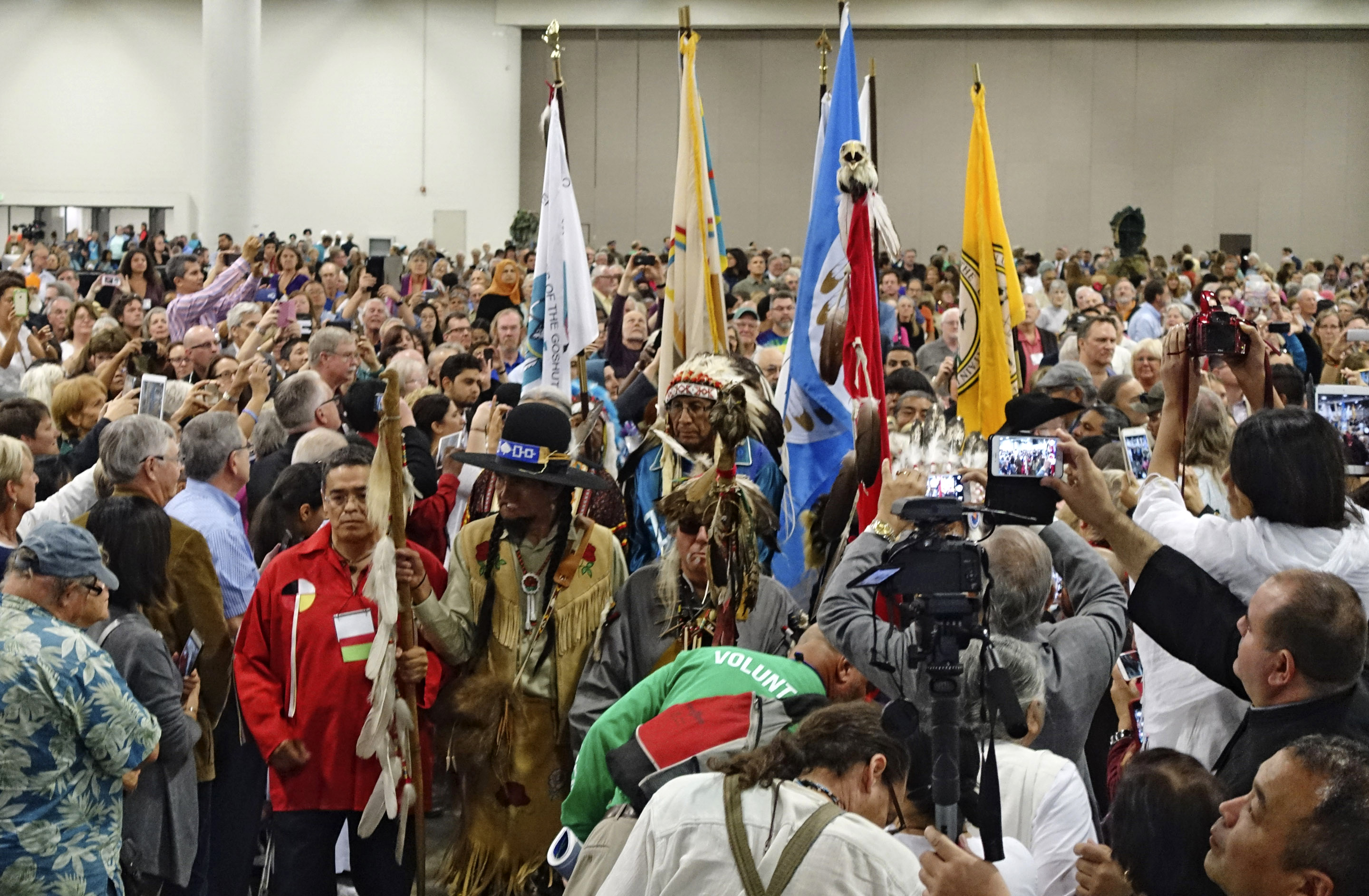
 We arrived in time for the opening of the Parliament on Thursday night. The Salt Palace was packed with 7000-8000 people, all eagerly anticipating what was to come. The opening grand procession was led by the Indigenous nations of Utah, drumming and dancing on stage, as well as Scouts and other young people with banners and flags. The Indigenous elders welcomed us to their ancestral land and reminded us to be mindful of our obligation to care for Mother Earth. This has become a tradition at the Parliament—honoring the aboriginal people whose land was stolen from them by Europeans intent on conquest and domination.
After this powerful procession, there was an expectant pause and then a gasp as nine men in business suits walked on stage. They seemed incongruous after the colorful and energizing display. It was very puzzling. Where are the women? Is this some kind of joke? Having men in suits open the Gathering reflected the power structure that is all too common in today’s world. Some were politicians, like Mayors McAdams and Ralph Becker and Governor Gary Herbert. Some, like Indarjit Singh and Rabbi David Saperstein, were internationally known religious leaders. They spoke as important men usually do, with great seriousness, but hardly connected at all with each or with the audience. The exceptions were Saperstein, a powerful orator, and Imam Abdul Malik Mujahid , the executive director of the Parliament, who spoke like a politician, asking us repeatedly, “Are you with me?” He assured us that more than half the speakers at the Parliament would be women, but we wondered: why weren’t more of them in the opening session?
After
the important men gave their speeches, others gave prayers, including two women, a
Catholic lay person and a Jewish rabbi named Lynn Gottlieb.
One
of the first women in history to be ordained as a rabbi, Gottlieb is a
passionate, courageous and often controversial advocate for social justice. She
began her prayer with a moving chant in Hebrew and then told a story about her
trip to Tehran. A rabbi going to Tehran (seen by many as a place hostile to
Jews) is already a powerful political statement, but her being woman rabbi adds
yet another dimension. Here is what she said:
 “I was taught by my ancestors that it isn’t enough just to talk, we must act. So I want to share a story. I was the first woman rabbi to go to Iran ever. There I met many Jews and Muslims. I went to a synagogue and when I left I was greeted by a young Imam who told me, ‘This place was holy to us because it has a well of waters in which the Mufti appeared.’ I said, ‘Al hamdullilah” [‘Praise God’ in Arabic]. He said, ‘You have a custom like this in Jerusalem. We tie red ribbons on the well and you tie notes on the wall in Jerusalem.’ I said, ‘Yes.’ He said, ‘This place is holy but it’s not intrinsically holy. The whole earth is holy.’ I said, ‘Yes, we believe the same. Jerusalem is not intrinsically holy, it belongs to everyone. The whole world is holy.’
The
imam then quoted a Muslim source saying if you harm one human being you harm
the whole world, and Gottlieb responded with a similar quote from the rabbinical
tradition. She then turned around and saw 300-400 Jews listening, no doubt in
amazement, as a Shia imam and a Jewish rabbi spoke these words of peace. She
quoted a rabbi who said, ‘Where is peace? Wherever you let peace in.’ Then she concluded
with this powerful prayer:
“So
may the wounds of the people of the holocaust and other genocides be healed and
may there be justice for my cousins the Palestinians. And may this be the year
that there is justice for the people from Ferguson to Gaza and may we bring
down all the walls that separate us and make justice happen in our time.”
The
crowd went wild at this deeply moving and prophetic words. It was, for me and
many others, the high point of the first evening.
Overall,
however, the opening to this year’s Parliament was a bit wobbly. As we went
back to our motel, I wondered what role women were going to play and whether
this year’s Parliament would address the most important issues of our day in a
meaningful way.